

What the Fog?! Fog happens — but sometimes it doesn’t lift, despite doing all the “right” things. Here’s how to figure out what’s going on and what to do next.
Start Here
Maybe you landed on this page because something tipped you off. A Sunday that felt like dread instead of rest. Three nights of bad sleep in a row. A conversation with your partner that went sideways and left you wondering what's wrong with you. The quiet thought — maybe at 11pm, maybe mid-commute — is this just my life now?
Maybe you don't use the word burnout. Maybe it's "a hard stretch" or "a lot going on" or just "tired lately." You don't need to name it correctly to recognize that something has been asking for your attention for a while, and you've been explaining it away.
This guide is for that moment. Scan it. See what fits. And if it does, know that there's a real map out of where you are — and it isn't another checklist.
Scan This List First
These aren't clinical criteria. They're the descriptions that come up in the first conversations with my clients — honest language people use before we get anywhere near frameworks or formal assessments. Take what resonates, leave what doesn't.
Energy and body
Exhausted after sleep — rest doesn't fully restore you
Tired and wired at the same time; can't come down even when you want to
Waking up without energy to begin the day
Everything requires more effort than it used to
Headaches, neck or shoulder tension, digestive upset that lingers
Getting sick more often or taking longer to recover
Noticing your body holding tension you can't locate or release
Brain and thinking
Brain fog that won't quit
Forgetting things, losing the thread mid-sentence
Making the kind of errors you'd normally never make
Can't make simple decisions — what to eat, whether to exercise, what to reply to
Mind always running, even when the day is technically done
Work and motivation
Dreading something that used to feel meaningful
Going through the motions — present on paper, somewhere else in your head
Doubting whether your work matters or whether you're still good at it
"Why bother" appearing as a regular thought
Imposter syndrome louder than usual, and harder to argue with
Emotions and relationships
Snapping at people you love, then feeling terrible about it
Resentment toward people or situations that once felt okay
Pulling back from social plans, friends, or people you care about
Irritability or flatness without a clear cause
Replaying conversations, editing them, worrying about them after the fact
Rest and recovery
Scrolling instead of sleeping
Trying to find the most productive way to rest
Feeling guilty when you're not doing something useful
Vacations that don't really help, or that require a week of decompressing before they start
Underneath all of it
Believing nothing will really change, or that it's too hard to change
Feeling stuck in a way that's hard to pinpoint
Not quite sure who you are outside of what you produce or manage
Several of these fitting together is a signal worth taking seriously. One or two might just be a hard week. When the pattern persists across weeks or months — especially when rest isn't touching it — that's the body and brain saying something has gone past ordinary stress.
Stress, Chronic Stress, Burnout — and When It's Depression
These four things get conflated, and sorting them out matters — not just for language, but because the support you need is different depending on where you are.
Stress is the body's response to a stressor. You have too much to do, or something difficult is happening, but adequate recovery is possible. Stress is normal. It can even be useful — cortisol is a necessary hormone, not a villain, and the kind of stress that comes with real challenge and real recovery can build resilience over time. A hard quarter. A difficult project. A season of parenting that tests you. These are stressors. Stress is survivable and often resolved when the stressor resolves.
Chronic stress is what happens when stressors pile up faster than you can recover from them, and the recovery window closes. The nervous system stays activated. Cortisol, which was designed for short bursts, starts running continuously. You're still functioning — but you're running at a deficit, and the debt accumulates. Chronic stress is where most people sit for months or years before recognizing anything is wrong, because the body adapts. You stop noticing how tense your shoulders are. You normalize the 3am waking. You call it "just busy."
Burnout is what chronic stress becomes when it goes untreated long enough.Christina Maslach, the leading researcher on burnout, describes it as a three-part syndrome: exhaustion that doesn't resolve with rest, cynicism or emotional distance from work and life, and a diminished sense of your own effectiveness. Burnout isn't caused by a single hard event — it builds over time, usually quietly. And crucially, it tends to be at least partly about your environment (your workload, your systems, the conditions around you) as much as your individual responses. It's a mismatch problem, not just a mindset problem.
Depression can look a lot like burnout — and they frequently co-occur. Both involve exhaustion, loss of motivation, and withdrawal. But depression tends to be more pervasive, affecting all areas of life more equally, and it often involves persistent sadness, hopelessness, or loss of pleasure in things that have nothing to do with work or productivity. The cognitive patterns are also different: depression tends to include negative beliefs about the self and future that feel global and fixed, while burnout is more specifically connected to feeling depleted and disengaged in the context of ongoing demands.
Importantly: burnout and depression make each other worse. The depletion of burnout can tip a vulnerable nervous system into depression. The cognitive distortions of depression (nothing will help, I'm the problem, this is permanent) make it harder to take the steps that would help with burnout. They're self-reinforcing. If you're not sure which you're dealing with — or if you suspect both — that's worth bringing to a therapist or physician. A therapist can help you sort out what's happening and treat both. If you already have a therapist, bring this article to your next session. If you don't have one,Psychology Today's therapist finder is a useful place to start.
Burnout coaching and therapy are not the same thing, and they work best together when depression is in the mix. Coaching operates on goals, patterns, and behavioral experiments — it assumes a basic level of functioning and capacity to take action. Therapy can hold the deeper clinical material. I work alongside therapists regularly, and I'm always honest about which tool fits the work.
Burnout Isn't Just a Work Problem
Most burnout research is rooted in the workplace, and that's where many people first notice it — the Sunday dread, the meeting you can't face, the project you keep avoiding. But burnout isn't a work condition. It's a whole-person condition.
You are not a different person at your desk than you are at the school pickup. The patterns that create burnout at work — over-responsibility, difficulty asking for help, worth tied to performance, conflict avoidance — are the same patterns operating at home, in relationships, in parenting. They run on the same nervous system.
What tends to happen is that people notice burnout first in the domain that demands the most from them. For many of my clients, that's work — but for others, it's the relentless logistics of being the default parent, or the invisible labor of being the person everyone leans on, or the quiet erosion of not having anything left for themselves by the end of the day.
Wherever you notice it first: it's probably showing up everywhere. Recovery tends to ripple the same way — when people start doing the real work in one domain, the other domains shift too, often in ways they didn't expect.
A Note on Stages
Burnout doesn't arrive all at once. It builds, usually over months or years, through stages — from early signs that are easy to rationalize ("I'm just stressed, everyone's stressed") to deeper physiological depletion where even small tasks feel genuinely insurmountable.
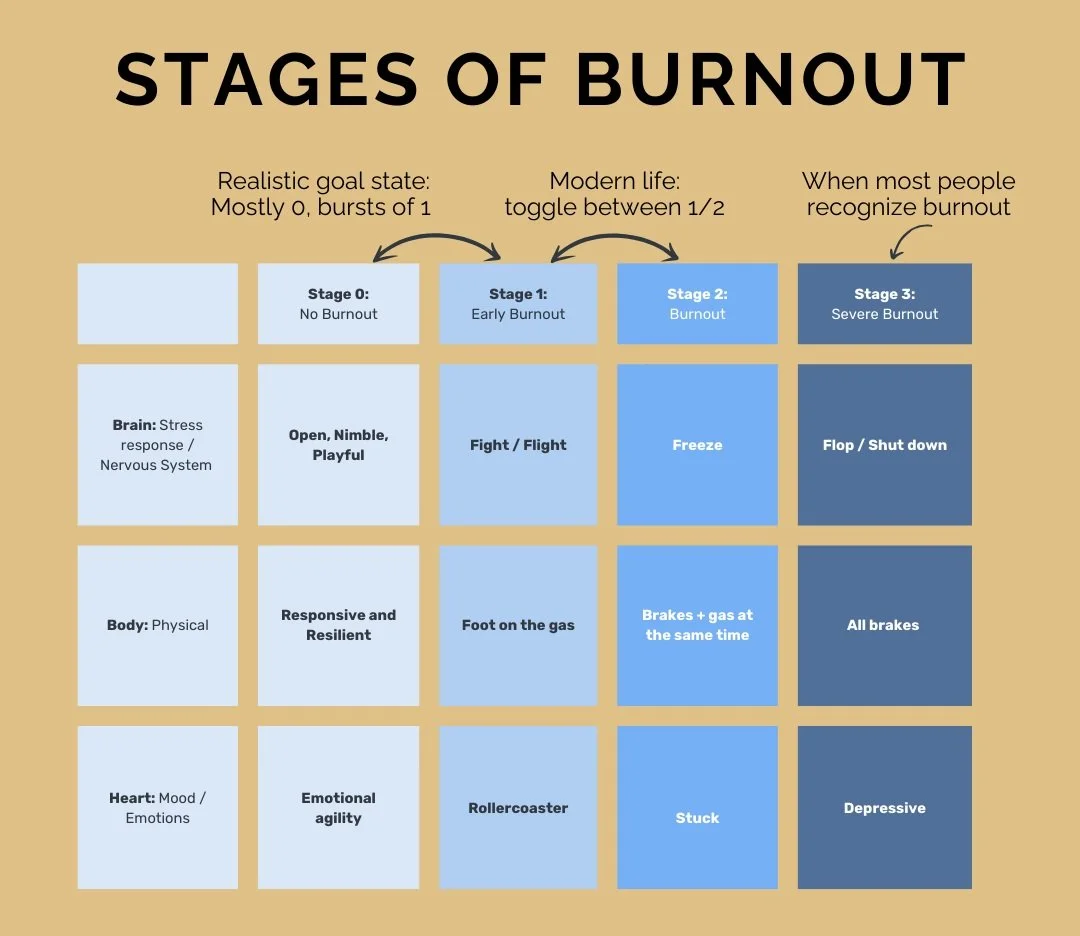
One thing that surprises most people: you can move among stages within a single day. A good night's sleep and a meaningful morning might move you out of acute exhaustion, and then three back-to-back meetings and a difficult email can pull you right back. The stage that tends to dominate your experience over weeks and months is what matters most.
Most people who come to coaching are somewhere in the middle stages — functional, effective on the outside, quietly running on fumes underneath. That middle ground is actually one of the most important places to catch burnout, because there's still enough capacity to do the real work of recovery.
The full stages breakdown — with the thoughts, physical sensations, and behavioral patterns that show up at each stage — is available onthe resources page here, with a downloadable reference. It maps directly to the FLOURISH recovery framework, which I'll explain more below.
Burnout Is a Biological Process
Christina Maslach, the psychologist whose research has shaped how burnout is understood and measured, describes it as a response to chronic workplace stress that has not been successfully managed. The World Health Organization officially classifies burnout as an occupational syndrome — something that develops in the relationship between a person and their work conditions, not from personal weakness or a failure to manage stress well enough.
Maslach's research identifies three core dimensions. In plain language, they look like this:
Exhaustion. Running out of energy in ways that ordinary rest doesn't repair. The tiredness is bone-deep. Sleep helps a little but doesn't restore you the way it once did.
Cynicism. A gradual detachment from work, from colleagues, from the purpose you once felt. "I used to care. I'm not sure I do anymore." Sometimes it shows up as irritability. Sometimes as numbness. Sometimes as a quiet contempt for things you once believed in. This one can feel like a personality change — and it's disorienting, especially if you've built your identity around caring deeply.
A diminished sense of efficacy. The growing belief that your effort doesn't make a difference, or that you're not as capable as you once were. This is the sneakiest of the three, because it doesn't always feel like burnout. It often feels like imposter syndrome, or like you've somehow lost your edge, or like you're just not trying hard enough.
These three don't arrive together or in the same order for everyone. Recognizing them doesn't require a formal assessment. It mostly requires honesty, and the willingness to stop explaining the symptoms away.
What Burnout Does to Your Body — and Your Hobbies
Emily and Amelia Nagoski, in their research-grounded book Burnout: The Secret to Unlocking the Stress Cycle, describe stress as a biological cycle — one with a beginning, a middle, and an end. The problem is that modern life almost never lets us reach the end.
You finish a hard meeting and move directly into the next one. You navigate a difficult parenting morning, walk into the office, and start performing competence. You get through a conflict with a coworker and eat lunch at your desk while catching up on email. The stress response activates over and over, but you rarely reach the part of the cycle where your nervous system registers: I'm safe now. It's over.
Here's something most burnout content skips: cortisol — the stress hormone that gets such a bad reputation — is necessary. It keeps you alert, helps you respond to threat, and plays a real role in survival. The problem isn't cortisol. The problem is sustained cortisol, the kind that runs continuously because the perceived threat never fully resolves. When cortisol stays high, your brain prioritizes threat detection over everything else. This is adaptive in the short term and genuinely damaging in the long term.
What gets downgraded when your brain is in sustained stress mode?
Creativity. The parts of the brain responsible for novel thinking and problem-solving are considered non-essential in survival mode.
Patience. Your window of tolerance narrows. Things that wouldn't bother you on a good day become genuinely grating.
Generous interpretation. The brain in threat mode reads ambiguity as threat. The email that might be neutral reads as passive-aggressive. The slightly tired face of your partner reads as irritation at you.
Socializing. What once felt restorative starts feeling like another obligation that requires performing.
Hobbies. This is where people often notice something is quietly wrong. The book that's been on your nightstand for four months. The guitar you haven't touched. The garden that feels like another task. The run you keep canceling. These aren't laziness — they're a nervous system signal. When you stop doing the things you used to do for no reason other than you loved them, pay attention. That's not a character shift. That's cortisol doing its job too well for too long.
What actually completes the stress cycle? Physical movement is the most direct signal — ideally sustained, ideally without simultaneously solving a problem in your head. Genuine laughter. Sustained physical affection. Crying. Creative expression. Slow, deliberate breathing — not as a performance, but as a physiological signal to your body that the threat has passed.
This is why "just rest" rarely works as a burnout cure. Rest is necessary — but it doesn't complete the cycle. It pauses it.
The good news in all of this: burnout is reversible at every stage. The body has an extraordinary capacity to recover. But it needs a specific kind of engagement, not just fewer obligations.
Burnout Starts at Work — and Spreads Everywhere
Most of the research on burnout roots it in the workplace. Maslach and her colleagues identified six specific conditions that consistently predict burnout, framing them as "mismatches" between what people need and what their environment provides. These aren't personality flaws. They're conditions.
1. Workload — being asked to do more than is sustainable, with insufficient time, support, or resources.
2. Control — having too little say over how you do your work, or being held accountable for outcomes you have no real authority to influence.
3. Reward — feeling consistently unrecognized or unrewarded, whether financially, socially, or in terms of the work feeling meaningful.
4. Community — erosion of trust, civility, or mutual support among colleagues. The experience of going it alone.
5. Fairness — perceived inequity in how people are treated. This one erodes trust faster than almost anything else.
6. Values — being asked to do work that conflicts with your own ethics, or working for an organization whose stated values don't match its actual behavior.
Most people I work with have at least three of these active simultaneously. And whatever is happening at work tends to mirror what's happening at home, because they come from the same underlying beliefs. You can read more about that inthis post on how leadership patterns at work reflect home dynamics.
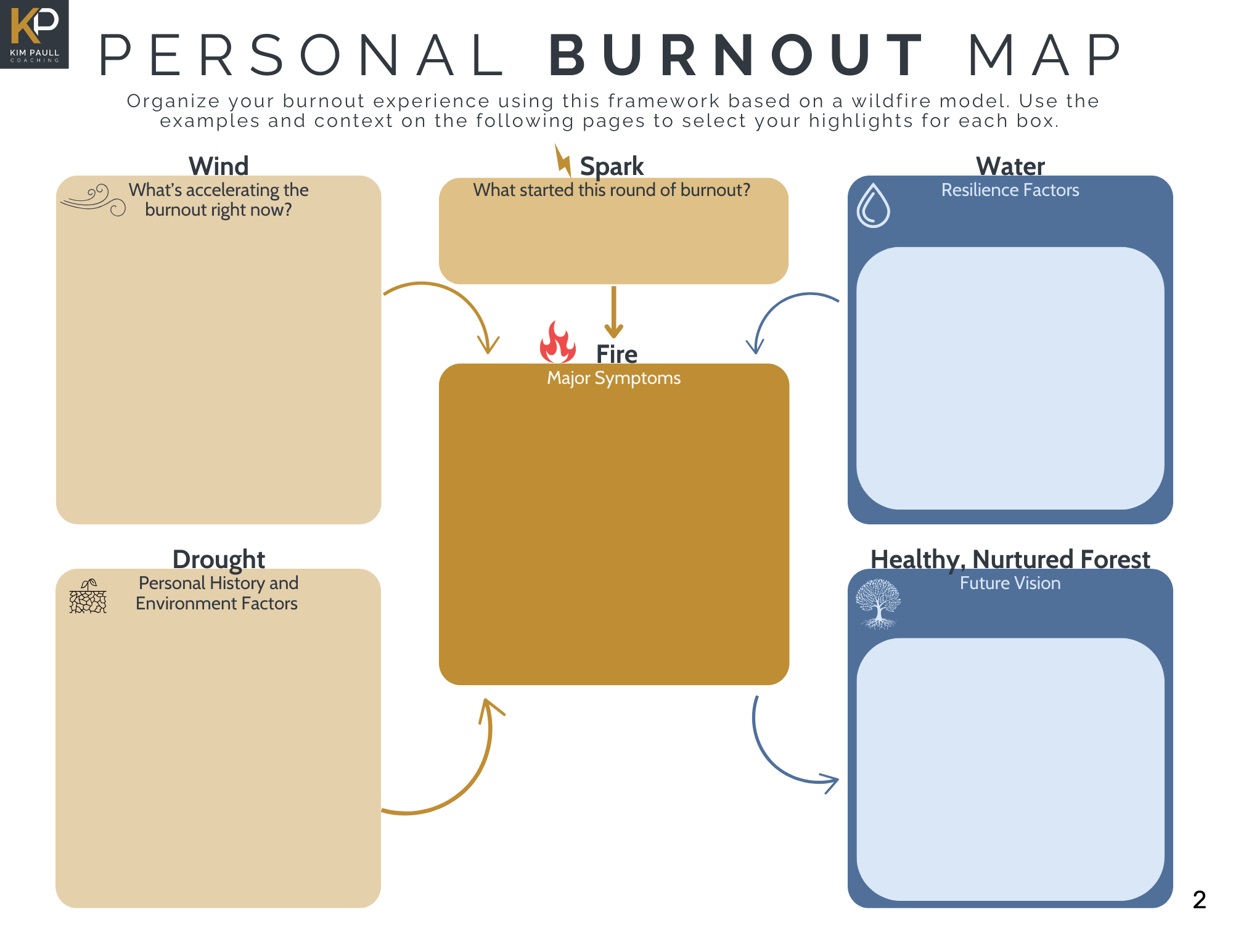
The Forest Fire Model organizes these conditions into what's sparking the burnout, what's accelerating it (the wind), and what deeper conditions made you more vulnerable (the drought). Identifying your wind factors — the ones you actually have some control over — is where the most useful coaching work tends to happen.
Things People Try That Don't Quite Work
In the interest of honesty: most of the things people try first aren't wrong. They're just insufficient for burnout, and often they're applied while the conditions creating the burnout stay exactly the same.
Some patterns that show up:
Working harder to get ahead of it. If I can just get through this sprint, clear this backlog, finish this project — then I'll rest. But the backlog refills, the next sprint starts, and the finish line keeps moving.
Changing jobs. Sometimes this genuinely helps, especially if a specific work environment is toxic. But if the patterns that created the burnout come along in your nervous system and your beliefs — and they usually do — you recreate the conditions in the new role within a year.
Self-care as checklist. I did my meditation. I booked a girls' night three months out, that'll get me through. I offloaded one small project. I scheduled a massage. I'm going to start leaving work by 5. The problem isn't any of these things — they're all fine. The problem is doing them while mentally preparing dinner logistics and school pickup schedules and running through the work email you haven't answered yet. Physically in the yoga class, mentally nowhere near it. Rest that comes with guilt attached doesn't restore.
Thinking your way out. If I just understand my burnout well enough, read enough about it, develop enough insight into my patterns... but insight without behavioral change is where most people get stuck. Awareness of a pattern and the ability to actually do something different with it are different skills.
Waiting for permission. Waiting until it's bad enough to justify asking for help. Waiting until you've "earned" the break. Waiting to see if it resolves on its own. It rarely does without some active engagement — not because you haven't tried hard enough, but because burnout actively impairs the cognitive functions you'd use to get yourself out.
None of this is a criticism. Most of it is just the burnout brain doing its best. The belief that nothing will really work is itself a symptom — and it tends to function as a self-fulfilling prophecy.
What Burnout Is Actually Costing You
Burnout is sneaky about money. Not because it's subtle — it isn't, once you're looking — but because the costs arrive in small, easily rationalized installments. The $400 a month on supplements and magnesium and the fancy meditation app you barely use. The Instacart orders because you have nothing left at 7pm. The last-minute flights and expensive vacations that, honestly, didn't quite do it this year. The checkout impulse buys that never feel like what they're supposed to.
And underneath the spending is something harder to tally: the promotion you probably would have gotten if you'd had more capacity. The project you didn't raise your hand for. The creative idea that didn't make it out of your head because your head was too full of logistics and dread. The research on presenteeism — being physically at work while mentally somewhere else — consistently finds that it reduces effective output by around a third. That's not a small number when it compounds over years.
There are also the medical costs. Chronic stress and burnout are associated with meaningfully higher rates of hypertension, immune disruption, digestive disorders, and sleep dysfunction — and treating those things isn't free. Neither is the therapy that sometimes becomes necessary when burnout and depression start feeding each other, which they do.
Then there's what it costs relationally. The people who came in for something else — a difficult manager, a demanding year, a sense that they weren't performing the way they used to — and who realized somewhere in the middle of the work that the real cost had been their marriage. Or their presence with their kids. Or five years of friendships they'd quietly let atrophy because they simply didn't have anything left.
These aren't abstract risks. They're the pattern I see in practice, and they're the ones that hit people hardest when they finally stop and look.
If you want to go deeper on this — with research, numbers, and a framework for actually calculating what burnout is extracting from your life — this post does the full accounting. The number at the headline level is $322 billion annually in measurable economic impact globally. But the post is really about your number — what it's costing you specifically, across all the domains people don't think to measure until they do.
One reason costs stay invisible: burnout actively impairs the part of the brain responsible for long-term thinking and consequence evaluation. You're not missing the costs because you're careless. You're missing them because the nervous system under chronic stress is quite literally focused on getting through today, not on calculating what today's choices mean for next year. That's not a character flaw. It's physiology — and it's one of the stronger arguments for addressing this sooner rather than waiting until it becomes impossible to ignore.
Burnout Makes It Harder to See Burnout
This is one of the more disorienting parts of the experience.
Research on cognitive scarcity — particularly the work of economistsSendhil Mullainathan and Eldar Shafir — shows that when we operate under chronic stress and overwhelm, our attention literally narrows. We focus on what's most urgent and lose access to long-term thinking, creativity, and perspective. Our cognitive bandwidth shrinks.
This isn't a character trait. It's what sustained stress does to the brain.
It means that when you're most burned out, you're also least able to see your way clearly out of it. The fatigue feels permanent. The patterns feel like facts. "Nothing is going to change" stops being a fear and starts feeling like an accurate read on your situation.
Rumination, overthinking, and anxiety compound this significantly. As burnout deepens, so does the tendency to replay and replay scenarios — rehearsing difficult conversations, running through worst-case scenarios, preparing for every possible bad outcome. The nervous system in threat mode treats rumination as preparation. If I imagine every way this could go wrong, at least I won't be blindsided.
But research on rumination is fairly consistent: it doesn't reduce the pain of the feared outcome when it arrives. And it keeps you half-living inside the bad thing in advance of it actually happening, which means you're carrying the emotional weight without the benefit of it ever actually resolving. Rumination and anxiety are both signals that the threat-detection system is running on overdrive — and both feed the burnout cycle while burnout feeds them.
This is also a significant reason why so many people wait much longer than is helpful. The burnout itself is telling them there's no point in trying — and they believe it, because they're too depleted to argue back.
How We Get Here — Survival Skills Gone Too Long
Almost everything that lands people in burnout started as a reasonable adaptation to real conditions.
People-pleasing, for most people, developed in an environment where it genuinely wasn't safe to disappoint. Conflict avoidance came from somewhere — a parent whose anger was unpredictable, a workplace where disagreement had real costs, a family system where keeping the peace was survival. Productivity as worth made perfect sense in a school or workplace or family that rewarded output above everything else. Perfectionism, at its root, is often just trying to stay safe — if everything is done well enough, nothing can go wrong, and nothing can be blamed on me.
These aren't character flaws. They're strategies. Skilled ones, often. The problem is that they get overapplied — flexed hard in every situation, long after the original conditions that made them necessary have changed. And they have a specific cost.
People-pleasing means you have a hard time knowing what you actually want, because you've been scanning for what others need for so long that your own preferences get quiet.
Conflict avoidance means resentment builds, difficult conversations don't happen, and small problems become large ones.
Inner critic as motivator means your engine runs on fear and inadequacy rather than genuine desire. It works — until it doesn't, and then it really doesn't.
Productivity as worth means rest always feels like a liability, and being isn't enough.
Guilt for resting means you can't actually recover, because recovery requires genuine permission.
Perfectionism means the finish line is always slightly out of reach, because good enough is never quite good enough.
Most of us weren't taught another way. We weren't taught how to tolerate the discomfort of disappointing someone. We weren't taught how to feel a difficult emotion and come out the other side without having acted on it or suppressed it. We weren't taught that our worth doesn't require constant demonstration. These are learnable skills — and part of what changes in real recovery work is acquiring them. Not willpower. Skills.
Neurodivergence and Burnout — This Deserves Its Own Section
If you have ADHD, autism, dyslexia, or any other form of neurodivergence — or if you suspect you might — burnout operates differently for you, and tends to arrive faster, harder, and with more confusion about why.
Here's the core of it: neurodivergent brains are often operating in systems that were not designed for them. The standard workday assumes linear time, sustained focus on demand, consistent energy, and the ability to shift attention smoothly between tasks. The school system assumes you can sit still, process verbal instructions in the same way everyone else does, and care about what you're told to care about because you're told to care about it. These assumptions are neutral for people they fit. For people they don't fit, they're a constant source of friction — friction that requires ongoing cognitive and emotional effort to manage.
That effort is invisible to most people looking from the outside. A person with ADHD who is high-functioning and meeting deadlines often gets there through enormous compensatory effort — over-preparing, staying late to redo work, rehearsing conversations before having them, building elaborate external systems to do what the brain doesn't do automatically. From the outside, they look fine. From the inside, they're burning a lot more fuel than the person sitting next to them.
Research by psychiatrist William Dodson estimates that by age 12, children with ADHD receive approximately 20,000 more negative messages than their peers — corrections, reprimands, sighs of frustration, "why can't you just..." — before they've finished middle school. That kind of accumulated feedback doesn't just affect self-esteem. It trains the nervous system to be on high alert for criticism. It rewires shame circuitry. And it produces, almost inevitably, a cluster of protective strategies: people-pleasing, perfectionism, imposter syndrome, never saying no, and the kind of over-functioning that eventually collapses into burnout.
Masking — hiding or suppressing natural neurological responses to appear neurotypical — is one of the most exhausting things a person can do, and it's a primary driver of burnout in neurodivergent folks. You spend your entire day performing "normal," and by the end of it, you have nothing left. This is why a lot of late-diagnosed adults describe looking back on their life and realizing the burnout cycles they'd attributed to stress or poor time management were actually the predictable result of a brain that had been working twice as hard for years to navigate systems that didn't fit.
Rejection sensitivity dysphoria — the intense emotional reaction to perceived rejection, criticism, or failure that is common in ADHD — compounds this significantly. When you're wired to feel criticism acutely, perfectionism isn't just an ego choice. It's self-protection. And when perfectionism drives every output, the bar is always moving, and the exhaustion is cumulative.
Executive dysfunction — difficulty with planning, initiating tasks, managing time, and shifting attention — means that tasks that take a neurotypical brain ordinary effort take a neurodivergent brain extraordinary effort. The to-do list is visible. Starting it is genuinely hard. That gap between knowing what needs to be done and being able to do it produces shame, which produces self-criticism, which narrows the window of capacity even further.
If this is you, I want to be direct: the right accommodations make a significant difference. Not because they're a workaround, but because they address real mismatches between how a brain works and what an environment expects. Clear written instructions. Flexible scheduling. Fewer unnecessary meetings. Explicit expectations. Feedback that separates the work from the person. These are accommodations I write about here, and research consistently shows they benefit everyone — because they address universal human needs, not just neurodivergent ones.
Executive function thrives with the right support. The shame-driven operating system does not. That's the real recovery target.
Other Burnout Multipliers
A few more factors that accelerate burnout and often go unaddressed in general-audience content:
Chronic illness. Conditions like autoimmune disorders, chronic pain, fatigue syndromes, and other ongoing health conditions require continuous management of symptoms, medical appointments, and often a degree of concealment at work. That baseline cognitive and physical load creates less margin for everything else. Burnout develops faster, and recovery requires more careful pacing. If this is part of your picture, any burnout recovery process needs to account for the energy envelope of your condition — not ignore it in favor of behavior change for its own sake.
Trauma history. Unprocessed trauma tends to lower the burnout threshold. Nervous systems that were shaped by early adversity, chronic stress, or experiences of helplessness may respond to ordinary current stressors with responses that are disproportionate to the present-day situation — because the body is responding to accumulated history, not just today's meeting. This is Gabor Maté's core insight inWhen the Body Says No: chronic illness and burnout are often the body's accumulated response to years of not being allowed to say no. Coaching can support this work, but when trauma is significant, therapy is an important co-condition for real change.
Being "othered" in your environment. People of color navigating predominantly white workplaces, queer folks in non-affirming environments, and others who carry the ongoing labor of existing in spaces that weren't built for them face a specific and often invisible additional load.Research on minority stress — the chronic stress of stigma, discrimination, and the need to manage others' perceptions of your identity — is a real and significant contributor to burnout. It's not equivalent to ordinary workplace stress, and addressing it requires naming it as what it is: a systemic condition, not a personal failing.
Burnout at Work Spreads to Teams — Especially from Managers
If you're in a leadership role, this part is worth sitting with.
Burnout doesn't stay contained to the individual experiencing it. When managers are burned out, the effects spread to their teams — often without the manager recognizing what's happening or intending to cause harm. The over-controlling manager who can't let go of tasks (because their nervous system is in threat mode and delegation feels dangerous). The one who withdraws from the team and becomes impossible to read. The one whose irritability makes the entire team walk on eggshells, quietly draining engagement one careful email at a time. The one who keeps saying yes to every initiative from above because they've lost access to the word no — and then passes an impossible workload down.
A burned-out manager trying hard to do the right thing often creates, almost by accident,exactly the conditions that accelerate burnout in their team: unclear expectations, limited autonomy, poor psychological safety, constant urgency. The cycle is self-reinforcing — the manager gets more burned out trying to manage the team dysfunction that their own burnout helped create.
None of this is about blame. It's about how the same nervous system that runs your home runs your team. When it's regulated, people around you feel it. When it's in survival mode, they feel that too. Recovery from leadership burnout isn't just for you — it's genuinely for the people working with you.
Burnout and Relationships — the Part The Surprises My Clients
Almost every person who completes a full recovery process describes a version of the same surprise at the end.
It isn't about productivity. It isn't finally getting the inbox under control or finding a better system.
It's about their relationships.
By the time most people arrive at coaching, the burnout has been quietly eroding their relationships for months or years — with their partner, their children, their friends, their colleagues. The degradation happens gradually enough that it starts to feel normal. The short replies. The cancelled plans. The snapping, then apologizing, then snapping again. The slow withdrawal from people who used to feel essential. And because it's gradual, people adapt to it. They stop noticing.
As recovery progresses — as the nervous system starts to regulate, as the underlying beliefs start to shift, as the physiological exhaustion starts to lift — people begin noticing they're actually present again. Laughing. Making a kind comment to their partner and meaning it. Curious about what's happening with a friend instead of too depleted to care.
A client who came to me reporting she was "just tired of being tired at work" — a VP carrying full responsibility for a struggling team — told me in our final session that the most unexpected outcome was her marriage. "I didn't realize how much I'd been bringing work home in my body," she said. "I thought we had a communication problem. Turns out we had a burnout problem."
Thehigh-conflict pattern, the over-functioning at home, the quiet withdrawal, the irritability that shows up as sharpness with the people closest to you — these are burnout symptoms in relationship clothing. And recovery in one area almost always ripples into the others in ways people don't see coming.
About FLOURISH
My burnout recovery framework, FLOURISH, is an eight-step process grounded in neuroscience, positive psychology, and behavioral change research. It maps the full arc from the moment of honest recognition through to sustainable change.
The eight steps:
F — Face Reality with Compassion — not catastrophizing, but stopping the minimizing. Seeing what's true with honesty and without self-blame.
L — Listen to Your Body — learning to read the signals you've been overriding.
O — Own Your Boundaries — understanding what's actually yours to carry, and what isn't.
U — Uncover Your Patterns — identifying the underlying beliefs that keep recreating the same conditions.
R — Run Small Experiments — sustainable change through low-stakes, iterative behavior shifts, not overhauls.
I — Invest in Connection — recovery requires presence with other people; isolation accelerates burnout.
S — Savor Meaning and Joy — rebuilding the experience of being engaged with life, not just managing it.
H — Honor Your Growth Spirals — recognizing that recovery isn't linear, and returning to earlier steps isn't failure.
Most people need to cycle through the first two loops a few times before they're ready for the deeper pattern change. This is normal. The caution point — where most people accidentally re-enter the burnout cycle — is the transition between awareness and actual behavior change. Knowing your patterns isn't the same as changing them. That's where coaching earns its keep.
TheFLOURISH diagram and stages table are available as free downloads on the resources page.
If Something in This Article Resonated
A checklist or article can tell you something real. It can't hold the mirror, name what you can't see from inside the experience, or help you build a genuinely different way of operating.
If you're ready to go deeper:
Regenerate + Relaunch — the full 13-session burnout recovery experience. The complete FLOURISH process, customized to your burnout map, your patterns, your life. Designed for people who are done managing symptoms.
The Next Right Step — a single focused session to map where you are and identify what's most worth addressing first. A good place to start if you're not sure yet.
Speaking and Training — if you're a leader or organization wondering about burnout conditions in your team, this is the starting conversation.
And if someone in your life needs this — the person who always says they're fine, who keeps showing up fully equipped and quietly falling apart — thereferral program is here.
Further Reading and Resources
On The Quitters Club Blog
Forest Fire Model of Burnout — how to map your burnout into its real components
Burnout Culture at Work and Home — why chronic hurry makes everything worse, and what to do about it
How Burnout Resilience Coaching Works — the real process, explained honestly
How to Ask for Help — the connection between hyper-independence and burnout
Default Parent's Guide — when burnout meets over-responsibility at home
High Conflict and Burnout — what's underneath the fighting
Leadership Patterns at Work and Home — the mirror between professional and personal patterns
ADHD Accommodations That Actually Help Everyone — neurodivergent-designed supports that benefit all brains
Difficult Conversations at Work — when avoidance is its own cost
Books
Nagoski, E. & Nagoski, A. (2019).Burnout: The Secret to Unlocking the Stress Cycle — the most practical book on the physiology of burnout; essential
Maslach, C. & Leiter, M. P. (2022). The Burnout Challenge — the foundational research, accessible and readable
Maté, G. (2003).When the Body Says No — on trauma, chronic illness, and the body's response to unmet needs
van der Kolk, B. (2014).The Body Keeps the Score — on trauma, the body, and what recovery actually requires
Mullainathan, S. & Shafir, E. (2013).Scarcity: Why Having Too Little Means So Much — on how cognitive bandwidth narrows under chronic stress
Neff, Dr. M.A.The Autistic Burnout Workbook — neurodivergent-specific recovery; a genuinely useful resource
Research and Frameworks
Maslach Burnout Inventory — the standard research-based burnout assessment
Self-Determination Theory — on autonomy, belonging, and competence as foundations for sustainable motivation
Art of Accomplishment — Joe Hudson's work on emotional processing and authentic change
Psychology Today Therapist Finder — if you're looking for a therapist, this is a good starting point
Minority stress research overview (Meyer, 2003) — on the specific stress load carried by marginalized groups
