
How Burnout Resilience Coaching Actually Works (And Why It's Different From Everything Else You've Tried)
Click the image above to download a high resolution version and access the Forest Fire Burnout Map (also below)
Your nervous system has one job: keep you alive. Not creative, not joyful, not connected. Alive. That's useful information — and it's the starting point for everything we do together.
You're sitting in your car in the parking garage after work, and you can't make yourself go inside yet. Not because anything particularly terrible happened today. Just because you're tired in a way that sleep doesn't fix, and the idea of walking through the door and being needed by one more person makes your chest tighten.
Or maybe you're in a leadership meeting, watching a colleague pitch the exact idea you brought up three months ago, and instead of feeling frustrated, you feel… nothing. Flat. Like someone dimmed the lights behind your eyes.
Or you're the HR director who keeps losing good people — the kind who care deeply, work hard, and then quietly implode. You've tried wellness programs, pizza parties, even a meditation app subscription. People smiled politely and kept burning out.
If any of this lands, this post is for you. Whether you're the person in the parking garage, the leader watching their team crumble, or the organization trying to figure out why good culture efforts aren't sticking — I want to walk you through how I actually work with burnout. All of it. Because after years of doing this across corporate trainings, individual coaching, leadership development, and keynote speaking, I've learned something that I think matters.
Burnout is not a mystery. It's a biological process with a map.
And once you can see the map, everything gets more manageable.
Burnout Is Designed to Slow You Down (And Fighting It Makes It Worse)
Before we get into how I work, I need to say the thing that most burnout content skips.
Burnout is not a malfunction. It's a feature.
Your nervous system is constantly scanning for threats and allocating resources accordingly. When it registers sustained stress without adequate recovery, it starts shutting down non-essential systems to conserve energy for survival. Creativity? Optional. Social connection? Luxury. Joy? Later. Complex decision-making? Not today. Your nervous system is essentially running triage, and it will sacrifice almost everything to keep the lights on.
That fog, that flatness, that inability to care about things you used to love — it's not random. It's your body's protection system doing exactly what it evolved to do. Christina Maslach's decades of research identifies three core dimensions of this process: emotional exhaustion, cynicism toward your work, and a reduced sense of personal effectiveness. These aren't character flaws. They're symptoms of a system under siege. (I go deeper into how burnout hides from your own awareness here.)
And here's the kicker: the people most likely to burn out aren't the ones who don't care. Maslach's research consistently shows burnout disproportionately affects the most committed, most capable, most values-driven people. The ones who give a damn. That's you.
The good news — and I mean this — is that burnout is reversible at every stage. Your nervous system learned these patterns, and it can learn different ones. I've seen it hundreds of times now. But the path through isn't "try harder" or "be more resilient." It's understanding what's actually driving the fire and addressing that.
Why Most Burnout Advice Doesn't Work
The burnout advice industrial complex tends to focus on one of two things: rest more, or manage your time better. And look, both of those are fine. They're just radically incomplete.
I had a client — a VP at a tech company, two kids, the kind of person who could run a marathon and prepare a board presentation at the same time. She took a three-week vacation. Came back rested. Within six days, she was right back where she started. Same tightness in her chest. Same Sunday night dread that started on Friday afternoon.
Rest addresses the symptoms. It doesn't touch the drivers.
Most burnout programs miss this because they treat burnout as an individual problem — your coping skills, your boundaries, your self-care routine. And sure, individual skills matter (we'll get to those). But Gallup's 2025 State of the Global Workplace report tells a more systemic story: global employee engagement dropped to just 21% in 2024, and manager engagement fell from 30% to 27%. The finding that's hardest to ignore? Seventy percent of team engagement is attributable to the manager. When managers are burning out — and they are, faster than their teams — it cascades downward through the entire organization.
This is why I work at multiple levels. Individual burnout recovery without understanding the system that produced it is like mopping the floor while the faucet's still running.
A Map for Something That Feels Like "Everything at Once"
Click the image above for the full Burnout Forest Fire Map workbook
I created the Forest Fire Model of burnout because I kept watching clients try to describe their burnout and hit a wall. "It's everything," they'd say. "I don't even know where to start."
Of course it feels like everything. That's actually one of the hallmarks of burnout — the cognitive fog that makes it nearly impossible to sort through what's happening while you're in the middle of it. Your brain, running in survival mode, isn't great at complex analysis. It's great at keeping you breathing. Not the same skill set.
So we need a different container. And forest fires, it turns out, are a remarkably useful metaphor.
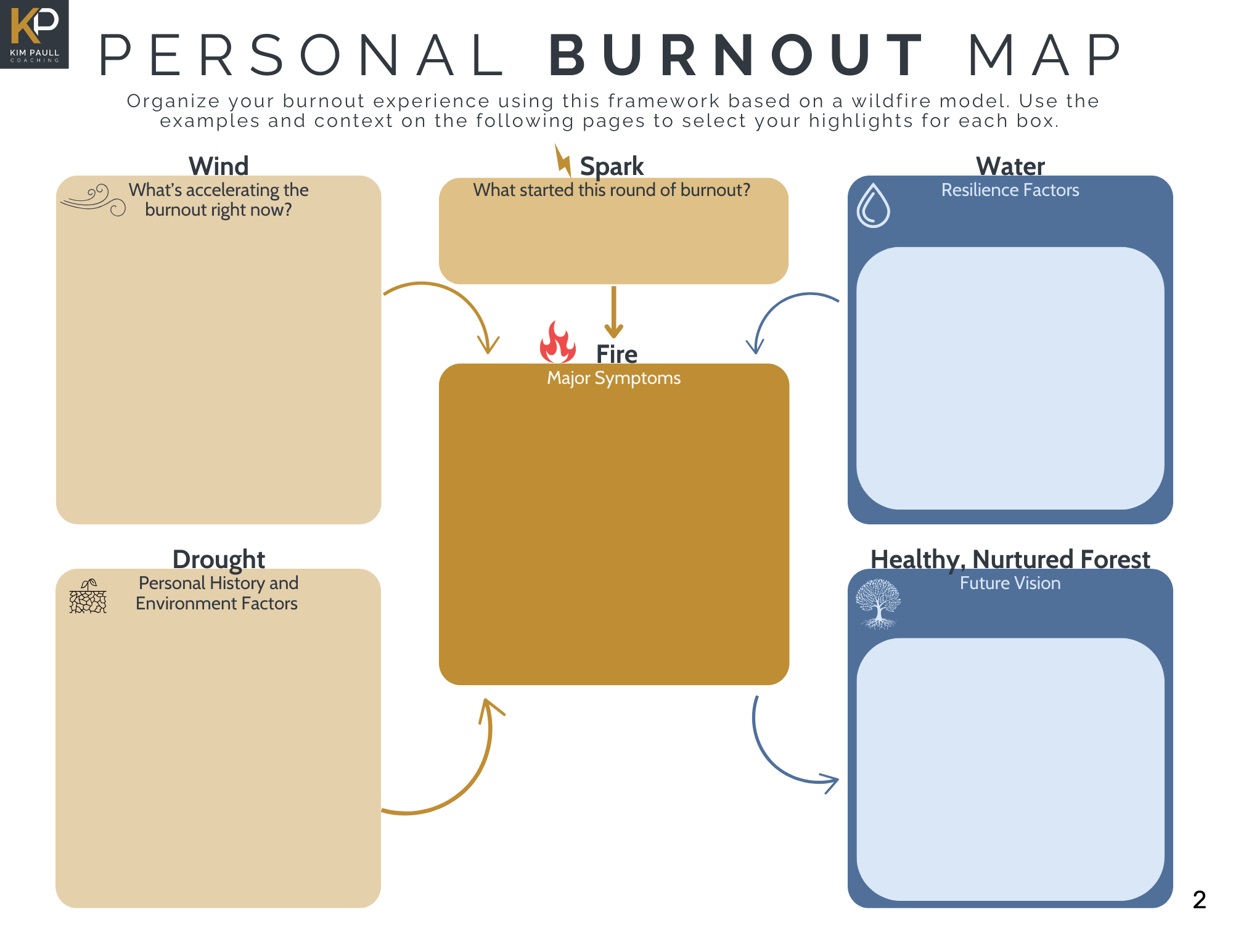
In the Forest Fire Model, burnout has six zones:
A Spark — what kicked off this particular round of burnout. Maybe a layoff, a new role, a baby, a health scare, a pandemic. The spark itself is often outside your control, and trying to "fix" the spark usually isn't where the leverage is.
Fire (Symptoms) — the stuff you're actually feeling. Exhaustion, cynicism, cognitive fog, emotional numbness, snapping at your kids, that thing where you stare at the fridge for four minutes and then close it. These are the flames, and they're important information — but they're not the cause.
Wind (Accelerants) — the habits, beliefs, and patterns that fan the flames and make burnout worse. Perfectionism. People-pleasing. Unprocessed anger. Passive-aggressive coping. The inability to ask for help. This is where most of the coaching work happens, because wind factors are the things you can actually change.
Drought (Deep Conditions) — long-term vulnerabilities that make you more susceptible. Early life experiences, neurodivergence, trauma history, chronic illness, cultural conditioning about worthiness and productivity. These don't cause burnout on their own, but they create the dry conditions where a spark catches more easily. Understanding your drought factors helps explain why this stressor hit you so hard when you've handled worse before.
Water (Resilience Factors) — the resources, relationships, strengths, and practices that protect you. You already have some of these. Part of the work is identifying them, and part is building more.
Healthy, Nurtured Forest — your vision. What does your life look like when you're not just surviving but actually living in a way that works? This isn't a fantasy — it's the pull that makes the work worth doing.
When clients see their burnout organized this way for the first time, the relief is almost physical. One client told me, "It's like I've been trying to describe a room in the dark, and someone just turned on the light. It's still messy, but at least I can see where things are."
That's the map. And it's the foundation for everything else.
Burnout Doesn't Stay in One Lane (Work Patterns Show Up at Home, Too)
Here's something I didn't fully understand until I'd been coaching for a while: the same beliefs driving burnout at work are usually running the show at home.
The leader who shields their team from organizational stress because they believe "it's my job to protect them"? That same person is probably shielding their partner from financial anxiety and managing their kids' emotional experiences. The manager who can't delegate because "it'll take longer to explain it than to just do it myself"? They're also the parent who re-loads the dishwasher after their teenager did it "wrong."
People come to me because they're overwhelmed and burning out at work, or because a company wants to build a healthier culture. And we almost always discover that healing in one place heals all over the place. Because the underlying pattern is the same — the belief that if I don't manage this, it will fall apart, or my worth comes from what I produce, or needing help means I'm failing.
As I wrote about in that leadership patterns post: in the absence of information, people make up stories. And they're rarely accurate or favorable to you. When you withhold, protect, and over-function — at work or at home — the people around you don't feel relieved. Their nervous systems sense the incongruence, and they fill in the blanks. They make up stories about not being trusted or not being capable. And you end up more isolated, more burdened, more burned out.
One of my clients — a startup founder — started coaching because she was running on fumes at work, making poor decisions from exhaustion, snapping at her co-founder. Three months in, she told me that her relationship with her kids had transformed. "I stopped micromanaging their homework and their emotions," she said. "Turns out, when I'm not in panic mode, they actually relax. My partner said he feels like he has his wife back."
"Last night, my spouse asked how to keep you on a paid retainer. Like for real. What you do is so beyond burnout. We're reconnecting in a way that we haven't in years." — Jenny G., coaching client
That's what I mean about healing in all directions. We didn't set out to fix her marriage or her parenting. We set out to understand why she was burning out at work. But the same beliefs that were driving her leadership pattern were organizing her entire life.
How I Actually Work: For Organizations and Teams
Let me walk through how this plays out in different settings, starting with the one I'm most energized about right now.
Corporate and Group Training: Building Cultures That People Don't Want to Leave
When an organization brings me in, it's usually because something isn't working. Turnover is climbing. Engagement scores are dropping. Managers are fried. Good people are leaving quietly. Or — and this is increasingly common — leadership recognizes that their culture is "fine" but not great, and they want to understand why wellness programs and team-building retreats aren't moving the needle.
My Good to Great series is built on a simple premise backed by hard data: when people feel like they matter and have clear guidance paired with high standards, they become your organization's marketing engine. Engagement, productivity, and profitability follow — not the other way around.
Here's why that matters financially. According to Gallup's research, engaged teams are 23% more profitable. A 5% increase in customer retention (which typically follows employee engagement) produces a 25% increase in profit. And disengaged employees cost the global economy an estimated $438 billion in lost productivity in 2024 alone.
But you don't get engagement by telling people to be more engaged. You get it by building environments where people experience what Self-Determination Theory calls the ABCs of sustainable motivation:
Autonomy — the genuine belief that you can make meaningful choices about your work
Belonging — being seen and valued for who you actually are, not just the role you fill (and belonging is emphatically not the same as fitting in)
Competence — doing work you're good at, being appropriately challenged, and being recognized for it
When these three things are present, people don't just show up. They bring their full selves. They solve problems creatively. They stay. They tell their friends to apply.
When they're absent — when people feel controlled, invisible, or stuck — you get what Maslach calls the "anxiety zone": high standards with low psychological safety. That's where burnout thrives, where people perform from fear rather than purpose, and where your best talent starts updating their LinkedIn profiles.
The Good to Great series covers four interconnected modules (RISE): Reinforce great relationships, Invest in process for great decisions, Sustain behaviors on your team, and Empower and expand beyond you, beyond now. We start with relationships because 70% of the variation in employee engagement comes back to the manager. And only 10-15% of people in management positions naturally have great managerial skills. Most of us manage how we were managed, parent how we were parented, and lead the way our nervous systems learned to lead. My work helps organizations interrupt those cycles — not with another leadership checklist, but by helping leaders understand what's actually driving their patterns.
Keynotes and Speaking
I speak at conferences, retreats, and organizational events on burnout science, culture building, and the neuroscience of sustainable leadership. My talks aren't lectures — they're participatory, research-dense, and practical. Attendees leave with frameworks they can use Monday morning, not just inspiration that fades by Wednesday.
From a recent training evaluation where 100% of participants said they would recommend the training to a colleague:
"Giving us strategies when talking with others like closing questions and deepening questions"
"The practical organizer tool is super useful and I plan to use and share it with my coworkers"
"Feeling understood" and "Feeling like I was not the only one going through this or something similar"
That last one matters a lot. Burnout is isolating. Part of what group settings provide is the profound relief of not being alone in this experience. When a room full of people collectively exhales because someone named the thing they've all been carrying silently, that's where change starts.
How I Actually Work: Individual and Executive Coaching
It Starts with the Map
Every coaching engagement begins with a thorough intake. This isn't a casual getting-to-know-you chat. It's a science-backed assessment process that includes a burnout inventory, a coping style assessment, and a robust personal history designed to illuminate the specific factors — the sparks, winds, drought conditions, and existing water sources — that brought this person to this moment.
I do this because burnout is both complicated and complex, but it doesn't have to be confusing. There are usually identifiable patterns, and once you can see them, they become workable.
We use all of that information to build a Personal Burnout Map. Think of it as a diagnostic picture of your burnout ecosystem: what sparked this episode, what's making it worse, what deeper conditions make you more vulnerable, what strengths and resources you already have, and what your vision of a healthy, nurtured forest looks like.
When clients see their stuff organized on a map for the first time, something shifts. It goes from "everything is on fire and I don't know where to start" to "oh, I can see the wind factors. I can see why this hit me so hard. And I can see some places where I actually have leverage." That clarity builds confidence — the confidence that yes, you can feel better, and yes, there's a real process for getting there.
"I had no idea how impactful it was going to be. Every time we came back and met, I was like, oh my gosh, wait, like things are actually better." — Mira H., coaching client
In session one, we review the map together and pick three goals that will move them toward their vision of a healthy, nurtured forest. And then we get to work.
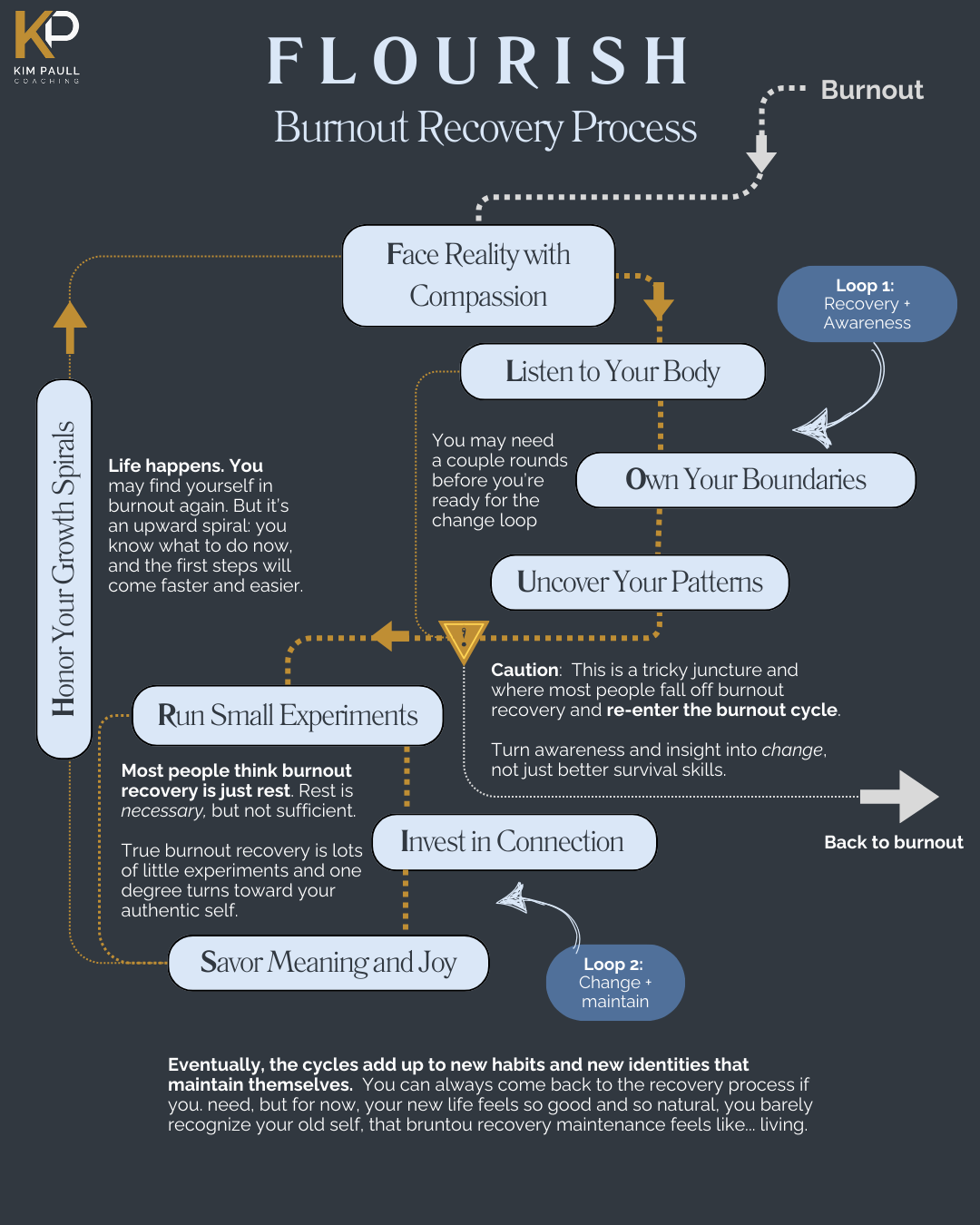
FLOURISH: How Recovery Actually Happens
FLOURISH is my framework for how we move through the coaching process. It stands for:
Face Reality with Compassion
Listen to Your Body
Own Your Boundaries
Uncover Your Patterns
Run Small Experiments
Invest in Connection
Savor Meaning and Joy
Honor Your Growth Spirals
These aren't a checklist you march through in order. We touch on multiple steps in most sessions. That said, there are two distinct phases, and we spend more time in the first one during early sessions.
Phase 1 (Inner Work): Face, Listen, Own, Uncover. This is where we build awareness and understanding. Facing reality means honestly assessing where you are without self-flagellation. Listening to your body means learning to interpret the signals your nervous system has been sending (signals you've probably been overriding for years). Owning your boundaries means figuring out what's actually yours to carry and what isn't — and believing you deserve the protection. Uncovering your patterns means identifying the beliefs, habits, and emotional loops that keep recreating the conditions for burnout.
Phase 2 (Outer Work): Run, Invest, Savor, Honor. This is where insight becomes action. Running small experiments means testing tiny changes — what I call "one-degree turns" — that are small enough to try even when you're exhausted, but over time produce massive shifts. Investing in connection means rebuilding (or building for the first time) the kinds of relationships that actually help you heal. Savoring meaning and joy means remembering (or discovering) what actually makes your life worth living, beyond productivity.
And the final step — Honoring Your Growth Spirals — is maybe the most important one. Because recovery isn't linear. You will revisit similar issues. You'll hit a stressful week and notice old patterns creeping back. And that's not a failure. It's an upward spiral — you're encountering the same stuff at a higher elevation, with more skill, more self-awareness, and more compassion. Each time around, the recovery is faster and the insights come easier.
There's also a caution point in the FLOURISH framework that matters. Between "Uncover Your Patterns" and "Run Small Experiments" is the trickiest juncture in the whole process. This is where people often have tremendous insight about their burnout — they can see the patterns clearly — but instead of making actual changes, they just get better at surviving. They fold their new awareness into more sophisticated coping strategies and re-enter the burnout cycle with a fancier vocabulary. Awareness without behavior change isn't enough. That's why the planning and experimenting step is non-negotiable.
Skills AND Emotional Processing
A lot of coaching programs focus on skills: boundary scripts, time management strategies, delegation frameworks. I teach all of those. They matter.
But here's what I've found over and over again: skills without emotional processing don't stick. You can learn the perfect boundary-setting language, and you'll still fold like a lawn chair the moment someone looks disappointed, if the underlying belief is "my worth depends on making people happy." You can optimize your calendar to the minute, but if you're running from a grief you haven't named yet, you'll fill every gap with urgency because busyness is the only thing keeping the feelings at bay.
So yes, we build skills. And we also do what I think of as "emotional yoga" — developing the capacity to feel difficult emotions without being hijacked by them or needing to make them stop immediately.
Grief comes up a lot. And not always in ways people expect.
Sometimes it's ambiguous loss — the kind where you can't quite name what you've lost, but the ache is there. The late-diagnosed neurodivergent person mourning a life that could have been so much gentler if they'd been seen and valued for their brain earlier. The years spent running unhelpful patterns around productivity because nobody taught you another way. The damage to your relationships with your kids from projecting your own unhealed stuff onto them — damage that, for the record, is almost always reversible once you see what's happening. The career path that winds and never felt quite right because you were running scripts that belonged to someone else.
You don't need to arrive in coaching knowing what you're grieving. It tends to surface when the conditions are right — when there's enough safety and enough space. And when it does, it frees up an extraordinary amount of cognitive and emotional energy that was being spent holding it all at bay.
"Kim cracked me wide open. The insights completely reshaped struggles I've had for years." — Jordan D., coaching client
"It is a testimony to Kim's gifts when I can honestly admit that I gained more insight with her than I did my therapist." — Emily K., coaching client
Between Sessions: Where a Lot of the Learning Happens
After each session, I send a detailed follow-up email. Not just a summary of what we discussed, but an expansion on what the client discovered — additional context, relevant research, sometimes a reframe that landed particularly well in the session, written out so they can sit with it.
I do this because I've learned that people absorb information differently. Some clients light up in the moment of insight during a session. Others need time to let ideas settle. The email becomes a resource they return to throughout the week — and sometimes months later, when they hit a new version of an old pattern and need the reminder.
"That was absolutely beautiful, Kim. It had a really nice flow… a beautiful combination of questions, reflections, but then also, here's something that could really help you." — Paradise S., coaching client
It's Not Linear, and That's By Design
Most weeks, we don't march through a curriculum. Something happened — a conflict with a colleague, a meltdown with your kid, a wave of apathy that scared you, a tiny victory that surprised you — and we fold it into the larger goals.
I'll often come prepared with education, frameworks, or concrete skills to weave in. But the session is client-led. The information arrives when the person is ready for it, not when the syllabus says it should. That's how humans actually learn — in context, when the need is real, when the body is engaged and not just the intellect.
And across sessions, we're touching all eight FLOURISH steps in some form, cycling through them iteratively, building skill and depth with each pass. That iterative spiraling is how sustainable change happens. One-degree turns, compounded over time.
Who This Is For (And What They Have in Common)
I work with individuals, leaders, and organizations across a range of contexts. But the people who find me tend to share some things.
Individuals — usually mid-career professionals, working parents, founders, or people in helping/mission-driven roles — who are exhausted, overwhelmed, and starting to notice that the strategies that got them here are the same strategies that are destroying their health, their relationships, and their sense of self. They've probably tried the self-help books. They might be in therapy (and sometimes coaching is a great complement to therapy — different tools, different focus). They're smart and capable, which is part of the problem — they keep getting results from the patterns that are also burning them down.
Leaders and executives — often referred through corporate partnerships — who sense that their leadership style, despite good intentions, might be contributing to their team's burnout. They've read the leadership books. They can articulate what psychological safety means. But under pressure, they default to patterns their nervous systems learned long before they read Dare to Lead. They manage how they were managed. They protect when they should be transparent. They solve when they should be asking. Not from incompetence — from deeply ingrained survival strategies that need updating.
Organizations — nonprofits, healthcare systems, startups, mission-driven companies, credit unions, chambers of commerce — who are watching good people burn out and want to do something beyond a webinar. They understand, or are starting to understand, that culture isn't built by HR. It's built in the daily micro-interactions between managers and their people. And that building great culture doesn't just feel good — it drives profitability, retention, and the kind of engagement that turns employees into ambassadors.
What all these folks have in common: they care deeply, they work hard, they've been carrying more than is sustainable, and they're ready to understand why — not just what to do differently.
A Note on Neurodivergence, Late Diagnoses, and Building Kinder Systems
Many of my clients are neurodivergent — some diagnosed early, many diagnosed late, and some who recognize themselves in the descriptions without a formal diagnosis. ADHD, autism, processing differences, sensory sensitivities.
The relationship between neurodivergence and burnout is significant and under-discussed. Masking (hiding your natural neurological responses to fit in) is profoundly exhausting. Executive function challenges mean you might be working three times as hard to accomplish what appears effortless for others. Sensory overload compounds stress. And when the accommodations you need don't exist — or when you don't even know to ask for them because you were never told your brain works differently — you internalize the struggle as personal failure.
I've written before about how accommodations designed for neurodivergent folks actually benefit everyone, because they address universal human needs: clear expectations, flexible approaches, human-centered feedback, and permission to work in ways that match your actual brain. Self-Determination Theory research bears this out — autonomy, belonging, and competence aren't special needs. They're human needs.
The grief piece is especially present in late-diagnosed clients. There can be a mourning process — sometimes fierce, sometimes quiet — for the years of running patterns that weren't designed for your brain. The career that could have been different. The relationships that might have been easier. The self-criticism that accumulated year after year because you thought you were lazy or undisciplined or "too much" when really, your nervous system was doing its best in an environment that wasn't built for it.
That grief, when it's allowed to move, makes room for something remarkable: a life designed around who you actually are, not who you learned to pretend to be.
Burnout Is Contagious. Recovery Can Be, Too.
One more thing about the organizational work, because I think this is worth saying clearly.
When managers burn out, their teams burn out. This isn't a theory — it's extensively documented. A manager's stress level, emotional regulation, and sense of purpose function as a thermostat for their entire team. When you're running in survival mode, your team feels it. They read your microexpressions faster than they hear your words. They sense incongruence between what you say ("We value work-life balance!") and what you model (emails at midnight, skipping lunch, never taking a real vacation).
But here's the hopeful part: when a leader starts to heal — when they develop genuine security in their leadership rather than performing confidence from a place of depletion — their team shifts too. It's contagion working in your favor. Calm is as contagious as panic. Authenticity invites authenticity. When you model that it's okay to not have all the answers, to ask for help, to set a boundary, to admit you're learning — you give everyone else permission to do the same.
That's why I'm passionate about working with leaders within organizational engagements. Individual coaching for key leaders, combined with team-wide training, creates a cascade of change that neither approach achieves alone.
Something Deeper Is Underneath the Tools
If you've made it this far, you've noticed a theme. The tools — boundary scripts, stress regulation techniques, communication frameworks like VIEW, delegation strategies — all of those matter. I teach them. They work.
But here's what I've learned, both from my own burnout recovery and from every client who's ever sat across from me: you can optimize your calendar, set perfect boundaries, master every nervous system regulation technique, and still recreate the same frantic, over-functioning patterns in whatever new system you build. If the underlying belief is my worth is measured by my output or if I don't control this, it falls apart or needing help means I'm failing — the tools are just a more sophisticated version of survival.
That's the piece that makes coaching different from reading blog posts (even really good ones). The beliefs that drive burnout are usually invisible from the inside. They feel like reality, not beliefs. Of course I have to handle everything. Of course I can't ask for help. Of course my family would fall apart without me running the show. These feel like facts, not stories. And they require another set of eyes — someone trained, someone outside your system, someone who can see the pattern without being caught in it — to gently, compassionately bring into view.
Kristin Neff's research on self-compassion is relevant here. Self-criticism — which most over-achievers run on like gasoline — actually activates the threat response. It floods your body with cortisol, narrows your thinking, and impairs creativity and decision-making. Self-compassion, by contrast, activates the care system. It creates the neurological conditions for actual change. This isn't woo. It's neuroscience. And it's why I lead with compassion in this work — not because it's comfortable, but because it's the fastest path to real transformation.
"Kim, you helped me see what I couldn't see before: that I can do it, and, now, HOW I will do it. And that my identities are not set in stone, that I've actually outgrown some of them I didn't even know I had." — Erika M., coaching client
So Where Do You Start?
If you're an individual reading this and thinking "okay, she's talking about me" — I want you to know something. You don't have to be in full-blown burnout to benefit from this work. In fact, it's more effective when there's still some capacity to work with. You don't have to hit a wall before getting help. (Though if you already have, that's workable too.)
If you're a leader or HR professional reading this and seeing your organization in these patterns — the gap between your stated values and your lived culture, the good people quietly leaving, the managers who care deeply but are drowning — I'd love to talk about what a group engagement might look like.
And if you know someone who needs to read this, I'd be grateful if you shared it with them. Sometimes the most powerful thing you can do for someone who's burning out is to hand them a mirror and say "I see you."
A blog post can start a conversation, but it can't hold the whole thing. The mapping, the pattern recognition, the skill-building, the emotional processing, the tiny experiments that compound into a fundamentally different way of being in the world — that's the work we do together.
For individuals ready to explore, start with The Next Right Step — a single session designed to map where you are and what's possible. Or dive into the full Regenerate + Relaunch 3-month coaching experience.
For organizations, leadership teams, and groups, learn about training, workshops, and speaking engagements designed to build a burnout-resilient culture from the inside out.
Know someone who would benefit? My referral thank-you program is my way of saying I appreciate the trust.
Burnout is complicated, but recovery and resilience don’t have to be confusing. There's a real process, and it works. And for once, it's not all on you to figure it out alone.
Kim Paull is a burnout recovery and resilience coach who works with individuals, leaders, and organizations through coaching, training, and keynote speaking. She's the creator of the Forest Fire Model and FLOURISH framework, and the voice behind the Now That You See It podcast. Learn more at kimpaull.com.
