
Secure Leadership: Why Your Behaviors Won't Stick Without the Inner Work

I can teach you the behaviors of a secure leader. The specific ways to ask questions instead of solving problems. How to create psychological safety. The exact language for warm directness when something needs to change. How to build a culture where people feel seen, competent, and autonomous.
And if that's all you do—if you adopt the behaviors without the internal work—it won't last. Your team will sense the performance. And eventually, under pressure, you'll default back to what your nervous system actually believes about yourself, your worth, and your power.
This is what I've learned through twenty years in human services, government, and healthcare, and through my own complete burnout and recovery. It's what I see repeatedly in leaders who want to shift their culture but can't quite make it stick. The gap isn't between knowing better and doing better. It's between doing the right behaviors and actually being secure in your leadership.
What Secure Leadership Actually Is
Secure leadership isn't about being nice. It's not about avoiding conflict or making sure everyone feels comfortable. It's about being grounded in your own competence, comfortable with your power, and clear about how your emotional state affects the people around you.
A securely attached leader understands that their energy—their stress level, their presence, their regulation—is the temperature gauge for the entire system. They know that people read their microexpressions before hearing their words. They recognize that their team is responding to their actual state, not their stated intentions.
When you're securely attached to your own worth—not to your productivity, your perfection, or your ability to solve everyone's problems—you can lead without needing to protect yourself through control, distance, or overwork. You can hold both high standards and genuine care for people. You can delegate without anxiety. You can ask for help. You can admit when you don't know something.
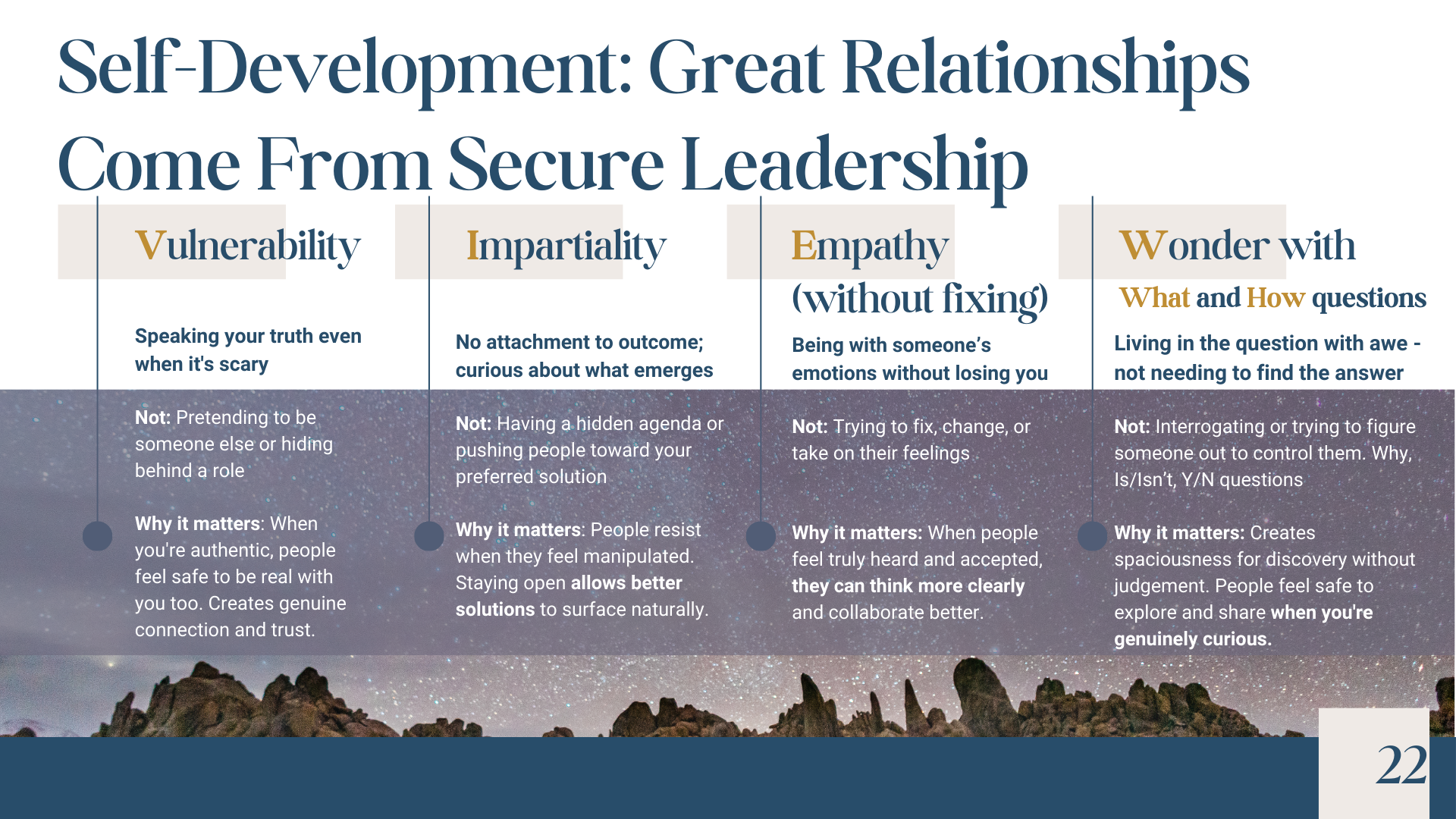
The Art of Accomplishment framework calls this the VIEW: Vulnerability (speaking your truth even when it's scary), Impartiality (no attachment to outcome; curious about what emerges), Empathy without fixing (being with someone's emotions without absorbing them), and Wonder (living in genuine questions instead of needing to have answers).
This isn't soft leadership. This is the foundation for high performance.
The Cost of Leading From Emotional Blindspots
Here's what happens when leaders operate from emotional blindspots—unexamined beliefs about their worth, their power, and what they need to do to be safe:
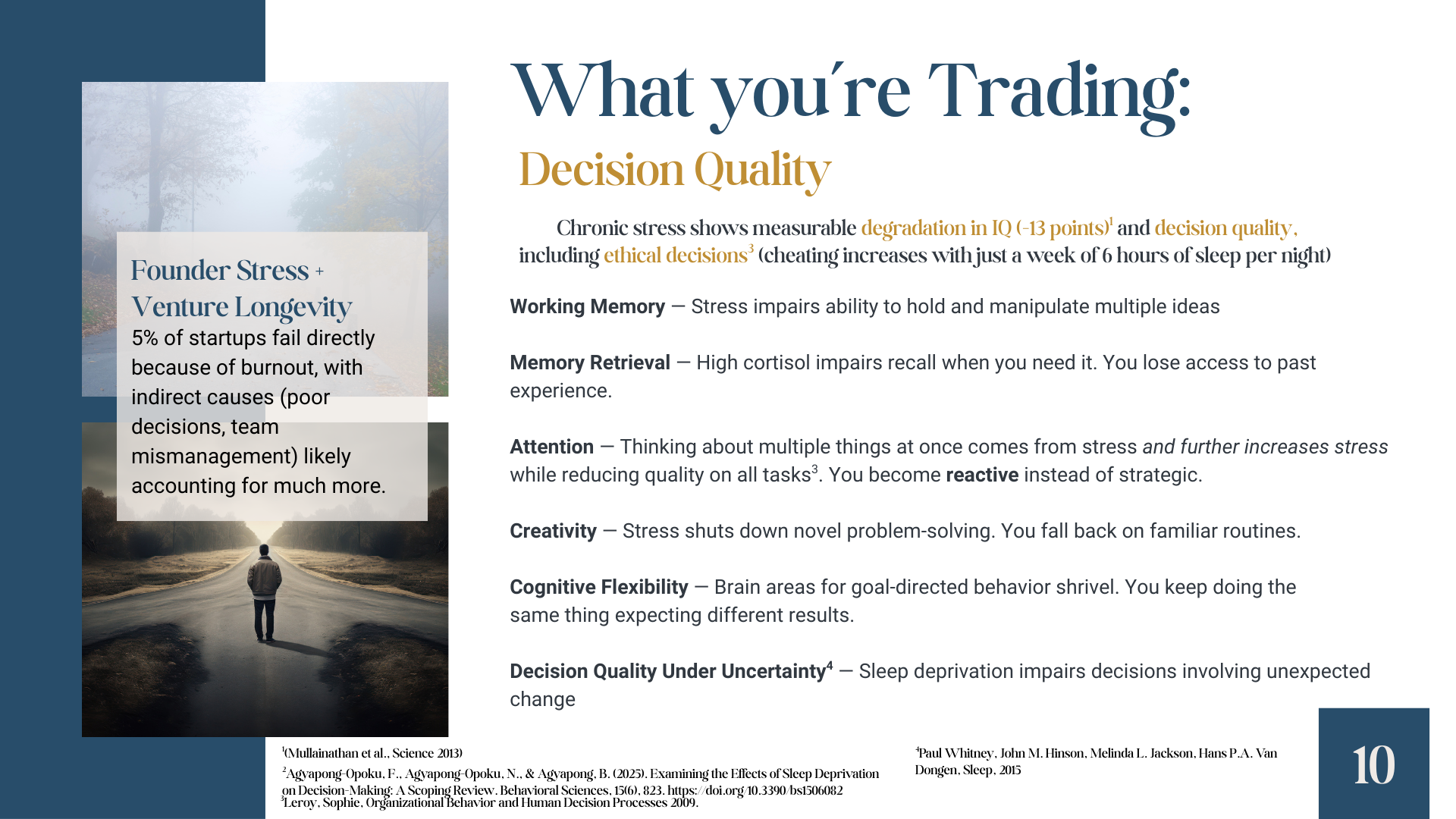
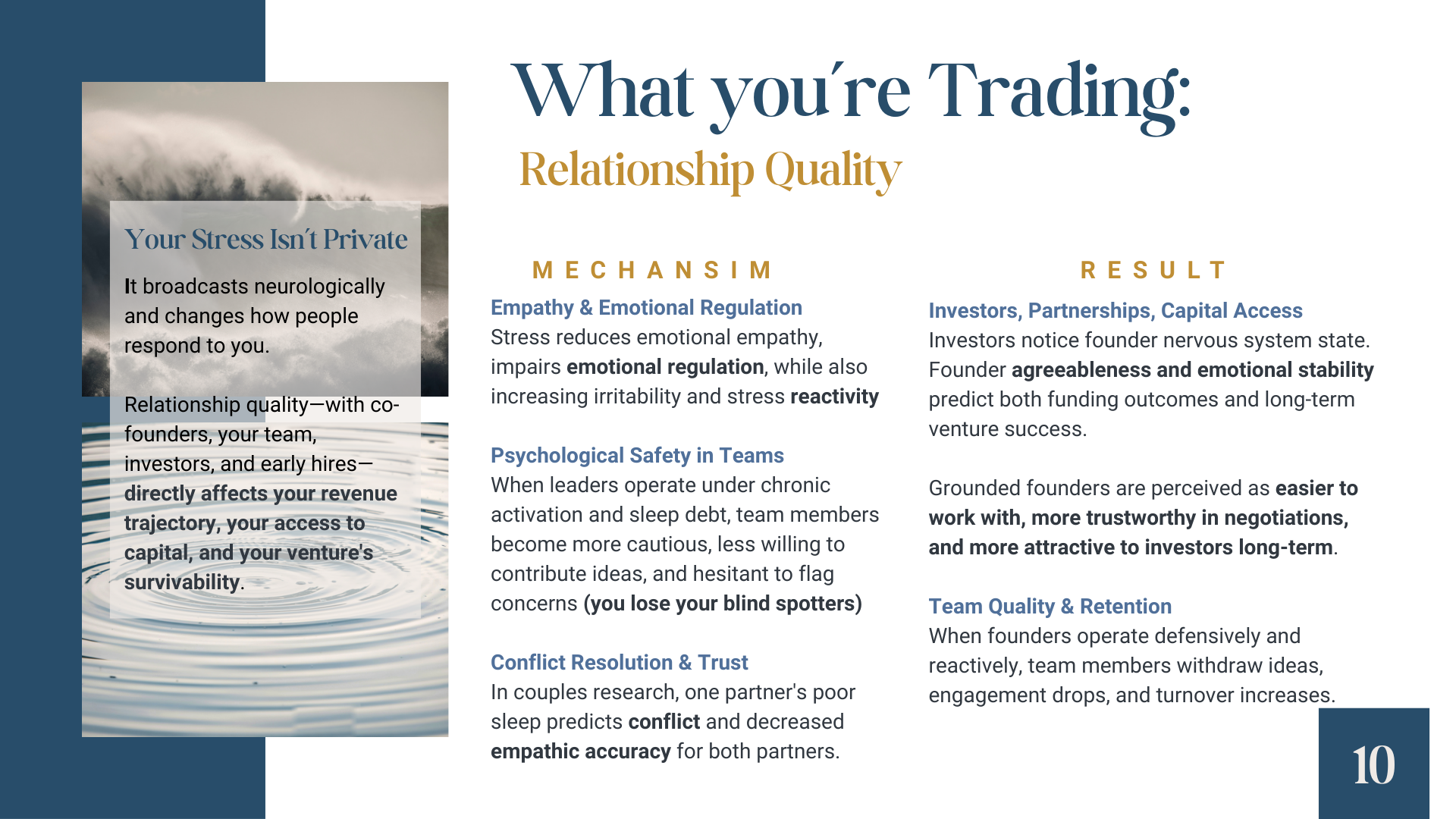
You become the temperature of the room, and the room gets cold. Your team feels your stress before you do. Neuroscience research on the polyvagal system shows that people's nervous systems literally synchronize with the nervous systems of people around them. Your tension becomes their tension. Your fragmentation becomes their confusion.
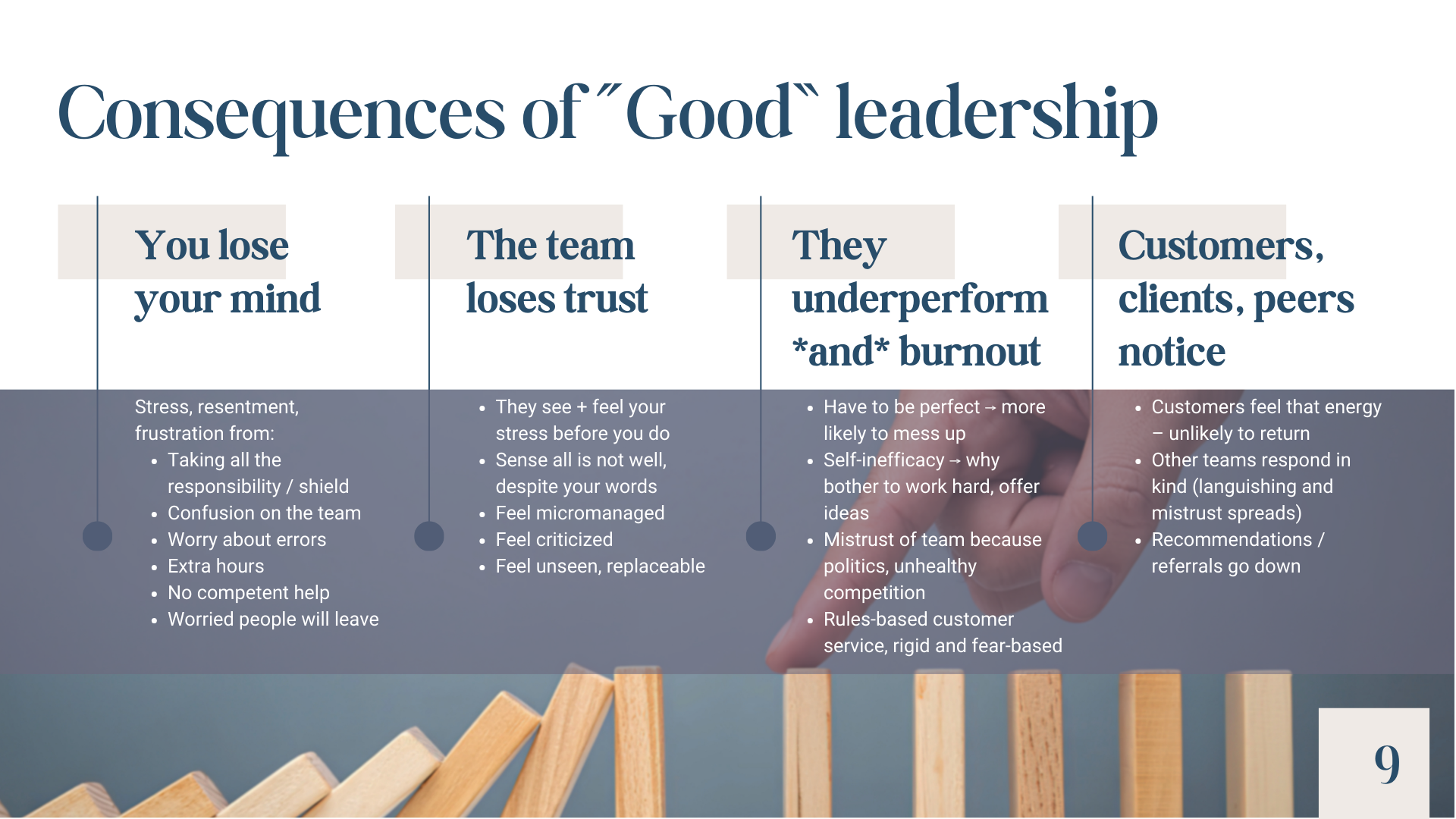
A leader operating from the blindspot "I'm only valuable if I'm solving problems" becomes a bottleneck. They can't delegate without anxiety. They check work repeatedly. They solve before asking. Their team learns that problems are scary and that they need to hide issues rather than surface them. Turnover increases. The best people leave first—they're the ones with options.
A leader operating from "I need to protect my team from reality" becomes secretive and distant. They sugar-coat bad news. They don't share information. Their team senses something is wrong but feels excluded and anxious. Rumors fill the void. Trust erodes. People stop offering ideas because why bother if the real information is being withheld?
A leader operating from "I need to be perfect" creates a team that's afraid to fail. They micromanage. They give feedback constantly. They catch every mistake before it becomes a learning opportunity. The research is clear: psychologically unsafe teams with high standards create anxiety and underperformance, not excellence.
The costs are real and they're substantial.
Gallup research shows that only 18% of managers are highly capable at management—not because they lack intelligence or education, but because many are promoted based on tenure or technical skill rather than on their ability to lead people and regulate their own nervous systems. That's a massive leadership development gap.
Research on employee engagement shows that engaged teams are 23% more profitable than disengaged teams. For a $500K business, that's an extra $115K in annual profit. For a $2M business, that's $460K. Low-engagement teams see voluntary turnover 18-43% higher than highly engaged teams, with replacement costs ranging from 50-200% of annual salary. For a five-person team at $50K average salary, that's $50K to $200K in replacement costs every two years.
A 5% increase in customer retention drives a 25% increase in profit.
The gap between secure and insecure leadership is literally a gap in revenue, retention, and customer loyalty. And that gap starts with the leader's own emotional health.
Why Emotions Are Contagious—Especially From Leaders
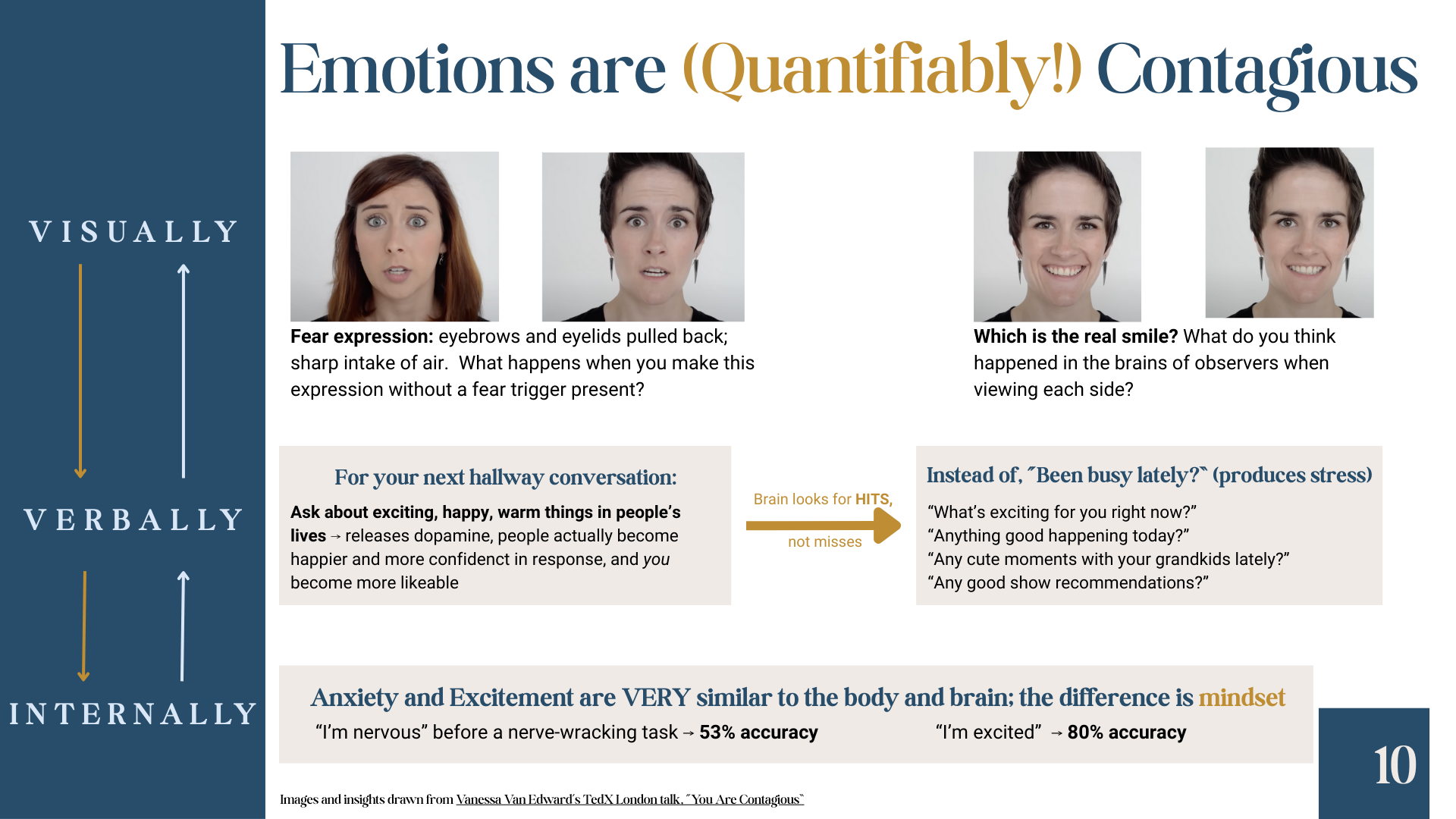
Your team doesn't just think about what you say. They feel it. Research on mirror neurons shows that watching someone else's behavior activates the same neural patterns in the observer's brain. Your stress response literally activates stress responses in the people around you.
When you're tense, your microexpressions flash across your face in fractions of a second—before you can control them. People see them. Your tone shifts slightly. Your body language changes. You use different language. All of this happens before you've said anything about what you're actually thinking.
A leader who says "I trust you" while visibly tensing communicates something very different than what their words express. The team doesn't know why they feel anxious, but they do. They become cautious. They stop offering ideas. They watch for danger.
This isn't about being fake or perfectly regulated all the time. It's about being honest about your state and what you're working with. A leader who says "I'm stressed about the timeline and I'm working on staying present with you—let me know if I'm checking in too much" gives the team accurate information. They can adjust their own expectations. They can be allies in the work instead of trying to figure out what's wrong.
The difference between these two scenarios is the difference between a team that trusts you and a team that's confused about who you really are.
What Secure Leadership Looks and Sounds Like
Let me show you what this actually looks like in practice. Here are some common leadership moments and how they look from insecure versus secure positions.
Scenario: A team member brings you a problem
Insecure (from the blindspot "I need to be the problem-solver") Team member: "I'm not sure how to handle this customer situation." Leader: [immediately switches into solution mode] "Here's what you do. First, X. Then Y. Call me if Z happens." [moves on quickly]
What the team learns: Problems are scary. I should hide them. My judgment isn't trusted. I'm not capable.
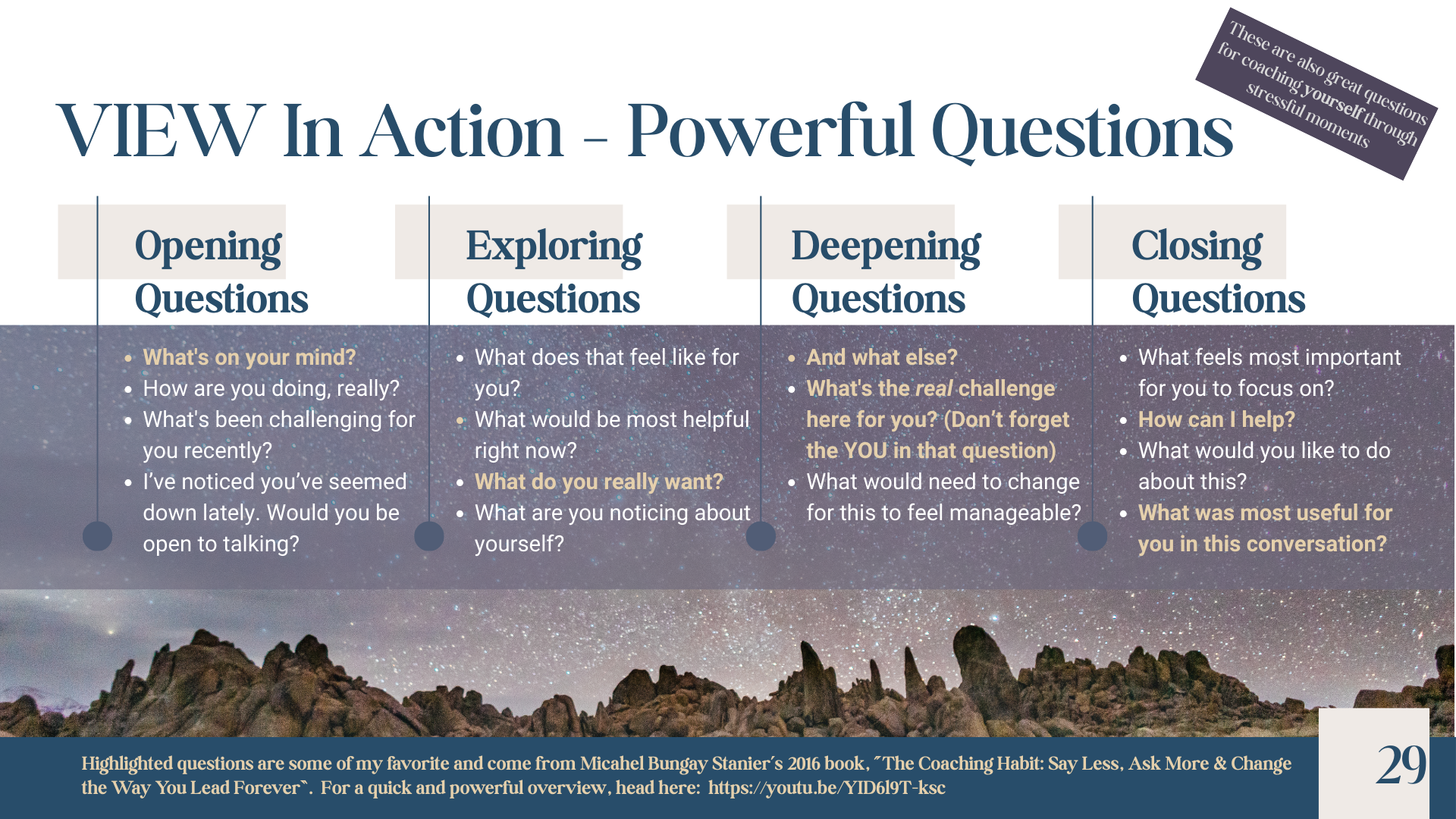
Secure (from genuine confidence in their capability) Team member: "I'm not sure how to handle this customer situation." Leader: "What's your instinct telling you?" [listens without interrupting] Team member: [describes their thinking] Leader: "What do you think would happen if you did that?" [asks follow-up question] Team member: [works through it, often arriving at their own good answer] Leader: "I think that's solid. Let me know how it goes."
What the team learns: My thinking is valued. I'm capable. Problems are solvable. The leader trusts me.
Scenario: Someone makes a mistake
Insecure (from the blindspot "I need to catch all errors before they become crises") Leader: [notices the mistake immediately] "This is wrong. Here's how you should have done it." [corrects it without the person's input]
What the team learns: I'm being watched. Mistakes mean I'm incompetent. I need to hide errors before anyone notices.
Secure (from confidence in people's ability to learn) Leader: [notices the mistake, sits with it briefly] "I saw something in your work I wanted to check with you about. Walk me through what you were thinking here." Team member: [explains their approach] Leader: "I see where you were going. Here's what happened when I tried that approach [shares specific consequence]... What would you try differently now?" Team member: [adjusts their thinking, learns] Leader: "Yeah, that makes sense. That's how I'd handle it going forward."
What the team learns: Mistakes are learning opportunities. The leader cares about my thinking, not just the output. I'm capable of doing better.
Scenario: You're stressed about deadlines
Insecure (from the blindspot "I need to handle stress alone") Leader is visibly tense. Checks in more frequently. Asks for updates on things that don't need immediate updates. Seems distant. Doesn't explain what's happening.
What the team learns: Something is wrong, but we're not supposed to know about it. The leader is stressed, so we should be too. We're probably failing somehow.
Secure (from the blindspot "I can name what's happening") Leader: "I want to be transparent with you. The deadline is tighter than I initially understood, and I'm working on staying present with you even though I'm stressed. If I'm checking in more than feels right, let me know."
What the team learns: The leader is human. They're honest about what they're experiencing. We can trust what they're telling us. We're partners in this.
The Business Case for Secure Leadership
Here's where secure leadership directly shows up in your bottom line:
For the business: Engaged teams driven by secure leaders are measurably more profitable. They have lower voluntary turnover. They make better decisions because the leader isn't solving everything from a reactive place. They innovate because people feel safe to suggest ideas. Customer loyalty increases because engaged employees provide better service.
For the team: People actually want to work for secure leaders. Not because the leader is nice, but because they feel genuinely seen, challenged, and trusted. They know where they stand. They know their growth matters. They know mistakes are part of learning, not evidence of incompetence.
This is the learning zone in psychological safety research—high safety, high standards. Teams in this zone actually perform at their highest level. They take risks because they trust the leader. They work hard because the challenge matters, not because they're afraid.
For customers and referrals: A 5% increase in customer retention drives a 25% increase in profit. Secure leaders create the conditions for teams to provide genuinely excellent service. People feel that. Customers feel that. They come back. They recommend you.
Why Behavior Change Alone Doesn't Work
You can memorize the behaviors of a secure leader. You can practice asking questions instead of solving problems. You can learn the language for warm directness. And if the underlying beliefs are still "I'm only valuable if I'm solving problems" or "I can't trust people to get it right," the behaviors will feel inauthentic. Your team will sense it. And under pressure, you'll revert.
This is what I see in leaders who go to workshops, get excited about new approaches, and then two weeks back at work are running the same old patterns. It's not laziness or lack of commitment. It's that the nervous system won't sustain a behavior that contradicts what it actually believes.
The real work is internal. It's understanding where your beliefs about your worth came from. It's noticing when you're leading from protection instead of from confidence. It's doing the work to regulate your own nervous system so you're not dumping your stress on your team.
This is where Regenerate + Relaunch comes in. This is the work that actually changes things.
Regeneration as a Competitive Advantage
Most leaders understand that their team's health affects business outcomes. Fewer understand that their own health is the foundation.
Think about it this way: Your team's engagement, creativity, and performance are limited by your own capacity. If you're running on empty, your team feels it. If you're regulated and present, your team rises to that. This isn't about self-care as a concept. It's about recognizing that your energetic health is literally infrastructure for business success.
Research on regeneration shows that rest isn't laziness—it's when your brain consolidates learning, solves problems, and restores the resources needed for complex thinking. A depleted nervous system can't make good decisions, can't hold boundaries, can't trust people. A regulated nervous system can do all of that.
The leaders who have the most sustainable success aren't working the longest hours. They're the ones who've done the work to understand what depletes them, what restores them, and how to build rhythms that honor both ambition and genuine recovery.
When you're regulated, your team feels it. When you're present and thinking clearly, you make better decisions. When you trust yourself, you can trust your team. And when your team feels trusted, they actually become trustworthy.
The Internal Work
So what does this actually involve? The work generally moves through a few dimensions:
Understanding your emotional blindspots. What beliefs about your worth, your power, and your safety are driving your leadership? Where do those come from? Maybe your worth is tied to productivity because your parent was never satisfied. Maybe you need to solve problems because that's how you felt safe as a kid. Maybe you can't delegate because asking for help felt dangerous in your family system.
None of this is your fault. But it is your responsibility to notice it and work with it, because it's affecting the people who work for you.
Regulating your nervous system. You can't think clearly from a dysregulated state. Most leaders are living in a low-level chronic stress response—slightly elevated cortisol, slightly elevated vigilance, slightly disconnected from their bodies. Five minutes every two hours of genuine integration (not thinking, not planning—just being present) can dramatically shift this. Walking without your phone. Sitting outside. Breathing practices. Movement. Whatever actually lands for you.
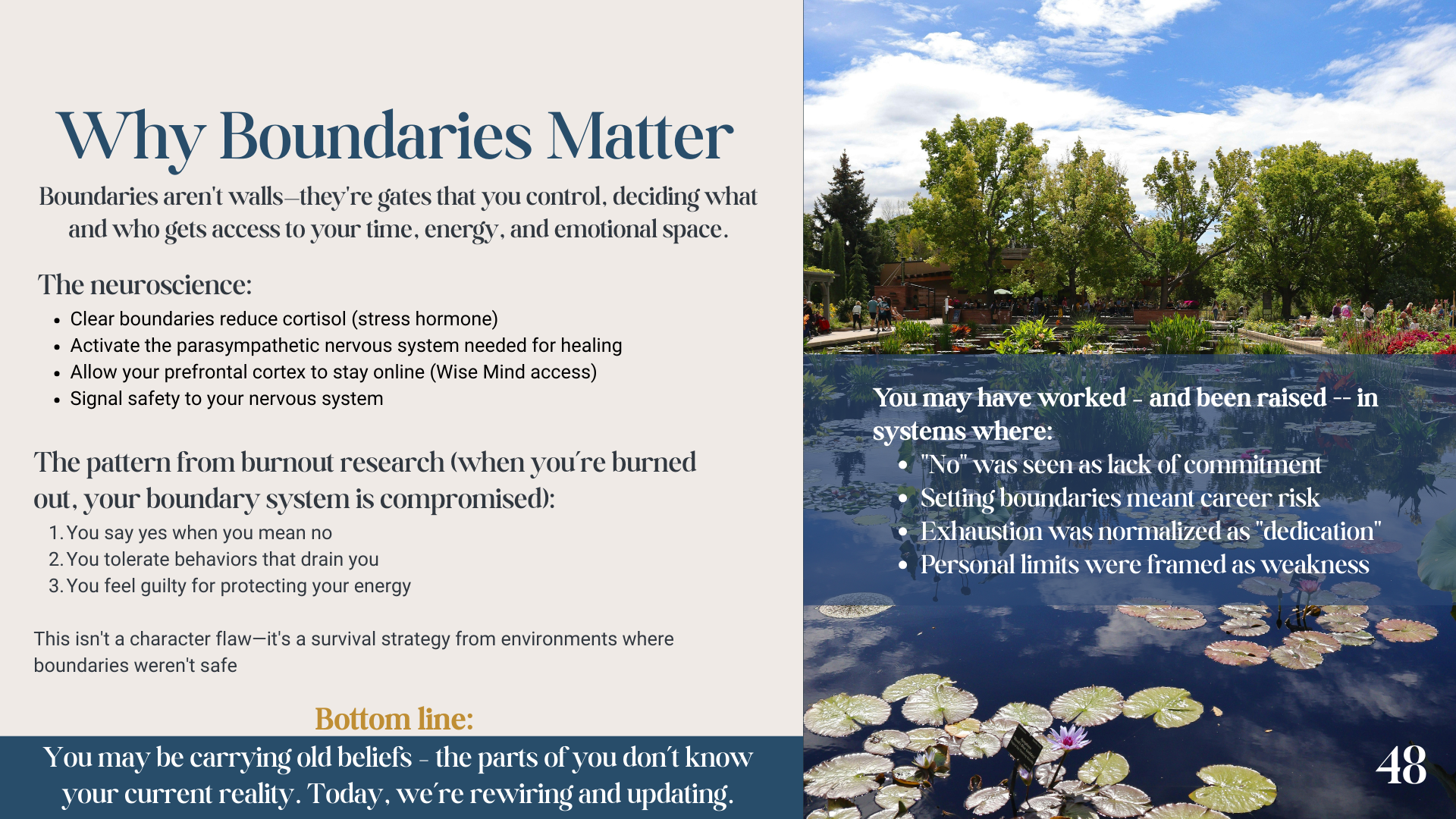
Examining beliefs about rest, boundaries, and asking for help. Many leaders operating from burnout have beliefs that rest is laziness, that boundaries are selfish, and that asking for help means incompetence. These beliefs create the conditions for burnout. And they get communicated—either explicitly or implicitly—to your team.
A team where the leader is regularly offline, where they ask for help, where they actually rest, learns that those things are acceptable. A team where the leader is constantly working, hiding struggles, and never truly disconnects learns that that's the price of competence.
Understanding what genuine confidence actually feels like. Most leaders know driven confidence—pushing harder, working longer, being more perfect. Genuine confidence feels different. It's quieter. It's present. It's not about convincing anyone of anything. It's about knowing you can handle what comes. It includes knowing when to ask for help, when you don't know something, when to change course.
Secure Leaders Know When to Lead and When to Follow
One more piece that matters: secure leaders are genuinely comfortable with their power. Which means they know when to use it and when to distribute it.
In some moments, you need to set a clear vision and direction. You're the leader; you have information or perspective the team doesn't have. You're clear about where you're going. That's not control; that's leadership.
In other moments, you create clarity about the vision and then ask the team how to implement it. You stay hands-off. You let them figure it out. You trust them with the how.
In other moments, you gather people together to think through something together. You facilitate conversation. You ask questions. You hold the space while the team works through it.
In other moments, you explicitly step back and let someone else lead. You support them. You stay available. But you're not the one driving.
A secure leader can move fluidly between these modes because they're not using leadership style to manage their own anxiety. They can let people struggle because they trust that struggle is where learning happens. They can be directive when direction is needed. They can step back when stepping back serves the work.
This flexibility is what allows teams to actually develop. Instead of learning to wait for the leader to solve it, they learn to solve things. Instead of getting frustrated by hands-off leadership, they understand when the leader is creating space for them to grow.
What This Actually Creates
Here's what happens when a leader does this work:
People clamor to work for them. Not because the leader is easy or says yes to everything. Because people know they'll be pushed to grow and treated with genuine care. The paradox of psychological safety with high standards is that people actually rise to it. They work harder. They stay longer. They care about outcomes because they care about the leader and the work.
People love coming to work again. The team's culture becomes one where people feel seen, where they belong, where they know they matter. Not because the leader is nice, but because the leader is genuinely interested in them as people and genuinely confident in their capability.
Decision-making gets faster because people are thinking instead of protecting themselves. Innovation happens because people actually offer ideas instead of waiting to be told what to do. Mistakes get surfaced early instead of hidden until they become crises.
Customers notice. Because engaged, thinking people provide genuinely excellent service. Not because they're performing; because they actually care about the work.
And the business outcomes follow. Higher profit. Lower turnover. Higher customer loyalty. All the things the Good to Great series is built on.
The Gap Between Knowing and Being
You can read this and say "yes, absolutely, I should ask more questions and trust my team more." And you might genuinely mean it. And then you'll be in a tense meeting with a tight deadline and you'll slip back into solving problems because that's what feels safe to your nervous system.
This is why the work is internal. It's why behavior change alone doesn't stick. Because your nervous system will protect you the way it knows how, and if that way is "solve the problem yourself," it will keep doing that until you've addressed the beliefs underneath.
The good news: this work is doable. It's not about becoming a different person. It's about becoming more yourself—the version of you that's genuinely confident in your own worth, not because of what you produce, but because you're a human being who matters.
And when you get there, everything shifts. Your team feels it. Your business feels it. Your own sense of ease in your leadership feels it.
Where to Start
If any of this is landing for you—if you recognize yourself in the insecure versions of these scenarios, if you see how your beliefs about your worth or your power might be affecting your team—the work starts with getting honest about where you are.
Not with guilt or shame. But with clarity. Clarity about what's driving your leadership. Clarity about where the gap is between the leader you want to be and the leader you're actually being.
This is exactly the work we do in Regenerate + Relaunch. It's a complete recovery program designed for leaders who know something needs to shift but aren't sure where to start. We work through the emotional blindspots, we build the capacity for genuine regulation, and we help you understand what you actually need to lead from a genuinely secure place.
Because the truth is: your team's thriving depends on it. And so does yours.
