
How Well-Intentioned Leaders Accidentally Create Burnout Culture at Work AND Home
The Pattern Follows You Home: Why and How Work Archetypes Show Up in Your Relationships
You manage your team one way. You manage your family another. But the same beliefs that drive your leadership at work are organizing your home life—often in ways you don't recognize until the cost becomes undeniable.
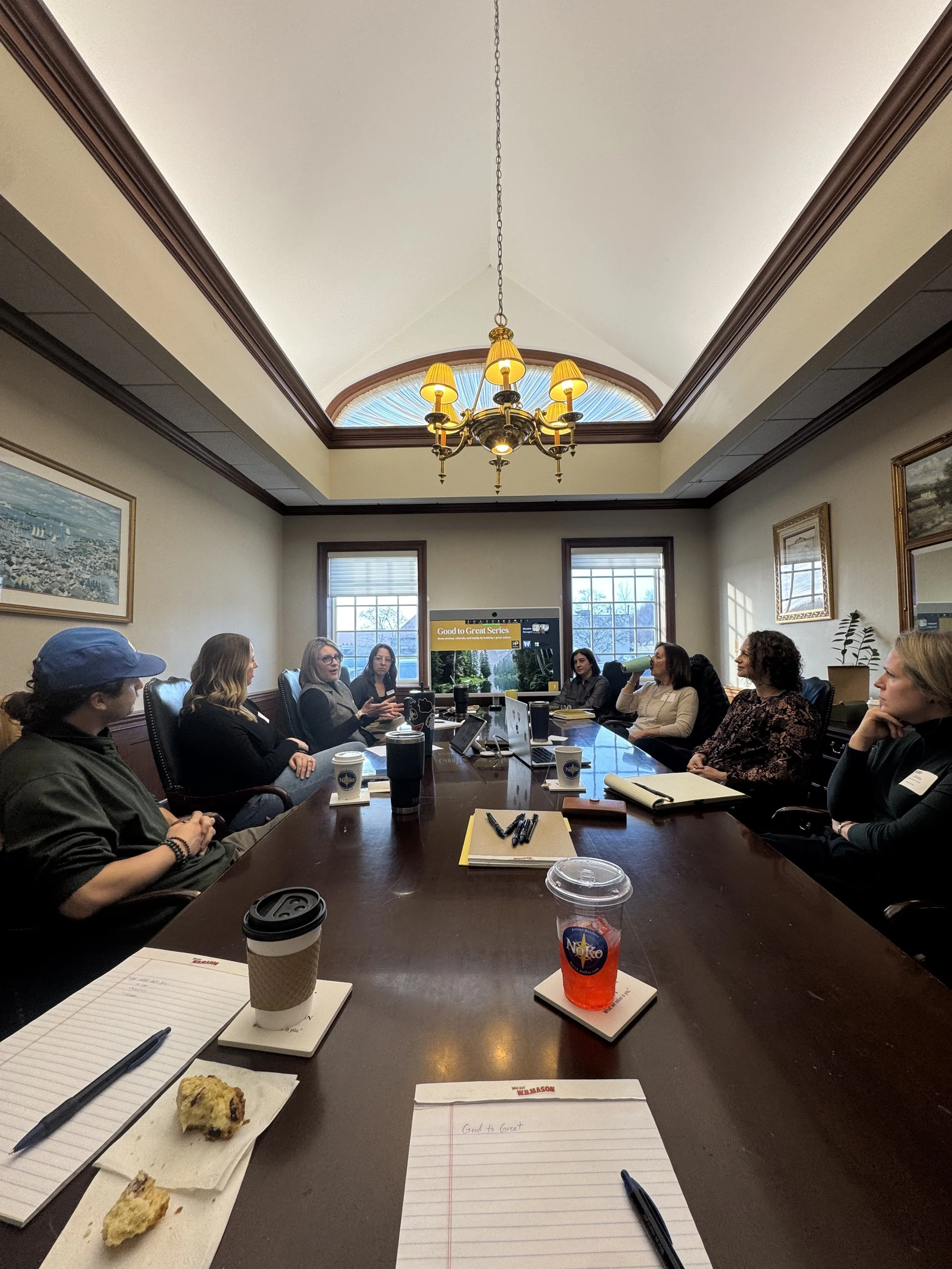
Outtake from the Good to Great Leadership series kickoff with the North Kingstown Chamber of Commerce, Washington Trust, and obviously, North Koffee 😋
THE PATTERN: WELL-INTENTIONED EFFORTS BACKFIRING (EVERYWHERE)
You come to leadership—at work, at home, in your relationships—wanting to do right by people. You've absorbed messages about what responsibility looks like: be competent, have answers ready, smooth the path, don't burden others with your stress, keep things running.
These aren't bad intentions. They're protective. And for a while, they work.
But here's what most people don't realize: the way you lead at work isn't separate from the way you parent, partner, or show up in friendships. The same beliefs drive both. The same blind spots organize both.
Here's the thing that most leadership advice—and most parenting advice—misses: In the absence of information, people make up stories. And they are rarely accurate or favorable to you.
When you shield your team from organizational challenges, when you manage your partner's decisions, when you guide your teenager through problems instead of letting them struggle—you're operating from the same belief: If I don't manage this, it will fall apart. Your team, your partner, your kids don't get relief. They get anxiety. Their brains fill in the blanks. They make up stories: You don't trust us. We're not capable. We're not safe here.
And you—the one trying to protect them—end up more isolated, more burdened, more exhausted. Because now you're not just managing the work. You're managing the information, the experience, whether they trust you. Across all domains of your life.
Research on psychological safety from Harvard Business Review shows that teams perform best when people feel they can take interpersonal risks—ask questions, admit mistakes, push back. The same is true in families. When a parent or partner is operating from unspoken anxiety—about control, about perfection, about being the one holding it together—everyone feels it. They become cautious. Compliant. They follow the system instead of thinking. They stop bringing problems because they've learned: just handle it yourself, or prepare for it to be "corrected."
THE ARCHETYPES: HOW THEY SHOW UP AT WORK AND AT HOME
In my work with leaders, I've noticed that well-intentioned people operate in one of several patterns. These aren't permanent identities—you might shift between them depending on stress or context. But most people have a default mode. And here's what matters: that default shows up at work and echoes loudly at home.
These archetypes come from what I call the golden algorithm—the pattern where trying to protect others from an emotional experience actually creates that exact experience. You're protecting them from something you're uncomfortable with. That discomfort organizes your whole approach to leadership, parenting, and relationship.
THE FIVE ARCHETYPES
| Archetype | At Work | At Home | The Cost—Both Places | What's Underneath |
|---|---|---|---|---|
| The Protector | You shield your team from organizational drama, competing priorities, chaos. You take the stress so they don't have to. You work nights and weekends to finish before things get overwhelming. You deliver a clean version of the work to your team so they can focus on their piece. | You manage your kids' disappointments before they happen. You step in when your partner is struggling. You carry the invisible weight of "what if something goes wrong" so others don't have to. You present a calm version of life so everyone else can just... be. | People become passive. They don't build resilience. They make up stories about what's really happening. Your team doesn't learn how to navigate complexity. Your partner stops offering solutions. Your kids learn: Mom will handle it. And you're exhausted managing both the work and everyone's emotional experience of it. | Fear of helplessness. Early learning that your job was to keep people safe, or that chaos meant danger. Your nervous system learned: If I'm not managing this, things fall apart. Maybe you were parentified. Maybe you learned that love meant taking care of people. |
| The Perfecter | You give detailed feedback on everything. You catch and fix mistakes early. You're modeling what excellence looks like. You notice the typo before the email goes out. You have thoughts on how the presentation could be stronger. | You notice when your teenager's room isn't organized. You redirect your kids mid-conversation about how they should have handled it. You offer "helpful" corrections to your partner's approach—at work, with parenting, with family. You see what "good" looks like and can't help but point out the gap. | People become dependent on your feedback instead of trusting their own judgment. They focus more on not making mistakes than on creating something meaningful. Your kids learn to seek your approval rather than their own sense of what's right. Your partner stops trying because nothing is ever quite right. Everyone starts to feel inadequate. | Fear of inadequacy. Often learned early that love was conditional on performance, or that mistakes meant you weren't good enough. Your nervous system says: If I don't catch this, it reflects on me. Maybe you grew up with a critical parent. Maybe your value was tied to achievements. |
| The Savior ("Adult in the Room") |
Someone brings you a problem, you fix it. Fast. You're responsive, solution-oriented. Your team counts on you. You get things done. You're the one people turn to when things are urgent. You're the person your boss mentions in that wistful way: "I don't know how, but somehow we'll figure it out." | Your child comes home upset about a friend conflict, and you immediately know how they should handle it. Your partner mentions stress, and you have three solutions ready. You're the one who remembers the details, makes the calls, solves the crisis at midnight. You're the reliable one. | People stop problem-solving. They wait for you. Your time becomes the bottleneck. You're exhausted. And secretly, people resent needing you. Your kids don't develop their own judgment. Your partner stops taking initiative. You create dependency instead of capability. And underneath, you wonder: Do people value me, or just what I do? | Fear of being needed and then abandoned. Often: "If I'm useful, I matter. If I'm not fixing things, I'm not valuable." Your nervous system equates solving with safety. Maybe you grew up with an unreliable parent, so you learned early: if you want something done, do it yourself. |
| The Invisible Leader | You give people autonomy—a lot. You hire smart people and let them do their job. You don't micromanage. You trust them. You're hands-off. You believe in independence and self-direction. You step back and let people figure it out. | You give your kids freedom to figure things out. You don't hover over homework or relationships. Your partner makes decisions without checking in with you. You value independence in your family, maybe to the point of distance. You're not trying to control anyone. | Without clear direction or vision, competent people flounder. New people especially struggle—they don't know what you value or how you think. At work, people make inconsistent decisions. At home, your kids feel untethered, unsure what you actually care about. Your partner feels alone in decision-making. People stop asking questions. The autonomy you meant as respect feels like invisibility. | Fear of being controlling or smothering. Often learned: "If I hover, I'm bad. If I step back completely, I'm trusting." But there's a middle ground you're avoiding. Maybe you grew up with a controlling parent, so you swung hard in the other direction. Maybe you learned that your needs weren't important. |
| The Nice One | You want everyone to get along and feel valued. You avoid conflict. You're friendly and approachable. Feedback is always kind, delivered gently, or maybe not at all. You bend. You accommodate. You say yes to things you're not sure about because saying no feels like letting someone down. | You smooth over family conflict. You say yes to things you don't want to do because saying no feels mean. You don't want to be the bad guy. You prioritize everyone feeling okay over clarity about what you actually need. You're flexible, accommodating, the peacekeeper. | Accountability gets fuzzy. People don't always know where they stand. Feedback gets delayed or softened so much it doesn't land. At work, people who care about growing wonder if you're invested in their development. At home, your family doesn't know what matters to you. Your resentment builds silently. You stay in situations—work, relationships, commitments—that don't fit because you can't bear disappointing someone. Passive aggressiveness becomes your language. | Fear of conflict or being perceived as unkind. Often: "If I'm direct, I'm mean. If I'm nice, I'm good." But directness is kindness when it comes from care. Maybe you grew up with a lot of anger or criticism, so you learned to be the peacekeeper. Maybe you were socialized as a "good girl"—accommodating, pleasant, never too much. |
THE REAL INSIGHT: IT'S NOT ABOUT WILLPOWER
Here's what most people discover in coaching: I thought my work problem was a work problem. But it's not. It's a belief problem. And that belief is running my whole life.
One client came for help with her team—they weren't delivering at the level she knew was possible. Years of reliable excellence, and suddenly people were coasting. She found herself exasperated, picking up slack, wondering why no one cared as much as she did.
But as we looked closer, we found the same pattern at home. She was carrying too much, managing too tightly, and the people around her (her partner, her children, her extended family) had learned something: someone else will handle it, or it will get handled, but it won't be on me.
Her beliefs about excellence, responsibility, and what it meant to be reliable were running the show everywhere. At work, she'd been the most prolific contributor for years, somehow always the one who figured it out. At home, she was the one who kept the household running, who noticed what needed to happen, who made sure everyone was okay. She wasn't chasing recognition—she just believed that's what responsibility looked like. And for years, it worked. Barely. Until it didn't.
Another client felt stuck in functional freeze at work—overwhelmed, behind, guilty about not doing more—and thought it was a productivity problem. She was behind on projects, anxious about what she wasn't delivering, stuck in a cycle of obligation and paralysis.
But the exact same pattern was happening at home with her daughter. Same anxiety about her development. Same sense of not doing enough. Same functional freeze that looked like laziness but was actually her nervous system saying: I can't handle this. I'm too much. I'm not enough. The root wasn't about work or parenting. It was about beliefs she'd inherited about what she owed, what she should be able to handle, who she needed to be. As we worked together, she realized these weren't her beliefs—they were inherited, passed down, never examined. Once she saw that, she could question them. And once she questioned them, she could change them.
A third client noticed that her obligation and resentment at work—the shoulds that had calcified into bitterness—were keeping her passive and small in her personal relationships too. She stayed in situations that didn't fit because she couldn't bear to disappoint anyone. Same belief. Different setting. Same cost. As we worked on this, she realized the root was old messaging about what she owed to family, to people who'd sacrificed for her, to maintaining family harmony at her own expense. Once she saw the pattern, she started to question it. And once she questioned it, she started to make different choices.
This is what coaching actually does. It's not JUST about behavior change. It's about belief and behavior change together. And as I wrote about in "Secure Leadership," behavior change without inner work doesn't stick. You can adopt new management techniques, new parenting strategies, new communication skills. But if the belief underneath stays the same, your nervous system reverts when the going gets tough (and it will; change is hard no matter what). You slide back into the archetype because it feels like the only way to be safe, to be good, to matter.
FROM GOOD TO GREAT: THE SHIFT HAPPENS EVERYWHERE
| Archetype | From "Good" | To "Great" | The Paradox (What Actually Shifts) |
|---|---|---|---|
| The Protector | You shield your team and family from stress. You manage the chaos so everyone else can focus. You're the one who handles it. | You bring your team the whole problem. You let them see real challenges. You trust them with complexity. At home, you let your kids experience realistic consequences. You stop managing their emotional experience. You enjoy success without catastrophizing. | The Old Way—Trying Harder: You read about delegation and try to step back. But underneath, you're still anxious, still scanning for problems, still carrying the weight. The New Way—Acceptance: You accept that the part of you that wants to protect, that feels safer in control, that learned love meant taking care of others—that part isn't bad. It kept you safe. And maybe it's time to question whether you still need it in charge. Maybe I'm allowed to not handle it all. Maybe people can struggle and still be okay. From that acceptance, the grip releases. Not from trying harder, but from finally stopping. |
| The Perfecter | You give detailed feedback on everything. You catch and fix mistakes early. You're modeling what excellence looks like. | You offer relatable recognition first, then redirection—often informal, in short bursts. You know what they care about. You say, "I see that you care about X. I notice this behavior that's undercutting that value. What can we do about it together?" ([Research on the Gottman ratio](https://www.gottman.com/blog/the-magic-ratio-the-key-to-relationship-satisfaction/) shows that for every piece of correction, there are five moments of genuine recognition.) | The Old Way—Trying Harder: You decide to give more praise. You create a checklist: five positive comments before feedback. You count them. You're still operating from the same belief: if you don't catch mistakes, bad things happen. The New Way—Acceptance: You accept that the part of you that scans for errors, that feels responsible for quality, that learned love was conditional on performance—that part made you excellent. But maybe excellence doesn't require perfection. Maybe people can make mistakes and still grow. Maybe my value isn't tied to catching everything. From that acceptance, your praise becomes genuine. People feel seen, not critiqued. |
| The Savior | Someone brings you a problem, you fix it. Fast. You're responsive, solution-oriented. Your team counts on you. You're the one who somehow makes it happen. | You ask how and what questions instead of providing answers. "What obstacles are you running into?" "What's your perspective?" At work, you resist the urge to solve your team's problems. At home, you let your partner figure things out. You discover that people are more capable than you realized—they just needed room to try. | The Old Way—Trying Harder: You decide to ask more questions. You make a list of open-ended questions. You pause before giving advice. But underneath, you're still anxious. If you don't jump in, will it get fixed? Will you still matter? The New Way—Acceptance: You accept that the part of you that jumps to solutions, that feels safer when solving, that learned usefulness equals worth—that part made you reliable. But maybe people don't need me to fix everything. Maybe they're capable. Maybe my value doesn't depend on being indispensable. From that acceptance, you genuinely ask. People sense you trust them. And something shifts inside you too: you don't have to be the one holding everything up. |
| The Invisible Leader | You give people autonomy—a lot. You hire smart people and let them do their job. You don't micromanage. You trust them. | You create clarity first—central vision, clear values, defined principles—then offer autonomy within that framework. At work, you share what matters to you and why. At home, you give your kids and partner room to operate, but they know where the guardrails are. You're present and involved, but not controlling. | The Old Way—Trying Harder: You decide to be more present. You schedule check-ins. You articulate your vision in a memo. But underneath, you're still operating from fear: if I hover, I'm controlling. The New Way—Acceptance: You accept that the part of you that fears being controlling, that learned to need nothing, that steps back at the first sign of risk—that part protected you. But maybe presence isn't the same as control. Maybe I'm allowed to have opinions and values and share them. From that acceptance, you articulate your vision not because you're trying to be a better leader, but because you're not as afraid. People feel safer because they actually know where you stand. |
| The Nice One | You want everyone to get along and feel valued. You avoid conflict. You're friendly and approachable. Feedback is always kind, or maybe not given at all. | You understand that clarity is kindness. You can be warm and direct: "I care about you as a person. And this specific behavior needs to change. Here's why it matters, and here's what I need from you." At work and at home. You stop smoothing over conflict. You say no when you mean no. | The Old Way—Trying Harder: You decide to say no more often. You practice the words. You feel guilty every time. You're still operating from: if I'm direct, I'm mean. The New Way—Acceptance: You accept that the part of you that smooths conflict, that accommodates everyone, that learned your job was keeping the peace—that part isn't weak. It kept your family safe. But maybe people respect honesty more than agreeableness. Maybe directness is kindness when it comes from care. From that acceptance, you become warm and direct naturally. People actually respect you more. They stop trying to figure out what you really want and just listen. |
WHY THIS MATTERS: THE UNEXPECTED BENEFIT
Most people come to coaching thinking they need help with a specific problem: "I can't get my team to step up" or "I'm drowning in my responsibilities as a parent" or "My marriage feels distant."
What they discover is that burnout recovery and resilience coaching isn't really about productivity hacks or boundary-setting templates or communication scripts. It's about changing the beliefs that drive your behavior across all domains of your life.
And here's the unexpected part: when people change these core beliefs, relationships get better. Not just work relationships. Not just parent-child relationships. All of them.
Because the belief shift is real. It's not a performance. People feel it. They respond to it. Your team becomes more engaged because you're not micromanaging their experience. Your kids become more capable because you're letting them struggle and learn. Your partner becomes more present because you're not carrying everything alone. Your friendships deepen because you're not performing the role of the reliable one anymore—you're actually there, actually yourself.
When you start to actually thrive, so do the people around you, without you micromanaging or worrying them into your version of “thrive”. It’s almost effortless.
One of the most surprising benefits of burnout recovery coaching is that people report their relationships getting dramatically better—not because they worked specifically on those relationships, but because they worked on themselves. They shifted their core beliefs about responsibility, worth, safety, and control. And when those beliefs shifted, every relationship shifted.
THE CONNECTION: WORK, HOME, AND THE DEFAULT PARENT PATTERN
This is exactly why we're running The Default Parent's Survival Guide workshop — based on this blog post — on February 10th at Artisan Bites in Cranston (co-hosted with Peace of Mind Nannies).
Because if you recognize yourself in one of these archetypes at work, I can almost guarantee you'll recognize it at home too. And if one parent is operating as the Protector or the Perfecter or the Savior—carrying too much, managing too tightly, taking responsibility for everyone's experience—the relationship dynamics shift. One person becomes the hub. The invisible work falls to one person. Information gets managed. The other person steps back, not from laziness, but from learned helplessness or resentment or the simple fact that they've learned: she's got this handled. Why would I step in?
The default parent pattern isn't a character flaw. It's what happens when someone's archetypal pattern meets a system (family, work, life) that rewards it. At least for a while. Until it doesn't.
Join us for the workshop to explore these patterns in partnership and parenting, and to discover what shifts when both people understand what's underneath. Because the work isn't about creating more rigid boundaries or better chore charts (though those can help). It's about shifting the beliefs that drive the patterns. And when both people do that work, everything changes.

THE PARADOX: YOU DON'T CHANGE BY TRYING HARDER
There's a paradox at the heart of this work, and it's one most self-help books get wrong.
You don't change these patterns by just trying to change them as another self-improvement project, coming from the belief that you need to do more and be better to prove your worth, capability, ability to call yourself a “good leader / manager / parent / employee / human”. You don't shift your beliefs by willpower or discipline or reading enough blog posts about the "right" way to lead or parent.
In fact, trying so hard to change yourself often makes it worse. Because trying to change is just another version of the same belief: I'm not good enough as I am. I need to be different. I need to fix this.
Real change comes from a different place. It comes from self-compassion and acceptance. <- Read that article before you roll your eyes at “self-compassion and acceptance” as fluff. They’re the most studied science-backed ingredients to lasting change.
“Are you trying to change because you genuinely want to grow—or because you don’t like who you are right now?
What happens if you accept the part of you that you’ve been trying to reject?”
This is where coaching is different from a self-help book. A book can show you the pattern. A book can name the archetype. A book can suggest new behaviors. But what actually allows the shift—what allows you to stop gripping so hard, to stop performing, to stop trying to be the person who held those old beliefs—is being witnessed.
One of my clients, after months of trying to force herself to step back from over-responsibility, finally said something that shifted everything: "Maybe I'm allowed to not handle it well all the time."
Not: "I will practice stepping back." Not: "I will change my behavior." But: Maybe I'm allowed. Maybe I’m okay as is, flaws and all, unchanged pieces included
That's the shift. That's when the grip releases. Not because she tried harder. But because she stopped rejecting the part of herself that wanted to handle it, that believed she should handle it, that felt safer when she was in control. She accepted that part. She saw where it came from. She understood what it had been protecting her from.
And from that acceptance—not from trying to be different—everything started to shift.
She started setting boundaries, not because she was forcing herself to, but because she didn't need to hold everything anymore.
Her team stepped up, not because she was trying to let them, but because she was finally present instead of performing.
Her kids became more resilient, not because she was implementing a new parenting strategy, but because she stopped managing their emotional experience.
Her partner became more engaged, not because she was trying to get them to care more, but because they finally felt trusted.
The amazing thing is that this process can feel so "woo-woo," so impossible to do on your own. How do you accept the part of yourself you've been rejecting your whole life? How do you stop trying to be different? How do you release a grip you've been white-knuckling for decades?
That's why coaching works. That's why a resonant witness—someone who sees you, believes in your capacity to change from acceptance rather than rejection, and holds space for you to question your beliefs—makes all the difference.
Coaching isn't about trying harder. It's about finally allowing yourself to set down, safely, the junk in the backpack so we can climb freely.
AN INVITATION TO DEEPER WORK
If you recognize yourself in these archetypes—at work, at home, or both—you're not alone. And knowing the pattern is the first step.
The real work is shifting the beliefs underneath. That's where coaching comes in.
The Next Right Step is a single focused session where we identify what's underneath your pattern and you leave with a framework for change. We look at where this belief came from, what it's been protecting you from, and what becomes possible when you question it.
Regenerate + Relaunch is a longer engagement for people ready to rebuild their relationship with success, responsibility, and what it means to be "enough." We use the FLOURISH method to recover your energy, listen to what your nervous system and patterns are telling you, and build new beliefs that actually serve you—at work, at home, everywhere.
If you're ready to explore what's possible, schedule a free consultation. We'll talk about where you are, what's been tricky, and whether coaching feels like the right fit.
A PERSONAL NOTE
I spent years as the Protector and the Savior both. At work, I managed everything, fixed everything, protected my team from stress. At home, I did the same with my family. I believed my value was in how much I could hold, how indispensable I could make myself.
My body kept score. My relationships felt distant even when I was constantly present. And I couldn't figure out why, even though I was doing everything "right."
What actually changed was when I looked at the belief underneath: I am only valuable if I am needed. I am only safe if I am in control.
That belief wasn't serving me or anyone around me. It was slowly destroying my health and my ability to actually connect with people.
If any of that lands for you, you're not broken. Your nervous system learned an adaptive strategy a long time ago. It kept you safe or helped you matter when you needed it to.
But it might also be the thing keeping you exhausted—and making the people you love smaller.
KEEP EXPLORING
Podcast: Listen to Now That You See It for deeper dives into nervous system regulation, the FLOURISH method, and what secure leadership actually looks like.
Blog: Read more on The Quitters Club Blog about burnout, relationships, leadership patterns, and building a life you actually love.
Gathering: The Default Parents' Survival Guide — February 10th at Artisan Bites in Cranston with Peace of Mind Nannies — explores these patterns in partnership and parenting. Read the guide here and join us for community, snacks, and discounts on both coaching and nanny service.
Newsletter: Subscribe here to get weekly posts on leadership, burnout recovery, and what it means to lead authentically.
Refer a friend: If this resonates and you know others caught in these patterns, share the referral program.
