
When “I Deserve” Feels Gross: The Quiet Cost of Not Seeing Your Worth
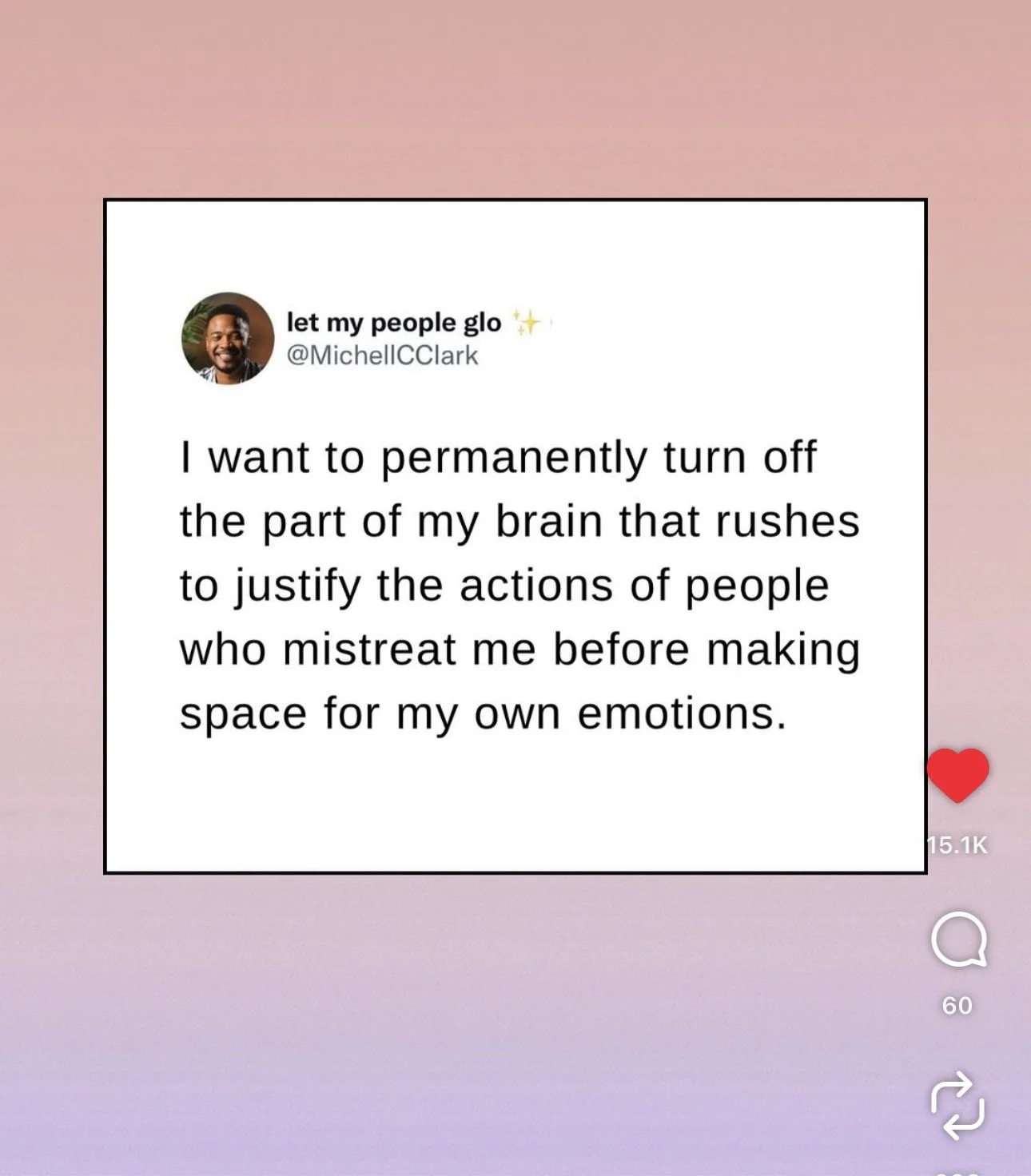
“I deserve…” is a complex, complicated, and confusing experience. Until it isn’t. Read more for the what, why, and how.
We were recording Now That You See It last week when our guest mentioned "deserve."
I watched my co-host, Pancho's, face shift. His jaw tightened. A micro-expression flickered—not quite disgust, but close. I know that look because I've made it myself, probably more times than I want to admit. We've both squinted at that word with the same uncomfortable, yucky reaction. That instinctive recoil. I've spent months in EMDR working through my own conviction that I didn't deserve much of anything, and watching his face reminded me of how complicated this feeling still is for me.
And — that most of the people I work with have the same response, at least in the beginning of coaching.
What It Actually Looks Like to Live This Belief
Over the past few years of coaching burned-out high-achievers, I've noticed something consistent. It shows up differently depending on who you are, but underneath, it's always the same thread: people who've learned that they don't really deserve.
For me, "I don't deserve" looked like this:
I never asked for help. I'd agree to things I didn't want to do—and then I wouldn't even remember saying yes. That's fawning for you: dissociation and self-sabotage at its finest, forcing the soul to do what it doesn't want. I'd apologize when things didn't work out, but I wouldn't actually change. I never took up space until my stubborn streak would take it for me, usually in some resentful or explosive way.
I lived in a car that was barely running. I lived in spaces that didn't reflect who I was anymore—the art on the walls, the furniture, the whole vibe—because updating it felt like too much, like I was asking for something I didn't deserve. Someone else probably needed a new car more. Someone else probably deserved a fresh, creative, sparkling home more than I did.
I stayed in jobs, relationships, living situations, friendships, and dynamics that were well past their prime. Not because the other people were bad, but because I didn't really let them see me. I just wanted them to think I was easygoing, adaptable, agreeable. I am those things—but not to a fault. The cost was that my brain space was clogged to the brim with junk: unnecessary worry about other people's needs, judgment of them for doing things I secretly wanted to do, and literal poisonous sewage of self-blame, inner critic voice, all the negative stuff designed to keep that "I don't deserve" script running.
When someone got angry with me, I'd tumble into a shame storm. I'd absorb all their emotion, take it on, need them to reassure me. That meant they had to take care of me instead of us being able to have real, mutual, appropriate accountability.
All of this kept me safe. Safe from risk. Safe from disruption. Safe from the uncertainty of a bigger life that would disrupt everything. Safe from someone getting mad at me and me not knowing how to handle it—because I didn't have the skills yet to trust myself instead of looking outside for validation.
I was at the mercy of other people's whims and winds. Chaotic. Stormy. A life I almost don't recognize now.
The Pattern
If you're a default parent, you might not feel you deserve:
Help with the mental load (remembering appointments, knowing what everyone needs, managing logistics)
Support from your partner or family in a way that's consistent and reliable
Time away without guilt or elaborate planning to "make it up" to everyone else
To ask clearly instead of hinting, sighing, or becoming unavailable
To prioritize your own health or peace without it feeling selfish
If you're a leader, you might not feel you deserve:
To set a boundary around availability
To say "I don't know" or "I need help with this"
To have strategic thinking time that isn't interruptible
To admit you're overwhelmed without it threatening your authority
To have needs that cost the team something
If you're a perfectionist or ambitious person, you might not feel you deserve:
To do something imperfectly and move on
To ask for help before you're completely stuck
To rest before the work is flawless
To fail and still be worthy of love and respect
To be human and mistake-prone
The result looks the same across all three patterns:
You manage more and more alone
You make smaller and smaller requests
You say yes when you mean no
You smile when you're furious
Resentment accumulates like lint in a dryer—usually expressed through passive aggression, eye-rolling, or cold distance
And the people who love you are confused. They don't know what they did wrong, because they don't actually know what you need.
Why We Cringe at "Deserve"
Here's the uncomfortable truth: We've confused deserve with judgment.
We learned somewhere—maybe from family, maybe from culture, maybe from that deep survival part of our brain trying to keep us safe—that to deserve something is to claim you're above someone else. Or that deserving comes with a price tag of perfect behavior. We saw people who talked about what they deserved as selfish, entitled, loud, demanding. And because we're good people, we decided the safest thing was to want nothing at all.
What Shame Actually Does
Brené Brown's research on shame defines shame as the belief that we are fundamentally flawed or not worthy of belonging. It's different from guilt (I did something bad) or embarrassment (something awkward happened). Shame is an identity thing. It says: I am not worthy. Not just my behavior, but my core self.
Shame is incredibly effective at keeping us in line.
If you grew up in a family system where your value was tied to how much you accomplished, or how well you managed everyone else's emotions, shame became a regulatory tool. Your nervous system learned to associate "deserving" with danger. A protective part of you took on a job—to keep you safe by ensuring you never asked for too much.
The Science Behind It: Your Nervous System on "I Don't Deserve"
Research from Being Well, hosted by Dr. Rick Hanson and Forrest Hanson, connects this to nervous system states. When you're constantly in a posture of "I don't deserve," your system stays in a subtle state of chronic vigilance.
You're not resting. You're performing. You're managing. You're protecting others at the expense of self-protection.
This depletes you in ways that sleep and vacation can't actually fix.
Because the real thing you're depleted from isn't busyness. It's the constant internal negotiation about whether you're allowed to exist as a person with needs. Eventually, you stop asking those questions. You just say no.
How "I Don't Deserve" Actually Protects You From Your Own Power
Here's the part that nobody talks about: Believing you don't deserve is a brilliant protective mechanism. Not because it keeps you safe—it doesn't. But because it keeps you from having to act.
Think about what happens when you believe "I deserve rest, or support, or a life that actually reflects who I am." That belief comes with an implication. An action. You'd have to do something about it. You'd have to ask. You'd have to set a boundary. You'd have to leave. You'd have to spend money on yourself. You'd have to disappoint someone. You'd have to be visible.
You'd have to be in your natural power.
That's uncomfortable. It requires energy. It requires facing uncertainty. So instead, you accept "I don't deserve." It sounds like "I can't" or "I would if I could." But really, it's a way to avoid the discomfort of making a change that requires you to show up for yourself.
When you stay small, stay quiet, stay invisible, stay "not asking for much"—you don't have to risk anything. You don't have to fail. You don't have to be seen. You don't have to own that you have agency and that you could do something about your situation.
It's a very effective trade-off. Your comfort and safety in exchange for your power.
What Protective Parts Do (And Why They're Not Wrong)
Internal Family Systems (IFS), created by Richard Schwartz, calls this a "protective part"—a part of your psyche that took on a job to keep you safe. It learned early that need was dangerous, so it said no, no, no to the part of you that wanted support, wanted rest, wanted to matter.
That part isn't wrong, it’s just been protecting you from something it doesn’t know you can survive.
But somewhere along the way, its protections not only became unnecessary, but took on a life of their own and created a whole worldview that is self-reinforcing, with shame and self-judgement at its core. Trying to exit this world is filled with booby traps and sneaky new thoughts that keep us stuck in “small”.
The Vicious Cycle: How Burnout Happens Faster Than You Realize
This is where it gets critical to understand the burnout angle.
This belief doesn't start when you're an adult burned out at work. It starts young. Maybe you had a parent who was overwhelmed, and you learned early that needing things was a burden. Maybe you grew up in scarcity and learned that wanting things was dangerous. Maybe you were praised for being "easy" or "not needing much," and you internalized that as your identity.
So you become the person who doesn't ask. The person who doesn't need much. The person everyone can rely on because you never make waves.
But when you don't ask, you don't get. When you don't feel safe noticing what you need, you literally lose this skill. And so you never ask for help, and help never comes, or if it does, you say you’re fine and reject it or micromanage it and then help stops coming for good. And then you think you live in a world where it’s only you who has to get things done — no one is coming to help you, hyper independence or bust. Not because you don't deserve it—but because nobody knows you need it, or how to help someone who seems like they have it all down. You've become invisible.
Then burnout accelerates.
It accelerates because help isn't coming. And help isn't coming because the only person who could ask for it is you, and you don't believe you deserve it. So you white-knuckle it. You manage it. You carry it. You keep going.
The cruelest part is that even if you noticed the problem—even if you woke up one day and said "I'm drowning"—support still feels like an option that's not available to you. Because the belief isn't just "I don't deserve external help." It's also "I don't deserve self-compassion. I don't deserve to stop beating myself up. I don't deserve permission to rest or ask myself for anything."
You become someone who doesn't notice you need help. And even if you notice, you don't see it as an option. Because asking yourself for self-compassion, for permission to stop, for acknowledgment that this is hard—that feels like too much. That feels like you're being weak or selfish or lazy.
So the cycle continues. You don't ask. You don't get. You don't know that asking is even possible. Burnout deepens.
A Scene from the Practice
I had a client once—a brilliant project manager, parent of two. The person everyone relies on.
She came to coaching because she was furious.
Not the kind of furious that's actionable. The kind that's diffuse and icy and cold. She was angry at her partner for not anticipating what she needed. She was angry at her kids for not being more independent. She was angry at her team for not picking up things she hadn't explicitly assigned. She was angry at herself for being angry.
When we started naming the pattern, she said something I've heard variations of dozens of times:
"But if I ask for help, that means they have to do something. And what if they have something going on I don't know about? What if I'm being selfish?"
What she was actually saying: "I don't deserve to have my needs be as important as everyone else's."
This kind of thinking looks noble. It looks like service. It looks like what a good person does.
But it's actually a specific bargain: "If I make myself small enough, if I ask for small enough things, if I manage enough, then maybe they'll love me, and also maybe I'll finally feel like I deserve to exist."
Default Parenting Is a Symptom of “I don’t deserve”
Here's where this gets specific for default parents—the person in the household carrying the invisible load.
You're managing:
Knowing what everyone needs before they ask
The mental calendar of every appointment, deadline, and permission slip
The emotional temperature of the household
Who needs what kind of support and when
The logistics of feeding everyone, getting them places, knowing what they're wearing
The emotional labor of keeping everyone else's lives organized
And if you don't believe you deserve help with this—if you don't believe you deserve to ask clearly and have that ask taken seriously—here's what happens:
You don't ask. Or you ask in ways that feel like hints:
"I could really use some help this week." (What they hear: optional, whenever you feel like it)
"Do you think you could take the kids to soccer?" (What they hear: a question, not a statement, and they feel free to say no)
"I'm overwhelmed." (What they hear: you're struggling, but it's your job to handle it)
Your partner doesn't know you're asking for a permanent shift in responsibility. They think you're having a bad week.
You end up stuck in high-conflict patterns where:
You're silently resentful because you're carrying what wasn't yours to carry
They feel criticized or controlled because they're getting the cold shoulder instead of clear communication
Neither of you actually asked for what you need
The resentment deepens
And the worst part. Your kids see all of this. They see you managing. They see your partner not stepping up. And they learn that's how relationships work—one person manages, everyone else gets managed.
That's not breaking a cycle. That's teaching it.
The Deeper Layer of What Actually Has to Shift
Most productivity advice is about managing existing tasks “better”, in your existing environment.
But what if your existing environment is less like a fertile field and more of a former landfill turned toxic dump?
You can optimize your calendar all day. You can create better systems, clearer boundaries, more efficient routines. But if you still believe deep down that your worth is tied to what you produce, or how much you manage, or how invisible you can make yourself so you don't burden anyone—if you’re harboring mental sewage — nothing good is going to grow, and what does grow is a little mutant-y.
Real change requires something different.
It requires you to look at what's underneath. What would it mean if you actually deserved. What identity would you lose. Who would you be if you weren't the one managing, carrying, holding it all together. What are you protecting yourself from by staying small.
These aren't rhetorical questions. These are the questions that separate a helpful blog post from actual coaching work.
Because your system—your nervous system, your identity, your relationships—is built around this belief. You can't just swap it out like a plugin. You have to understand what it's been protecting, what you've been using it to survive, and then very carefully, very slowly, make different choices while everything inside you is saying "This isn't safe."
What You Can Try This Week
I don't want to hand you homework. You've got enough on your plate.
But if something in this resonated, here are a couple of small things to notice:
1. Notice Where You're Not Asking
This week, pay attention to moments where you want something—support, input, help, time alone—and you don't ask for it.
Don't change anything yet. Just notice.
What's the thought that stops you?
"They're too busy"
"They might judge me"
"I should be able to handle this"
"If I have to ask, it doesn't count"
"They'll think I'm selfish"
Just get curious about what your protective part is actually protecting you from.
2. Notice the Resentment That Fills the Space Instead
This is the key piece.
When you don't ask for what you need, something has to go somewhere. Often it becomes:
A cold tone
A sarcastic comment
An eye-roll
A shutdown
Quiet unavailability
Martha Beck calls this "tolerance." We "tolerate" situations that don't work for us, and our body pays the price in resentment. Your nervous system can't be peaceful while you're tolerating something that violates your own values.
So notice where your tolerance is showing up as anger you're directing at someone else, even though they don't actually know what you're asking them to stop doing.
3. Ask for One Small Thing Differently
Not perfectly. Just differently.
Instead of managing around someone or hinting, try saying the actual thing:
"I need help with X this week"
"I'm not going to be available after 6 on Wednesday"
"Can you take the kids to soccer?"
"I need 30 minutes alone this Saturday morning"
Notice what happens. Notice the discomfort. Notice whether the person actually rejects you (spoiler: they often don't).
And notice what your brain does with that data.
This is the first loop of the FLOURISH recovery process: Awareness. You can't change what you can't see. But the moment you start seeing it, your system begins to shift.
Look Forward to this: What Happens When You Make Peace with Deserve
After doing this work both personally—months of EMDR on my own "I don't deserve" cognition—and watching it shift in dozens of clients, here's what I know:
Making peace with "I deserve" doesn't make you selfish.
It makes you:
Clearer. You're not running a mental calculation about what you're allowed to need
Less resentful. You're actually saying what you need instead of pretending you don't have needs
A better leader, parent, partner, and friend. You're not running on fumes while smiling
More connected. Authenticity and asking for help breed healthy interdependence
Genuinely happier. Your life is yours instead of a performance you're doing to prove you're worth keeping around
But here's what also happens:
It gets worse before it gets better. Your system relied on shame around "I deserve" for a long time. It will not give up so easily.
You feel uncomfortable. Real change feels risky because it is.
Your nervous system rebels at first. You ask for something small, and your body says "See? Danger!" Even though the danger isn't actually there.
This is normal. This is part of the process.
The moment you stop saying no to your own needs, everything that's been held in place by that "no" starts to move. That's uncomfortable. That's also how change happens.
The Invitation
You deserve to run a process—pursuit of your values, meaning, life mission—that is your own.
You have inherent worth. Not because you've earned it. Not because you're productive enough or managing well enough or invisible enough. But because you're a human being. And humans deserve autonomy, belonging, and competence. They deserve to say what they mean, do what they want to do, and live how they want to live, even if people disagree.
This is the work of the FLOURISH burnout recovery process—moving from awareness into actual change.
And if you're a default parent reading this and seeing yourself—seeing the patterns, seeing what your silence is costing you—I'm running a workshop specifically designed for you on February 24: The Default Parent's Survival Guide. It's built around the FLOURISH framework and designed to help you see the patterns, understand why they got there, and start making different choices from a place of clarity instead of obligation.
Or if you want to explore this more directly—to understand what your protective part is actually doing, to untangle the specific beliefs that are running your life—there's always coaching. We start with a conversation about what's actually happening for you, and whether this kind of work is a fit.
Either way, you don't have to keep running on the belief that you don't deserve.
Want to go deeper?
Why Passive Aggression Is the #1 Driver of Burnout (And What to Do About It)
4 Ways to Stop Carrying What You Don't Need (Backed by Science)
How to Get Out of High Conflict (And Why It's Burning You Out)
Ready for support?
Sources & Resources
Being Well Podcast with Dr. Rick Hanson and Forrest Hanson — exploring nervous system, shame, and protective patterns
Internal Family Systems (IFS) Institute — Richard Schwartz — understanding protective parts and inner systems
