
Burnout Culture at Work AND Home: Why You Can't Care When You're Always in a Rush
Part of the Good to Great Workplace Culture series — Session 1, Relationships
This post is part of a series I'm developing called Good to Great, designed for teams and organizations that are functioning fine on paper but feel something eroding underneath. The series focuses on two levers that separate good workplaces from great ones: strong relationships (do you see me? do I matter?) and clear decisions and processes (who's in charge? how do we decide?). Today's post dives deep into the first lever — and into one of the most common, least recognized ways we accidentally hollow out the relationships that hold everything together.
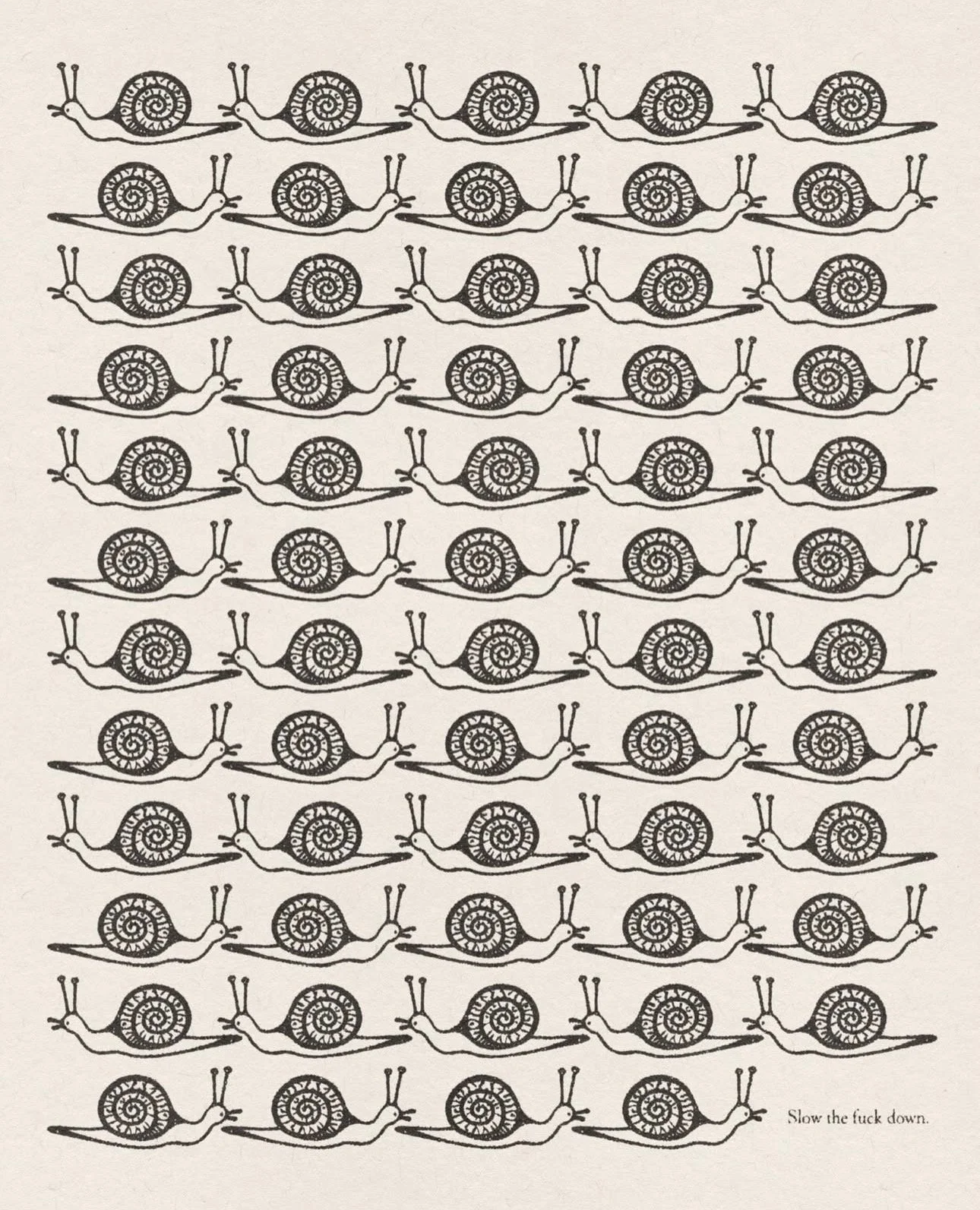
Image credit to the incredible @realfunwow
You're in back-to-back meetings from 9 to 4. The last one runs long. You glance at the clock and start mentally packing up — laptop closed, earbuds in, already triaging Slack. A colleague lingers after, camera still on, and starts to say something that sounds like it might be personal. Maybe about their kid. Maybe about something harder. Your cursor hovers over the "Leave" button.
You click it. You had to. There's a 4:15 you're already late for.
And in the car at 5:47, racing to get home before soccer practice pickup, you pass the school parent who always waves. You wave back, but you don't stop. You're doing math in your head — if I skip the store, I can defrost something, and that buys me eleven minutes — and by the time you pull into the driveway you've optimized a dinner plan so tight it could be a logistics case study, and you haven't actually talked to another human being in a way that counts since... when, exactly?
This isn't a dramatic moment. It's a Tuesday.
And the reason it matters is that these micro-decisions — click "leave," keep driving, skip the conversation, optimize the evening — aren't happening because you don't care. They're happening because the way most of us work and live has made it genuinely difficult to care in practice, even when we care deeply in principle. And there's a growing body of research suggesting that this gap between caring about people and actively caring for them is one of the most expensive things happening in workplaces and homes right now.
Rush Culture vs. Care For Culture
Most of the leaders, managers, and working parents I coach are good people who want to do good work. That part isn't in question. They want their teams to feel supported. They want their kids to feel seen. They genuinely care about the people around them.
And they are moving so fast that the caring can't land.
Researcher Zach Mercurio, who studies mattering at Colorado State University (and wrote The Power of Mattering for Harvard Business Review Press in 2025), draws a distinction that I think is crucial for understanding what's eroding both workplace engagement and family connection. Caring about someone is passive. Caring for someone is active. Caring about is knowing your direct report is going through a hard time. Caring for is the ten-minute conversation where you ask how they're doing and actually listen. Caring about is loving your kid. Caring for is being unhurried enough at bedtime that they feel safe telling you about the thing that scared them at school.
Active care — caring for — requires presence. It requires a moment where you genuinely believe, even briefly, that there is no better place for you to be than right here, with this person. And for many of us, that belief is in direct competition with a nervous system that's screaming you're behind, you're behind, move faster, you're behind.
Here's what this looks like when Rush Culture starts eating away at Care For Culture at work. Some of these might feel familiar.
Signs of Rush Culture in the workplace:
Back-to-back meetings with no buffer — no transition time, no hallway conversations, no unstructured human contact between one call and the next
Managers who know they should check in with their people but physically can't — the calendar doesn't have room, so the door stays closed, and the team reads that as "I don't care about you"
Slack and email replacing real conversation — faster, yes, but also stripped of tone, nuance, and the relational warmth that builds trust
"How's the project?" replacing "How are you?" — evaluative questions (closed, judging, output-focused) crowd out expansive questions (open, curious, person-focused)
Meetings that start on the dot and end on the dot — no lingering, no small talk, no "water cooler" moments where people actually connect as humans
Speed as a status signal — the busier you are, the more important you must be, and the less permission you feel to slow down
Other people's urgency becoming your urgency — living in the inbox, absorbing every "ASAP" as if the building is on fire, when most of the time, it isn't
Performance reviewed on output, never on connection — no one asks "does your team feel like they matter?" because it's not on the scorecard
If that list hit close to home, I'd be willing to bet some of these are familiar too:
Rushing your kids through morning or bedtime routines, barking instructions, watching their faces close up
Half-listening to your partner while you mentally run tomorrow's schedule
Feeling your body tighten when someone wants to talk because you're already behind
Choosing the efficient path every time — ordering instead of cooking, texting instead of calling, scrolling instead of sitting — because you're running on fumes
Optimizing your grocery route like there's a trophy for fewest repeated steps (there isn't, I've checked)
These aren't separate problems. The same nervous system driving your packed work calendar is running the show at home. The same internal taskmaster that won't let you linger after a meeting won't let you linger at the dinner table either.
Why We Default to Rush Over Care (And Why That's Backwards)
Here's the thing. Most of us default to Rush over Care For because — consciously or not — we believe that's what drives results. We treat caring as soft. As a nice-to-have. As something we'll get to after the work is done. Being exactly on time to the next meeting feels like professionalism. Staying two minutes late to ask how someone's doing feels like... indulgence?
But the data says we have this completely backwards.
The Gallup 2025 State of the Global Workplace report paints a stark picture. Global employee engagement dropped to 21% in 2024 — the steepest decline since the pandemic. And one of the Q12 engagement elements with the largest drop since 2020? "My supervisor, or someone at work, seems to care about me as a person." Only 39% of employees feel strongly that someone at work cares about them, down from 47% in 2020. Among Gen Z and younger millennial workers, the drop is even sharper — from 54% to 41% over five years.
And here's why that matters financially, if the human argument doesn't land in your next leadership meeting. Gallup's research shows that managers account for 70% of the variance in team engagement. Not the perks. Not the ping-pong table. Not the mission statement on the wall. The manager. And when engagement is high, Gallup's meta-analysis of over 82,000 business units finds that top-quartile engaged teams see 21% higher profitability, 17% higher productivity, and 10% higher customer ratings than bottom-quartile teams. Turnover in highly engaged organizations drops by 24-59%.
And turnover — the most visible symptom of people not feeling cared for — is one of the most expensive avoidable costs a company carries. Gallup estimates that replacing a single employee costs 50-200% of their annual salary, depending on role. For leaders and managers, that's roughly 200% of salary. For technical roles, 80%. I think of turnover like a trip to the Emergency Department — sometimes unavoidable, but it doesn't happen when things are going well. And it's vastly more expensive than the preventive care that would have avoided it.
So let me ask you this. If you worked at a company going through a rough patch — budget cuts, uncertainty, hard quarters — but you knew these people cared deeply about you as a human being, saw your unique strengths, and helped you apply them... would you stay? Would you get creative, take risks, work hard to help the company get through it?
Now imagine the same rough patch, but with nice, harried people who know nothing of real value about you. Who are too rushed to notice you're struggling, too packed to ask a real question, too efficiency-focused to slow down for the conversation that would actually matter. Would you stay and fight for that?
Most people wouldn't. And that's not a character flaw. It's a perfectly reasonable response to a culture that signals, through a thousand tiny micro-moments of rush, that you as a person are secondary to the pace.
Productivity and caring are not in competition. They are dependent on each other. We get this backwards all the time. And the irony is sharp — you'll never have time to be truly productive if you spend all day rushing around prioritizing "productivity." Real productivity comes from trust, clarity, creativity, and willingness to take smart risks. All of which require people to feel safe and cared for enough to bring their full brain to work.
Caring Deeply and Keeping Standards High
I want to be clear about something, because I think there's a fear that "prioritize caring" means "lower the bar." It doesn't.
Kim Scott's framework in Radical Candor maps this beautifully. Her two axes are Care Personally and Challenge Directly. The sweet spot — Radical Candor — is when you do both. You care deeply about someone as a human AND you're willing to be honest, direct, and have the hard conversations. Standards stay high. Maybe higher, because people actually trust the feedback.
When you challenge directly without caring personally, you get what Scott calls Obnoxious Aggression — the boss everyone dreads. But when you care personally without challenging directly? That's Ruinous Empathy — and it's where a lot of well-intentioned, rushed leaders live. They're too nice (or too time-pressed) to have the real conversation, so performance slides, resentment builds, and nobody grows.
This is the growth zone. High care and high standards. And getting there requires something that Rush Culture systematically strips away... time. Time to notice. Time to ask. Time to listen to the answer.
This is what I explore throughout the Good to Great workplace culture series — the idea that profits, productivity, and turnover are lagging indicators of how people feel about their work. And at the heart of how people feel about their work are two questions: Do you see me? and Do I matter?
Why Rushing Makes Us Less Capable of Caring
So if most people genuinely want to do good work, treat people well, and be present for the people they love — and I believe they do — what's getting in the way?
Three things, backed by research. And they all connect.
1. Hurry overrides values
There's a study from 1973 that I come back to constantly in my coaching and training work. Psychologists John Darley and C. Daniel Batson at Princeton took a group of seminary students — people literally training to be ministers — and told them to walk across campus to give a talk. Some were told the talk was about the parable of the Good Samaritan. Along the route, researchers placed a person slumped in a doorway, coughing and groaning, clearly in distress.
The variable that predicted who stopped to help? Not their personality. Not their values. Not even what they were about to talk about. Just whether they'd been told they were late.
Among students who were unhurried, 63% stopped. Among those in a moderate hurry, 45%. Among those who'd been told they were running late? Only 10% stopped. Some literally stepped over the groaning person.
(Darley & Batson, 1973, Journal of Personality and Social Psychology.)
This is not a study about character. It's a study about conditions. The environment — the rush — overrode deeply held values. And I think that's one of the most compassionate and important findings in social psychology, because it means that when you blow past the colleague who needed something, or snap at your kid in the morning rush, or can't seem to slow down enough to ask your direct report a real question... the problem probably isn't that you don't care. The problem is that your conditions aren't allowing care to show up.
2. Mattering requires presence, and presence requires time
Mercurio's mattering framework identifies three components: noticing, affirming, and needing. To make someone feel like they matter, you need to (1) notice them specifically — not just as a role or a task, but as a person, (2) affirm their unique contribution, and (3) convey that you need them — that if it wasn't for them specifically, something would be missing.
All three require attention. All three require time. And in Rush Culture, all three get squeezed out.
Mattering is also different from belonging, a distinction worth sitting with. You can belong to a team, to a family, to a community, and still feel invisible within it. Mattering means someone noticed you specifically. That's a different experience.
Gordon Flett at York University has studied the flip side — what he calls "anti-mattering," the experience of feeling unseen, insignificant, like you don't make a difference. His research links anti-mattering to depression, anxiety, loneliness, and insecure attachment. And anti-mattering isn't just the absence of being valued. It's a distinct psychological experience — the active sense that nobody would notice if you weren't here.
When you're rushing through your workday, cycling through tasks and meetings on autopilot, it's easy to accidentally generate anti-mattering in the people around you without knowing it. Not because you're indifferent, but because noticing people requires a gear your nervous system can't access at full speed.
This is something I see constantly with leaders who genuinely want to do right by their people but whose calendars and cultures make active caring nearly impossible. They know the behaviors. They've read the books. And the environment won't let them practice what they know. That's an incredibly frustrating place to be, and it erodes their engagement too.
3. Rushing keeps your nervous system locked in a state that blocks connection
Here's the physiology, because I think it explains a lot.
When you're hurrying — even the low-grade, background-hum kind of hurrying that many of us have normalized — your nervous system shifts into sympathetic activation. Fight-or-flight mode. Cortisol rises. Your attention narrows to tasks and threats. You're scanning for what needs to be done, not for who needs to be seen.
And the cruel part is that genuine social connection — the kind where someone actually sees you, where you slow down enough to see them — is one of the most powerful cortisol regulators we have. Heinrichs et al. (2003) found that social support combined with oxytocin produced the lowest cortisol concentrations and the highest reported calm during stress (Biological Psychiatry). Connection doesn't just feel nice. It literally shifts the body's stress chemistry.
So the loop looks like this: We rush → cortisol stays elevated → we become less capable of noticing and connecting → we miss the connection that would have actually lowered our cortisol → we feel more depleted → we rush harder.
And here's what's easy to miss — your body reads its own signals. If your jaw is clenched, your shoulders are up by your ears, your breathing is shallow, your pace is fast... your brain interprets all of that somatically as threat. It doesn't matter that you're just walking to a meeting or loading the dishwasher. Your nervous system hears "EMERGENCY" and responds accordingly — more cortisol, more narrowed focus, less capacity for warmth.
This is what I mean in the Forest Fire Model of burnout when I talk about wind — the accelerating conditions that fan every spark into a bigger flame. Chronic hurry is wind. It doesn't cause burnout on its own. But it makes everything else burn faster, and it dries out the connection and self-compassion that would otherwise act as firebreaks.
And we can't care for ourselves when we're rushing, either. Self-compassion requires the same slowed-down nervous system that compassion for others does. If you're moving too fast to notice your colleague struggling, you're also moving too fast to notice that you're struggling.
A Personal Note on Being an Acela with a To-Do List
I'll be honest about this: rush is my baseline setting. I didn't fully appreciate how deep it went until I started mapping my own burnout patterns, and I realized the constant acceleration wasn't just a work habit. It was an identity.
Having kids and two jobs means that if I don't actively choose otherwise, a vast amount of my brain space goes to solving unnecessary puzzles: How do I rejigger my grocery list to navigate the store with the fewest repeated steps, as if there's an award? How do I sequence my morning tasks — vitamins, tea, breakfast, the random to-dos I shove into "waiting slots" — so no task sits at "done" for too long before I advance it to the next phase?
My inner monologue, for years, was basically Andy Grove. I read Only the Paranoid Survive and High Output Management at pivotal developmental moments in my early career, and I've been scanning for ekes of efficiency ever since. Grove was a fellow Hungarian (where are my paprikás people at!?) and a Jewish survivor of the Nazi occupation and the 1956 Hungarian Revolution. His paranoia was born from surviving actual life-threatening circumstances, and it was the engine that built Intel. But his was not my life context, and the extra paranoia that saved him was... not the dose I needed to find peace and success in mine.
At work, I was ordering and re-ordering tasks, living in my inbox, rapidly absorbing other people's urgency — urgency that may or may not have been real. At home, I was moving through the world like a cross between an Acela train and a shark that cannot stop moving or else it dies. And it was costing me the very things I said I cared about most.
I see this in almost every client I work with, and in many of the leadership teams I train. Not because they're failing at being human. Because they've been rewarded for speed for so long that slowing down doesn't just feel inefficient. It feels dangerous.
Four Small Experiments (Not Obligations)
These aren't prescriptions. They're experiments — things to try and notice what happens. None of them take more than a few minutes. All of them are informed by research and by what I've seen work with my coaching clients and corporate training groups.
1. Create water cooler moments on purpose
In remote and hybrid work, the moments of spontaneous human contact that used to happen naturally — hallway chats, coffee runs, lingering after meetings — have been engineered out. In virtual meetings, there's a "Leave" button. You can exit without ever having an unstructured human moment all day.
At work: Try arriving to one meeting this week 2-3 minutes early with your camera on. Or stay 2 minutes after. Not with an agenda. Just present. Ask someone how their weekend was and actually listen.
At home: Sit at the table for five minutes after dinner instead of immediately clearing. Be in the room when your kid is doing homework, not doing anything, just... there.
Presence signals safety to other people's nervous systems. It says I'm not going anywhere right now. You can unfold.
2. Ask one real question per day
Mercurio distinguishes between evaluative questions (closed, judging, output-focused — "Did you finish that?" "How was school?") and expansive questions (open, curious, person-focused — "What was the hardest part of your day?" "What are you working through right now that I might not know about?").
At work: Replace one status-check question with a genuine curiosity question this week. Not "Is the report done?" but "How are you feeling about the project?"
At home: Replace "How was school?" (which always gets "fine") with "What's something that annoyed you today?" or "Who made you laugh?"
Expansive questions signal: I'm interested in you, not just your output. And they tend to generate the kind of conversation where people actually tell you things.
3. Notice the invisible people
Some of Mercurio's early mattering research focused on custodial staff — people who are physically present in a workplace every day but functionally invisible. When leaders simply noticed these workers — learned their names, acknowledged their presence, said something specific — it shifted the relational texture of the whole environment.
At work: Who in your orbit do you walk past without seeing? Reception, IT, the junior team member who's always in the meeting but never speaks? What would it look like to acknowledge them this week, even briefly?
At home: Sometimes the "invisible" person is your partner, who's being "easy" and therefore not getting attention. Or your kid, who's being quiet and therefore being ignored. Noticing isn't a grand gesture. It's "Hey, I see you're reading that book. Tell me about it."
Flett's anti-mattering research shows that being unseen — not excluded, just unseen — is a distinct psychological risk factor, separate from loneliness. It's worth paying attention to who might be experiencing that around you.
4. Notice what happens in YOUR body when you try to slow down
This is the self-compassion piece, and it's the one most people skip.
The experiment: At one point today — maybe in the car, maybe walking between meetings, maybe standing at the counter making dinner — intentionally slow your pace by about 10%. Not a dramatic shift. Just a gear down.
And notice what happens. Does anxiety spike? Does guilt show up? Does your brain immediately start listing all the reasons you can't afford to slow down?
That reaction is information. It tells you something about what your nervous system believes about speed, about worth, about what happens when you stop producing.
Now try this: relax your belly. Take one full breath — not the shallow kind you've been running on, but a real one. Unclench your jaw. Let your eyebrows ease. Notice what that feels like.
If you've been running in sympathetic activation for a long time, even these small somatic shifts can feel surprisingly good. Because your nervous system senses safety not just from external cues, but from internal ones. When your body isn't clenched and rushing, your brain gets a different message. Not "EMERGENCY." Something closer to okay, we're alright for now.
These experiments map to the early stages of my FLOURISH burnout recovery framework — Face Reality with Compassion (noticing the pattern without judgment) and Listen to Your Body (paying attention to the physiological signals you've been overriding). Chronic hurry, in the Forest Fire Model, is wind — the accelerating factor you might have the most control over and the least willingness to address. Because addressing it means sitting still. And sitting still means feeling whatever you've been outrunning.
Why Slowing Down Alone Isn't Enough
You can slow down your morning. You can leave buffer in your calendar. You can ask better questions and notice invisible people and breathe more fully. These things genuinely help.
And for some of us, they won't stick.
Because underneath the rush, there might be a set of beliefs that are hard to override with behavior alone. Beliefs like: I'm only valuable when I'm producing. Or if I slow down, everything falls apart. Or nobody else is going to handle this if I don't. Or the one I find in almost every hyper-independent, over-responsible person I work with: speed equals competence equals worth equals safety.
If slowing down triggers a knee-jerk "I can't waste time" response — notice that voice. It probably isn't new. For many of us, the urgency template was set long before this job, this family, this packed Tuesday. We learned somewhere that moving fast kept us safe, or noticed, or worthy of help. And our nervous system has been running that program ever since.
This matters because the cost of Rush Culture isn't always big and obvious. It's more like a small tax you constantly pay. A missed connection here. A snapped response there. A closed office door. A kid who stops trying to tell you things because you always seem too busy to listen. A direct report who quietly disengages because they've learned that "cares about me" isn't really part of this culture, no matter what the values poster says.
The behaviors alone won't stick without the inner work. You can slow your calendar, but if your nervous system still believes that slowing down is dangerous, it will speed you back up. You can learn all the right questions to ask, but if you don't genuinely believe — even for a moment — that there is no better place for you right now than with this person... they'll feel the difference. People always do.
In my own burnout recovery, the Forest Fire Model helped me see that the wind — the constant acceleration — was the factor I had the most control over and the least willingness to change. Because slowing down didn't just mean being less efficient. It meant sitting with feelings I'd been outrunning for a long time. And that's uncomfortable. It probably gets worse before it gets better.
And that's where a blog post reaches its honest limit. Recognizing the pattern is one thing. Changing the beliefs underneath it — the ones your nervous system has been running since long before this career or this family — is different work. It usually requires someone to slow down with you. To hold the mirror. To help you tolerate the discomfort of doing less while the world keeps spinning.
If You Recognized Yourself Here
I've been thinking about Mercurio's observation — that hurry and care can't coexist — and how it applies to teams, to families, and to the relationship you have with yourself.
If any of this landed — the packed calendar, the optimized grocery run, the colleague you should have asked about, the kid who's stopped talking — I want you to know that recognizing the pattern isn't evidence that you've been doing it wrong. It's evidence that you've been operating in conditions that make active caring really, really hard. And you've been doing your best inside those conditions. Noticing is how things start to shift.
If you want to bring this conversation to your team or organization, I'd love to explore that. I have the privilege of traveling to several client sites for speaking and training in 2026, and a few slots are still open. These aren't lectures — they're interactive sessions where teams build a shared language for what's actually happening in their culture and leave with concrete tools.
If you're more in a "I want to figure out my own patterns first" place, a discovery session is a good way to start. No commitment, just a conversation about what you're noticing and what might be possible.
And if this resonated and you know someone who needs to read it — the friend who's always "fine" and always in a rush — my referral program is the easiest way to share.
