
You Already Know Something Isn't Working: How and Why to Face Reality With Compassion

The F in FLOURISH: Face Reality With Compassion
"Baby, it's not been just a few hard days. I think it's been six hard years. And now you're exhausted from trying so hard. But you have no idea how to not try so hard, and you're terrified of what that could mean."
I said this to one of my kids recently, on a morning when the accumulated weight of years of trying to be someone they weren't finally became too heavy to carry. I'm keeping the details vague to protect their privacy, but what I can tell you is this: the moment I said it out loud, something shifted for both of us. We didn't have a plan or a solution — just the relief of having named the pain. And the relief wasn't just from naming the reality. It was from naming it without blame. Without "why did you wait so long" or "look what you've done to yourself." Just: this is what's true, and it makes sense, and you're not bad for being here.
I've heard versions of that same exhaustion dozens of times in my coaching practice, from accomplished, capable, high-functioning people who have no idea that what they're carrying has a name.
It sounds like: "I know something has to change. I just don't know what. Or how. Or whether I even have the bandwidth to figure it out." Or: "I've been telling myself it's just a busy season for about four years now." Or it sounds like nothing at all — just a growing flatness, a Sunday dread that now starts on Thursday, a creeping sense that the things you used to care about have gone a little gray.
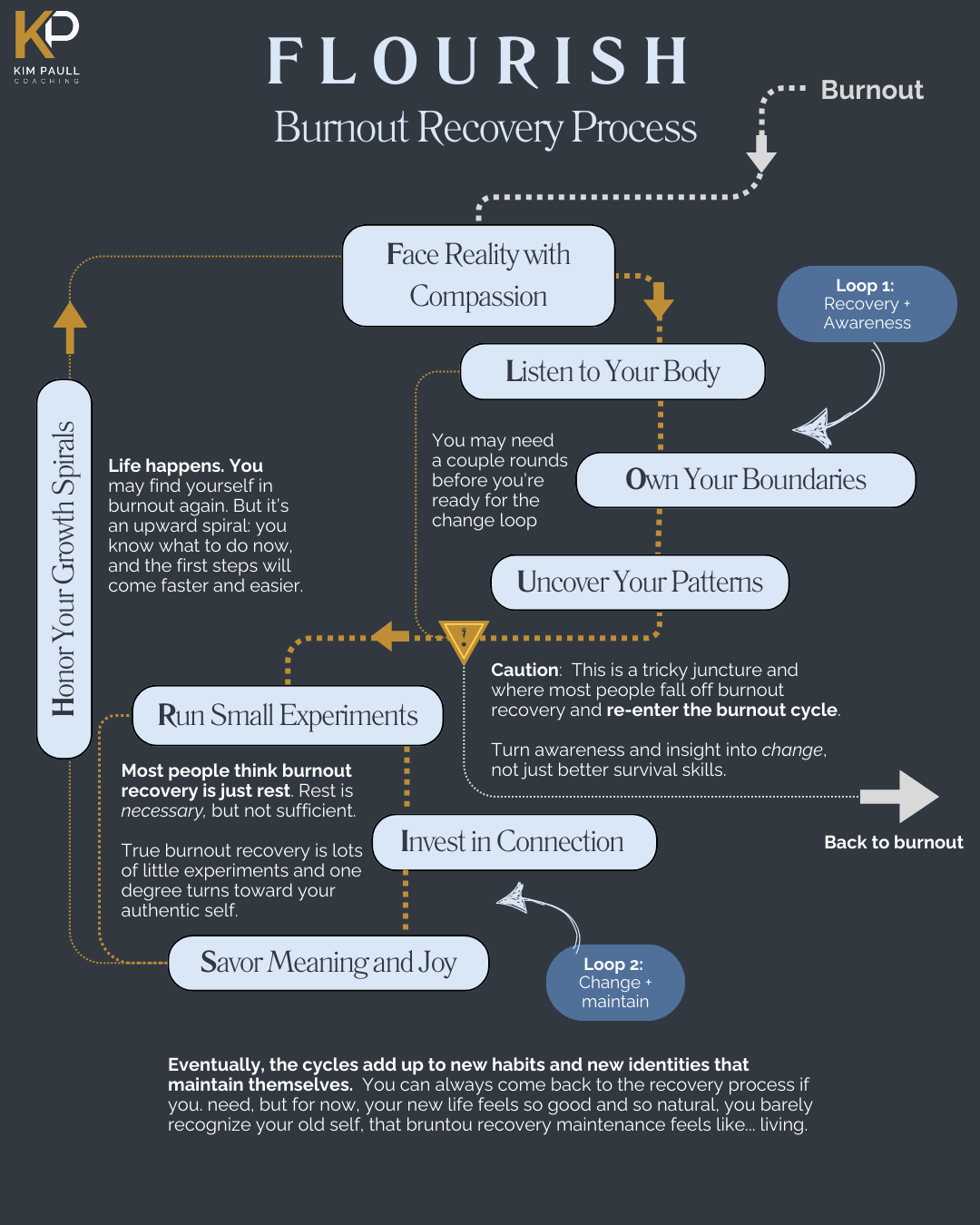
That's the F in FLOURISH — the first and most important step in burnout recovery. Face Reality with Compassion.
Maya Angelou said that courage is the most important virtue, because without it, none of the others are possible. F works the same way. You can't listen to your body, own your boundaries, uncover your patterns, or build anything new until you've allowed yourself to honestly acknowledge what's actually happening and believe yourself. Not manage it, not explain it away, not fix it — just see it.
Both words in that phrase are doing essential work. Face Reality. With Compassion. And it turns out both halves are much harder than they sound.
Most People I Work With Have Read the Books
Here's something that surprises a lot of people: most of the clients who come to me don't call what they're experiencing burnout, at least at first.
They call it stress, or exhaustion, or just "a lot going on." They're often highly intelligent, well-read people. But burnout comes with stigma — the quiet fear that you're giving up, or you're weak, or the most common one: "everyone's burned out, what's the big deal?" Even after I share the research, including Christina Maslach's three dimensions of emotional exhaustion, cynicism, and reduced effectiveness, they may nod and say "yeah, I guess so?" without really believing it's worth addressing specifically — not just as stress, but as the physiological, cognitive, and emotionally depleting response to it's been too much for too long.
That's because burnout really has been normalized. And because facing it honestly means contending with some complicated feelings. Shame, often. Guilt. The gnawing sense that you should have been able to handle it. Or, in the other direction, the helplessness of "I can't just stop being a parent" or "finding a new job in this economy feels impossible" or "nobody listens to me at work anyway, so what's the point of saying anything?"
These aren't excuses. They're real. And they're exactly why "Face Reality" only gets you halfway there without the second half of the instruction.
Burnout isn't often dramatic. It can be mundane. It looks like:
Knowing you're stretched too thin but telling yourself it's just a busy season (every season)
Saying "I'm fine, just tired" often enough that you start to believe it
Trying to fix the feeling by optimizing your schedule, your routine, your habits — and feeling vaguely betrayed when it doesn't hold
Sensing that something deeper is wrong but deciding it's not the right time to deal with it (it's never the right time)
Feeling a flash of recognition when someone describes burnout, and then quickly categorizing yourself as "not that bad yet"
Research on burnout consistently shows that it hits hardest in people who care deeply, not people who don't. The folks who burn out aren't the ones who stopped trying. They're the ones who kept trying past the point where their system could sustain it, and then couldn't figure out why trying harder wasn't fixing it. If you're uncertain whether what you're experiencing is stress, burnout, or something else, this post is a useful place to start.
Your Brain Is Doing What It’s Supposed to Do
Here's something that gets skipped in most conversations about burnout: it's designed to keep you stuck.
Your nervous system's job — its one irreducible job — is to keep you alive. Not creative, not joyful, not growing. Alive. When you've been running on depleted resources for long enough, your system starts conserving energy by narrowing your view. The brain under chronic stress has reduced activity in the prefrontal cortex, which handles long-term planning, creative thinking, and the ability to imagine a different future. As I've written about before, burnout isn't random — it's a biological process with a map. But part of what it does is obscure the map from you.
So when burnout tells you "nothing you try will make a difference," it may not be accurate — but it is purposeful from the survival brain's perspective. Effort takes energy. Change means risk. Even if that change is the only way out. Which is part of why it can be so helpful to work with a therapist, coach, or trusted person outside your own head, because the messages you get from survival-brain are designed to be very convincing.
It's the equivalent of a phone at 3% battery shutting off the camera before the app even loads. The option is still there. The system just decided you can't afford it right now — and doesn't know a charger exists.
This is why the standard advice — take a vacation, exercise more, try therapy, meditate — only goes so far. Those things have value. But if you're still operating in the conditions that created the burnout, the nervous system registers no change in the threat level, and the conservation mode stays on.
The psychotherapist James Hollis writes that what makes large change so disorienting is that "the fact of our being out of control is no longer deniable." That's a pretty accurate description of what it feels like when you stop managing burnout reality and actually stay with a moment of "I just can't do this anymore." For people who are used to being competent, capable, and in control, that moment of genuine acknowledgment can feel scarier than the burnout itself. Because at least with burnout, you're still in the story of trying. Acknowledging means something has to change. And when you're depleted, your system doesn't yet know whether you can afford that.
The Behavior Patterns Are More Honest Than the Thoughts
Because burnout can hide even from the person experiencing it, it's sometimes more useful to look at patterns than feelings. Thoughts under burnout can be unreliable narrators. Patterns are harder to rationalize away.
Some things that might be worth sitting with:
You're managing, but it costs more than it used to. Getting through the day, being present with your family, doing good work — these are still happening. They just require more effort than they once did. What used to feel like your natural capacity now feels like a performance you're maintaining.
Your world has been quietly getting smaller. You've stopped doing things you used to love. You've been saying no to things that once felt easy. You're spending more time in low-stimulation activities that aren't quite restoring you, but at least don't demand anything.
You oscillate between "I should be grateful" and "I cannot do this anymore." Both feel true at different times. Holding both simultaneously is exhausting in its own right.
Change feels pointless before you've even tried it. Good suggestions get filtered through a lens of "yeah but that won't actually work for my situation." This isn't cynicism as a personality trait. It's one of Maslach's three burnout dimensions: reduced sense of personal effectiveness. The feeling that your efforts don't matter is a symptom, not a conclusion.
You've had the "I need to change something" realization before and gone back to normal. Multiple times. And each time you went back, something in you quietly logged another data point: "See? Nothing changes."
If you catch yourself saying "I just can't do this anymore" — believe yourself. That voice is data.
Step One Is Both Harder and More Powerful Than It Sounds
My FLOURISH model for burnout recovery has eight steps. The first is F: Face Reality with Compassion.
It sounds gentle (maybe? If you’re an intellectualizer, it might). But it isn't always.
F doesn't mean you have a plan. It doesn't mean you know what needs to change, or have the energy to do anything about it. It just means being willing to say — to yourself, out loud, ideally with someone else who can hold it with you — "this isn't working. I don't know how to not do this, but I know I don't want to keep doing this."
In other words, F doesn't have to mean "Found my peace" or "Found the solution!"
It can just mean F*ck. Or F*ck it. Or "I have no answers, no plan, but I am done pretending this is Capital F Fine."
That's it. That's the whole first step. A tentative, exhausted "yeah, okay, I guess."
I remember when I finally began to face the reality of my own whole-life burnout. Up until that point, I'd had all manner of socially acceptable anxieties and coping mechanisms covering up an inner dread that I was on the wrong path. I resisted admitting how out of whack I felt because that seemed like giving up, and I was no quitter. But more honestly, I had no idea how to change things without just rearranging deck chairs and ending up exactly where I started, now with color-coded lists.
Then I read about Martha Beck's Change Cycle, drawn from her book Finding Your Own North Star. The first square is what she calls "death and rebirth" — or, more memorably, "bug soup." It's the square where your old identity is dissolving and you haven't yet formed a new one. Everything feels uncertain. Nothing makes sense. Beck's rule for navigating this square is deliberately disorienting: "This makes no sense and I'm okay."
Most people hate this square. There's no plan, no clarity, no evidence that anything better is on the other side. It feels like loss without a destination. Like falling.
Though — to paraphrase a famous idea — accepting a hard reality without resisting or justifying or rationalizing it, just radically accepting it, can feel like falling, but then recognizing that there's no bottom.
In other words: it can start to feel like flying.
Brad Stuhlberg, in Master of Change, writes about how real transformation requires moving through a middle state of disorientation — where the old normal is gone and the new one hasn't arrived yet. The failure mode isn't the disorientation itself. It's trying to escape it before you've actually been through it, by snapping back to the old patterns that feel safer, even when they stopped working.
One client courageously faced the reality of not just burnout, but the effect her burnout had had on her relationships – pain projected at others, which is so normal when we are squeezed and feel trapped and seek control, or just to vent the pressure.
At the end of our engagement, she said, "I learned how to say to myself, 'you're safe, you're going to figure it out, you don't have to solve it right this second.' And then realizing that everyone around her was changing too:
“I feel like I'm on a growth journey at the same time as some of the people I'm closest to, and I don't feel embarrassed or ashamed about it. Are they responding positively because they're growing, or because I'm learning how to communicate better? It's probably both — and it doesn't matter. It's a positive feedback loop."
That arc — from scared to acknowledge, to discovering that acknowledgment was the door — is a pretty faithful map of how F tends to go. The scary part isn't the work that follows. It's allowing the first honest statement to actually land.
F isn't a decision point. It's more like a release valve. Years of maintaining a version of reality that isn't quite true — "I'm fine," "it's just a busy season," "I can manage" — requires actual energy to sustain. Maintaining cognitive dissonance, holding two contradictory things as simultaneously true, is physiologically taxing. When you finally allow the other truth to be spoken — even quietly, even to one person — something in the body often responds. A yawn, a long exhale, a kind of relief that surprises you.
Back to my kid. After years of trying hard to conform to something that didn't fit, they hit a wall of panic and pain one morning. Between breathless sobs, an acceptance that this wasn't a hard couple of days — it was a hard five years, more than half their life. And then a tentative, exhausted "yeah, good I guess" when I asked if it might feel better to just be honest about who they are. That "yeah, good I guess" was the first brick in something that had seemed impossible to build until that moment. Their body knew it too — the long exhale, the double inhale of someone who's cried their eyes out, the physical release of years of tension. Not relief exactly. More like: okay. We finally set down what we can no longer carry. We can work with whatever this is now.
Your F doesn't have to be as dramatic. The burnout version of this moment is often much quieter. It might sound like admitting — to a coach, a partner, yourself — "I've been telling myself it's fine for a long time and I don't think it's fine and I want some help." That can be enough.
Why "...With Compassion" Is So Important, Neurologically
Here's what gets left out of most conversations about facing reality: facing it harshly doesn't actually work.
Most people who come to me have already faced their reality, in some sense. They've had plenty of moments of brutal self-awareness: I'm a mess. I should be handling this better. Other people manage, why can't I? That kind of reckoning isn't facing reality with compassion. It's facing reality with a verdict. And it tends to produce the opposite of change — shame, shutdown, or a desperate sprint back to the coping mechanisms that keep the feelings at bay.
Kristin Neff, who has spent decades researching self-compassion at the University of Texas, defines it as being supportive toward yourself when you're experiencing suffering — whether that suffering comes from your own mistakes or from external circumstances that weren't your fault. It has three components: self-kindness (treating yourself with warmth rather than judgment), common humanity (recognizing that struggle is a shared human experience, not evidence of personal failure), and mindfulness (staying with the feeling without dramatizing it or pushing it away). Her research, and that of her colleagues, consistently shows that self-compassion is linked to reduced burnout, greater resilience, and — critically — more motivation to change, not less. The myth that being kind to yourself leads to complacency turns out to be just that: a myth.
Brené Brown's research on shame offers a useful companion frame. Shame, she's found, needs three things to thrive: secrecy, silence, and judgment. Self-compassion — with its emphasis on openness, common humanity, and non-judgment — is essentially the direct antidote to all three. Which is why facing reality without compassion often leaves people stuck in shame rather than moving through it.
This matters in practice because the reasons people can't face their burnout reality are almost always compassion problems, not information problems. They already know something is wrong. What they're stuck behind is one of these:
Shame about how they got here. "I did this to myself." "I should have said no sooner." "I made the wrong choices and now I'm paying for them." These thoughts feel like accountability but they're actually just punishment — and punishment doesn't produce change, it produces hiding.
Guilt about who their burnout affects. "My kids deserve better." "My team is suffering because of me." "I've let everyone down." This is real, and it matters. But guilt that spirals into shame stops being useful data and starts being a wall.
The belief that nothing can actually change. "I can't just stop being a parent." "I can't leave this job in this economy." "Nobody at work is going to listen to me." These feel like facts. Under burnout, they usually feel like permanent facts. Some constraints are genuinely real. What compassion does is help you separate the actual constraints from the ones your exhausted nervous system has decided are fixed.
I worked with a client once — a mother, warm and creative and funny and genuinely gifted, who had spent twenty years in a marriage that was dismissive, belittling, and at its worst, abusive. She'd finally left. Years out from her divorce, she was still carrying something she didn't know what to do with: rage. It would flare at her kids, and then she'd feel crushing guilt, and then shame, and then she'd try harder to manage it, and it would flare again.
When I reflected back to her: "You lived in a desert of connection for twenty years," she crumpled and sobbed. Yes. She had. And that reframe — from "I'm a rageful, bad mother" to "I'm a person who survived something depleting, and my nervous system is still carrying the weight of it" — didn't excuse the impact on her kids. It actually made it possible to address. Because she could hold accountability for the ruptures without collapsing into shame. She could apologize and repair in ways that were genuine and age-appropriate — because she understood what had happened well enough to explain it honestly, to herself first. She could work on the anger because she finally understood where it came from, and she could stop spending all her energy managing the shame long enough to do something useful with the information.
That's Face Reality with Compassion. The full version. Not "it's not your fault, you're wonderful" or “It’s really bad, you better get your life together, now” — but "here is what actually happened, here is what it cost you, and here is what was understandable about how you survived it, and here’s a reminder that you’re not the only person who’s every been here." From that place, change becomes possible. From shame, it usually isn't.
“I tell you this
to break your heart,
by which I mean only
that it break open and never close again
to the rest of the world.”
The poet Mary Oliver wrote about being broken open as a way of becoming — not as damage, but as the precondition for receiving something that couldn't get in before. Self-compassion isn't soft. It's what makes the opening survivable long enough to be useful.
Surrender Gets a Bad Rap
We tend to associate surrender with giving up. With weakness. With defeat. It isn't any of those things.
Surrender, in this context, means stopping the active effort to fix, problem-solve, control, or make sense of something that you haven't been able to fix by fixing it. It means loosening the grip on the version of reality you've been working to maintain.
There's actually research on this. Studies on resilience consistently show that one of its most predictive characteristics is the capacity to ask for and receive help — specifically because help-seeking bridges people from disorder to new order when their own reserves are exhausted. Asking for help when you're already depleted is hard for most people who've burned out, often because hyper-independence got wired in so early it feels like identity. Surrender chips at that.
It's also worth naming that the consciousness that creates a problem can't always solve it. Survival mechanisms work brilliantly – until they don’t, and we don’t always know what comes next.
You've been inside your situation, with your particular combination of history, beliefs, and nervous system responses, for a long time. It's a feature of being human. Sarah Peyton, therapist and author of Your Resonant Self, describes a resonant witness as someone who can hold your experience with warmth and genuine attention — who can reflect reality back to you in the doses you can actually take in. That's sometimes a therapist. Sometimes a close friend, a coach.
The reason F is so much easier with someone else present isn't that you can't do it alone — it's that your own cognition under burnout is often depleted and unreliable, and an outside perspective, offered with compassion rather than judgment, can see what you can't.
The Window Doesn't Stay Open
Here's something I've observed across many coaching conversations — including some I've had with myself: people have moments of clarity around burnout fairly often. Stuck in the car, unable to make the transition to work or home. The full-week dread of the Sunday dread. The middle-of-the-night reckoning. And then they go back to normal. Not because they're weak or in denial, but because normal is right there, with all its familiar demands and all its familiar voices — "you can manage," "it's just a few more months," "other people have it worse" — and the window closes.
There's a body of research on what's called plasticity-rigidity cycles — the science behind why systems, including human beings, are most open to change in transitional states, and progressively less so as new patterns solidify. Early in a disruption, the brain is in a more plastic state: receptive, reorganizing, genuinely open to new input. This is the state you're in after a breaking-open moment. Over time, as the familiar patterns reassert themselves, that plasticity gives way to rigidity — the new normal calcifies, and the hassle of change starts to feel not worth it anymore.
It's the same reason real estate agents tell you to fix everything you don't like about a new house within the first six months of moving in. After that, you've adjusted. The thing that drove you crazy becomes invisible. Your brain has filed it under "this is just how things are." It's the same reason advertisers specifically target new homeowners, the newly pregnant, people going through major life transitions — because people at transition moments are genuinely more open to trying new things. That window is real, and it closes.
Rahm Emanuel famously said "never waste a crisis" — and while that phrase has a complicated history, the underlying observation isn't wrong. Moments of genuine disruption carry a particular kind of openness that more stable periods don't. The question isn't whether to feel the disruption. It's whether to use it.
Elizabeth Lesser, in Broken Open, writes about transformation as both inevitable and available — but not always waiting forever. You don't have to act on everything all at once. But sitting with the acknowledgment — staying with "this isn't working" long enough to really let it register — matters.
Don't waste a surrender. Don't waste an epiphany.
This is also what hurry culture steals from us — the pace at which we move through our lives doesn't leave much room for the F moment to settle. We get to the edge of acknowledgment and pivot back to productivity, because sitting in disorientation feels like wasted time. It isn't.
Where to Go From Here
A blog post can point toward the F. It can name the pattern, offer some science and a framework, and hopefully provide a little relief at being seen. But actually moving through F — staying with it, not closing back up, and holding it with enough compassion that you don't spiral into shame and back out — is much harder to do alone. Partly because the voices that want you to go back to normal are inside your own head. Partly because your nervous system under burnout doesn't trust itself, and having a resonant witness — someone outside your system who can hold it with you — makes it genuinely easier to stay present to what you're acknowledging rather than retreating from it.
One more thing worth saying: burnout resilience coaching doesn't require you to be crispy burned out. You don't have to hit the wall. F just requires you to have come face to face with the fact that something isn't working, that you want it to be different, and that you're open to some help. You want to do big things without losing your mind — and somewhere in you, you know that at this rate, you might lose something important. That's enough. That's the beginning.
If what you've read here sounds more familiar than you'd like, there are a few places to go next. The Personal Burnout Map is a free download that can help you start to see your fire more clearly — what's burning, what's fanning it, what your underlying conditions are. If you're wondering what working together would look like, the Regenerate and Relaunch program is built around the full FLOURISH arc, starting right here at F. And if you're more of a "let's talk first" person, there's always a free discovery session — no pressure, just a real conversation.
If you're not ready for any of that yet, that's okay too. Sometimes the most useful thing this moment requires is sitting with the fact that something in this post sounded familiar. Noticing that. Letting yourself notice it without immediately doing something about it.
That might be the first brick in something new.
Know someone who needs to read this? Send it their way — or learn about the referral program.
