
Why You Keep Canceling on People You Love (The I in FLOURISH, #5 in the series)
The text has been sitting in your drafts for three days.
It's not a complicated text. It's just "hey, when are you free?" to someone you genuinely miss, someone you think about when something funny happens, someone who'd absolutely show up for you if you called at midnight. But you haven't sent it. And if you're honest, you probably won't. Because by the time you sit down to send it, the moment has passed, your window has closed, and it just feels like too much.
Not the text. The whole thing. The logistics of coordinating schedules. The energy of showing up and being present and having a real conversation when you have nothing left. The guilt of knowing you've already canceled twice. The quiet fear that you've been gone so long you might not fit the same way anymore.
So you close the phone. Put on the show. And feel a little more alone.
This pattern — the retreating, the fading, the slow cancellation of the social life you used to have — is one of the quieter symptoms of burnout. Not the splashy ones, like the snapping or the crying in your car or the inability to make a decision about anything. Just a steady narrowing of your world. And the thing nobody mentions is that this narrowing feels like you. It feels chosen, even reasonable. Like you're being responsible with your limited energy. Protecting people from your depleted self.
What's actually happening is more interesting, and honestly more forgivable, than that. But it does require a look at the mechanism — because once you see it, the canceling starts to make a different kind of sense.
This is the I in FLOURISH — Invest in Connection. And it comes later in the recovery arc for a reason.
How Burnout Shrinks Your World
There's a version of this I hear in some form from almost everyone who finds their way to burnout coaching. The specifics vary — it's a canceled girls' trip, or the friend group chat that's gone unreplied-to for a week, or the standing dinner date that quietly stopped standing. But the shape of it is usually the same.
At some point, under pressure, you started triaging. Work stayed. Family obligations stayed (you didn't have a choice). Sleep barely survived. But friendship — real, reciprocal, effort-requiring friendship — slipped off the list. It wasn't dramatic. There was no announcement. Just a series of small cancellations, each completely justified in the moment, until you looked up and realized you couldn't remember the last time you talked to someone who actually knew you.
And by the time you noticed, you were probably too exhausted to do anything about it.
A few things tend to compound this. Hyper-independence, which a lot of high-achieving people develop early as a survival skill, makes receiving help or initiating connection feel both exposing and unnecessary. If you've been running on "I've got it, I'm fine, I don't need to make this anyone else's problem" for long enough, reaching out can feel weirdly vulnerable — almost embarrassing. Like an admission of something you're not supposed to admit.
Add in the structural reality that many of my clients are navigating: full-time work, some version of the default parent role, aging parents, and a social landscape that has genuinely become harder to navigate. The atomization of American life — fewer neighborhoods where people know each other, fewer third places, more commutes and screens and solo activities — is real and documented. It's not a personal failing that making friends feels harder than it used to. It's a systems problem wearing a personal face.
But here's the part I want to sit with longer, because I think it matters more than the logistics. Burnout is not neutral in how it shapes your perception of connection. It actively distorts it.
Burnout Narrows Your Social World the Most
When your nervous system has been in chronic threat-detection mode — which is what sustained burnout essentially is, a prolonged activation of your stress response — it starts making decisions about resource allocation. And those decisions are not friendly to your social life.
The stress hormones flooding your system (primarily cortisol, which chronically elevated looks very different from the useful, short-burst version) signal your brain to conserve. To simplify. To pull in. Research on the neuroendocrine mechanisms of loneliness shows that chronic stress activates what's sometimes called the "conserved transcriptional response to adversity" — a biological shift that upregulates inflammation and downregulates the reward-seeking pathways involved in social connection. Your brain, running in scarcity mode, starts treating social effort as a luxury it can't currently afford.
In other words, burnout tells your brain that people are expensive. And your brain, in its exhausted wisdom, agrees.
This is why the most depleted people often describe social interaction as something that sounds appealing in theory but actively costs them in practice. You genuinely want to see your friend. And yet when the day comes, something in you resists — and not just because you're tired. It's that your stress system, optimized for isolation and conservation, is reading "social engagement" the same way it reads "threat." Something to brace for, not to reach toward.
The Nagoski sisters, in their research on the stress response cycle, make a related point: one of the most effective ways to complete the stress cycle — to actually metabolize the accumulated tension in your body — is human connection. Physical presence, laughter, affection, being genuinely seen. And yet that's precisely what burnout makes feel impossible. You need the medicine, your system has decided you can't have it, and so the cycle stays open. The stress stays metabolized only halfway. And you stay depleted in a way that rest alone doesn't fix.
I was deep in this loop for longer than I want to admit. For years, I thought I was an introvert. I described myself that way. "I need a lot of alone time to recharge." And that was partially true — I do need quiet, I do need solitude. But I also look back and see how significantly burnout had narrowed my world, and what I'd mistaken for introversion was actually a kind of managed isolation. I could tolerate my work people, barely, and the people right in front of me at home. But the wider web of friendship — cross-city, cross-context, the people who know you from before your current role swallowed everything — I'd let that go almost entirely. Not because I wanted to. Because I'd run out of what it took to maintain it.
What I know now, from climbing back out — that web was exactly what I needed. And rebuilding it was part of what rebuilt me.
There's also a loop worth naming here, because I think it explains why people stay isolated long past the point where they actually have zero capacity for connection. Burnout and loneliness don't just coexist — they actively amplify each other. Research shows that chronic loneliness itself elevates cortisol and dysregulates the HPA axis — meaning the longer you've been isolated, the more your stress system treats connection as a threat, and the harder it becomes to reach toward the very thing that might help. The isolation that started as a symptom starts functioning as a cause. You cancel enough times, and the distance starts to feel like your personality.
There's a structural piece to this that doesn't get enough airtime. In 2023, the U.S. Surgeon General issued a formal advisory on loneliness and isolation, naming social disconnection one of the most pressing public health challenges of our time. About half of American adults report measurable loneliness. The health consequences are comparable to smoking 15 cigarettes a day. This is not a character flaw spread across half the population. It's a systems failure — of built environments, of work culture, of policies that make integrated, community-embedded life nearly impossible for most working adults — and it lands heaviest on people who are already running depleted.
One client I worked with — a healthcare administrator in her early forties, two kids, a job she was good at and exhausted by — described her social life as "maintenance mode." She kept the essential threads alive — birthday texts, the occasional group dinner she'd show up to already depleted and leave early from. She couldn't remember the last time she'd had a real conversation. The kind where you say what's actually true about your life. "I think I forgot how," she told me. That's not antisocial. That's what burnout does to the social self when it goes untended long enough.
Why Investing in Connection Comes Later in FLOURISH
If you've been following this series, you've already read about Face Reality with Compassion (the F), Listen to Your Body (the L), and Own Your Limits (the O). And you may have noticed that those steps are largely internal — about naming what's true, learning to read your own signals, and understanding where your limits actually live.
That sequencing matters.
I — Invest in Connection — comes later in the arc for a reason. Some inner work usually has to happen before investing in connection stops feeling like an obligation and starts feeling like something you actually want. If you're still in the thickest part of burnout — the cynicism, the depletion, the "I have nothing to give anyone" phase — this isn't a post that's going to tell you to push through and just show up. It's not about gritting your teeth and socializing yourself to health. That doesn't work, and it often makes things worse.
But if you've done some of the earlier work — if you've begun to face your reality with more compassion, if your body is starting to tell you more than it used to, if there's even a small, tentative sense of "I'm ready for something more than just surviving" — then this step might be closer than you think.
And it does not require a complete personality overhaul, or twelve new close friendships, or a functional sense of belonging from scratch. It just requires a willingness to start noticing, and occasionally, to start titrating.
Four Ways to Start (None of Them Require You to Be Fully Recovered)
These are not a prescription. They're observations from coaching, from my own recovery, and from Kat Vellos — whose work on adult friendship is genuinely some of the most practical I've encountered. They're experiments, not requirements. Try the one that costs least and go from there.
1. Start by noticing, not doing.
Before you plan anything or reach out to anyone, just spend a few days observing how connection actually feels in your body. Not in theory — in the moment it's happening or just after. Does a brief conversation with someone at the coffee shop leave you lighter or more depleted? Does a quick text exchange with a close friend feel like a relief or a weight? Is there one person whose name showing up in your phone actually makes you smile?
The answers tell you something about your current capacity and your genuine preferences, which are different things than your "should" list. You're not looking for a verdict. Just information.
While you're noticing, it's worth paying attention to one specific distinction — whether a given connection feels like love or like obligation. Joe Hudson, whose Art of Accomplishment work I return to often, makes a point I think about constantly in coaching: the warmth drains out of love when obligation starts driving it. If you notice that most of your social interactions feel like items on a list — things you do because you said you would, because not going would be worse than going — that's worth sitting with. Not as a judgment about those relationships, but as information about which ones are actually feeding you. Connection that nourishes tends to feel different in the body from connection that depletes. Starting to tell the difference is the first useful thing you can do.
2. Lower the floor significantly.
One thing I suggest when someone has been isolated and is starting to rebuild — don't start with the big dinner, the weekend trip, the event that requires you to be "on" for four hours. Start with the run-errands-together ask. The "come over and we'll both work on our laptops" text. The invite to walk your respective dogs in the same park at the same time and talk while you do it.
Kat Vellos has a term for it: no-expectation hangouts. Co-existing in the same space without the pressure to perform connection. Real friendship can happen in a lot less glamorous containers than you think.
There's a systems-level piece here worth adding, from Vellos's book We Should Get Together: book the next time before you leave the current time. Don't end a hangout with "we should do this again soon." End it with a date. This one change removes most of the scheduling friction that kills adult friendships — the fourteen-text back-and-forth over group availability, the month that passes while you both wait for the other to initiate. It sounds almost too simple. It works. And if you're the kind of person who needs external structure to counteract executive function gaps, building a recurring rhythm into your calendar — even something as low-key as a monthly standing walk — is an act of friendship infrastructure that costs almost nothing to set up and pays in the texture of your everyday life for as long as you keep it.
3. Ask for something specific.
This one is counterintuitive, because when you're burned out and feel like a burden, the last thing you want to do is ask for things. But there's a reason the brainstorm I'm working from for this post includes "ask for help — it bonds people to you."
Asking for something concrete — a truck for moving furniture, a hand carrying boxes, someone to sit with you while you do admin — gives people a way to show up that doesn't require them to guess at what you need. It's specific, it's actionable, and it actually brings people closer. Most of us want to be useful to the people we love. We just don't always know how.
I sent an email recently to my community as I was moving into a new place. It listed everything I needed — rugs, kitchen chairs, a queen mattress, help with stairs, someone who knows how to grow blackberries. I was nervous to send it. Hyper-independence does not make asking for help feel natural. But the responses were something I'll keep for a long time. "I love this email so much." "This is so easy to know how to help." "I'm going to figure out what we can contribute and come by on the 31st." One person summed it up in a way I've thought about since — "This is kind of how I see it: everyone needs stuff from people at various points in their lives and, kind of perfectly, it makes people feel good to help."
Yes. That's it exactly. Asking for help is not a tax on your relationships. It's often the thing that deepens them.
4. Show up to things that feel unnecessary.
The dodgeball tournament at school. The birthday party where you only vaguely know the guest of honor. The neighborhood block thing. The friend-of-a-friend gathering where you won't know anyone and you'll probably spend an hour wondering why you came.
I know. It sounds terrible when you're running on empty. But there's a phenomenon I've noticed in my own life and in coaching — I call it the click. The moment, usually somewhere around the third or fourth appearance at the same recurring thing, when the awkwardness melts and you suddenly can't wait for it. You can't force the click. You can only show up enough times to let it happen.
One thing worth checking as you do — is the discomfort you're feeling the temporary friction of early-stage connection, or the sustained depletion of a genuinely wrong-fit group? These feel similar but they're different. The first fades with repetition. The second doesn't. Not every group is your group. But most of the time, when someone tells me they're not a "group person," what they actually mean is they haven't found a group where the click happened yet — which is different from it not being possible. Showing up to something that feels a little unnecessary right now is a bet that the click exists. It usually does. You just have to get there.
The Harvard Study of Adult Development — 85 years of following real people through real lives — found that warm relationships predicted health, happiness, and longevity more reliably than almost any other factor. Dr. Robert Waldinger, who currently directs the study, has said it plainly: "Loneliness kills. It's as powerful as smoking or alcoholism." That's not hyperbole. It's what the data has shown, repeatedly, across decades.
We are built for this. And sometimes "built for this" means it takes a few awkward appearances before it starts to feel that way.
A Note on Neurodivergence
If you're ADHD, autistic, or highly sensitive, this section of FLOURISH deserves more than a footnote.
Social exhaustion often hits differently when your nervous system is processing more sensory input, navigating masking or code-switching, or dealing with the aftermath of a conversation that looked fine from the outside but required enormous internal regulation. What reads as "antisocial" or "flaky" is often genuine sensory and executive function depletion — not avoidance, not disinterest.
For this group, "invest in connection" might look like drastically lowering social demands first. Not as a permanent retreat, but as genuine grace. If groups are overstimulating right now, one-on-one might be your starting point. If in-person costs too much, a voice message or even a slow-moving text thread counts. Rebuilding connection doesn't have a required format.
For ADHD brains specifically, the executive function cost of initiating — opening a text thread, remembering to follow up, holding the thread of an ongoing relationship across weeks without a prompt — is genuinely higher than for neurotypical people. It's not flakiness or disinterest. It's the same initiation deficit that makes starting any task feel impossible even when you want to do it. Some things that actually help — keeping a very short list — three to five people you want to stay close to — and setting a simple recurring reminder to reach out. Not a whole system. Just a nudge. A "thinking of you" voice note requires almost no executive function to send and tends to land harder than you'd expect.
There's also rejection sensitivity to consider. RSD — rejection sensitive dysphoria, common in ADHD — means the perceived risk of social rejection is experienced with unusual intensity. The "what if they don't actually want to hear from me" thought that most people can dismiss in two seconds can, for some people, feel like a legitimate threat that stops them from initiating at all. The perceived downside of reaching out is enormous. The perceived upside — when you're already depleted — feels uncertain. So you don't send it. The silence extends. The shame accumulates. One canceled plan becomes "I'm a bad friend." A few missed responses become "I've probably damaged this." A few months of absence becomes "I've been gone too long, it's too weird to come back now."
That shame spiral is its own form of social withdrawal — and it feeds on itself. Naming it can help. Just noticing "that's the RSD talking, not reality" introduces a small gap between the feeling and the story it's generating. And that gap is enough to send the voice note.
The model I borrowed from a concussion rehabilitation doctor is useful here. You don't avoid the stimulus entirely, but you push until symptoms appear, then retract and recover. Then try again, with slightly more capacity. You titrate. Slowly, without guilt, you rebuild. The goal isn't to become someone who loves big parties. It's to find the forms of connection that are genuinely nourishing for your particular system.
Underneath the Logistics
Here's where I want to slow down for a moment, because most friendship advice stops at the logistics — the scheduling hacks, the friend-date templates, the how-to-keep-in-touch systems. And those things are real and useful. But they skip something important.
Many of the patterns that lead to burnout are relationally originated.
The hyper-independence. The "I've got it." The inability to receive help without immediately figuring out how to pay it back. The sense that being seen as needy, or depleted, or having things fall apart is somehow shameful. The deep ambivalence about intimacy — wanting it, fearing it, maintaining a studied distance from it even with people you love.
These didn't come from nowhere. Most of us learned, at some point, what we needed to do to prove our worth to other people. And often those lessons were relational — taught by families, schools, early relationships, the cultures we moved through. The people who need approval to feel safe. The oldest children who became the capable one. The perfectionists who learned that their value was contingent on performance. The ones who were told, explicitly or implicitly, that needing things was weakness.
Investing in connection without doing that inner work often produces a strange result — technically more social, still somehow lonely. Because you're showing up, but not all the way. You're present but not permeable. You're connecting at the surface, but the hunger underneath — the one for being actually known — stays unfed.
The I step works best when it's woven with the individual work. It requires pulsing between solitude and togetherness, between looking inward and reaching outward. The old patterns — the ones that say connection is conditional, or dangerous, or something you have to earn — they don't dissolve on their own. They need to be seen, named, and slowly disconfirmed through real experience.
That's not a weekend project. And a blog post can only point toward it. But the pointing matters. Once you see it — the relational template underneath the burnout — the canceling and the fading and the "I just don't have it in me" start to look different. Less like personal failure and more like a very understandable adaptive response to a belief system that was never quite true.
There's a particular version of this I see in people who have become the person everyone else leans on — the capable one, the organized one, the one who holds things together. Often these are the same people who feel most alone inside their own lives. They've become so identified with giving that receiving feels almost transgressive. And their friendships, over time, quietly become one-directional — with them always on the giving end — because that's the role they've made themselves available for, and the people around them have adjusted accordingly.
What they're often missing isn't more connection. It's reciprocal connection. Friendships where they are also the one who sometimes doesn't know, sometimes needs, sometimes calls at a bad time. The problem isn't availability. It's that they've slowly unlearned how to be on the receiving end without immediately converting the help into debt. If you notice that you like yourself better in some people's company than others — that with certain people you feel lighter, more like yourself, less like you're managing the interaction — that quality is worth paying attention to. It's pointing toward what genuine belonging feels like for you. And it tends to be very different from the obligation-flavored connections that fill a calendar but don't fill a person.
Early motherhood is worth naming directly here, because it can be one of the loneliest experiences in adult life — and the research backs this up. The Surgeon General's advisory flagged postpartum isolation as a meaningful risk factor not just for mental health but for physical wellbeing. There's a particular cruelty in it — you're surrounded by need, rarely alone, often touched constantly — and profoundly isolated at the same time. The people in your pre-parent life don't fully understand your days anymore. The new-parent community can feel performative or competitive in ways that don't offer much actual relief. And the logistical reality of getting out the door, securing childcare, and arriving somewhere without having already spent everything you have is its own kind of exhaustion. If you're in that season, or remember it: the connection deficit you're feeling is not a reflection of how lovable you are. It's a structural reality of a life stage that asks everything and makes it logistically brutal to tend to your own relationships at the same time.
The work of rebuilding — or building for the first time — the kind of connection that actually holds you is slow, and it's nonlinear, and it's best done with some support. But it starts exactly where you are. With the unsent text. With the canceled plan you wish you hadn't canceled. With the small, tired, tentative recognition that you miss people — and that maybe, slowly, you could let them miss you back.
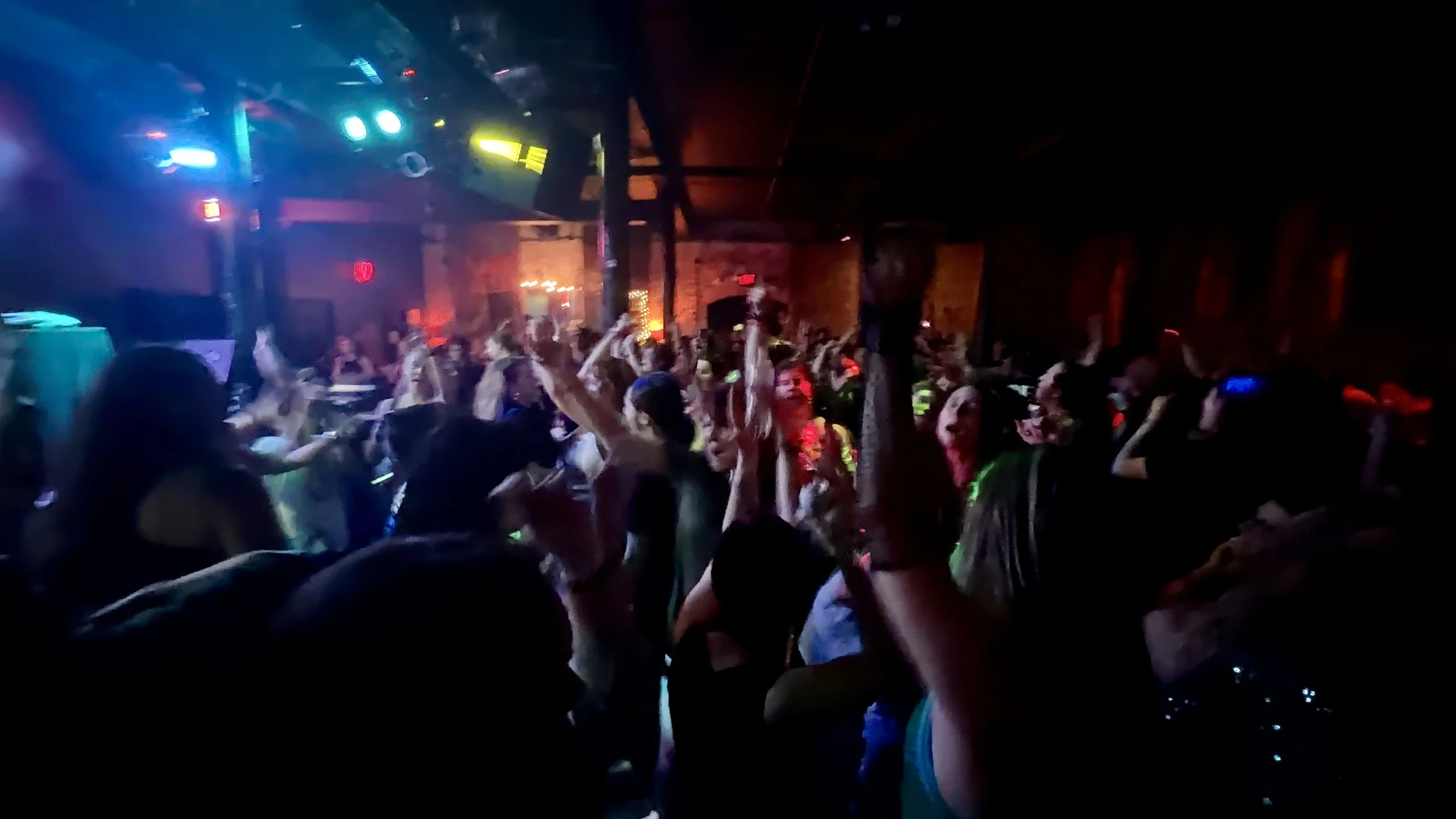
The dance party I mentioned in May — the one I went to with my friend Megan, who I hadn't seen in nearly a year — was the Early Birds Dance Party in Providence, for women who, as they put it, have shit to do in the morning. 80s, 90s, 2000s music, 6pm to 10pm, Girls on the Run beneficiary, total strangers shrieking to Kriss Kross. We didn't pregame with anything except high-protein dinners and electrolytes. We didn't do a big life update. We looked good, made new friends, and screamed a lot.
Old friendships need those moments. Not necessarily dance parties — but moments that don't require any explanation of where you've been. Moments that exist just because you both showed up.
That's what I'm after. And I think you might be too.
If This Resonates
FLOURISH is a recovery process, not a checklist, and the I step — Invest in Connection — is one of the places where the outer work and the inner work become impossible to separate. You can build the systems, book the standing coffees, show up to the birthday parties — and still find yourself in the same isolation if the underlying beliefs about whether you're someone people want to show up for haven't shifted.
That shift takes support. Not because you're incapable of it, but because most of us built these patterns in relationship, and they're most efficiently unbuilt in relationship too — usually with someone who can see the pattern from the outside and reflect it back with honesty and without judgment.
If you're at a point where you're ready to start doing that work, Regenerate + Relaunch is the most comprehensive version of what I offer — three months of working through the full FLOURISH arc with me, building your personal burnout map, and making the kind of shifts that actually stick. Or if you want to start with something smaller, The Next Right Step is a single session designed to help you figure out what actually needs your attention first.
If you work with teams or organizations dealing with burnout culture, speaking and workshops are an option too — because when one person reclaims their capacity, the people around them notice.
And if someone in your life is dealing with this and you think coaching might help, you can refer them here.
You don't have to cancel the text forever. But you also don't have to force the connection before you have the capacity for it. There's a middle path, and it's probably closer than your tired brain is letting you see.
This post is part of the ongoing FLOURISH series on burnout recovery. Start at the beginning with F — Face Reality with Compassion, read about L — Listen to Your Body, or catch up with O — Own Your Limits. For a broader look at why adult friendship has become so hard — and research-backed ways to start rebuilding it — see The Adult Friendship Crisis.
