
No One Can Cross Your Boundary But You: Owning Your Boundaries, The O in FLOURISH
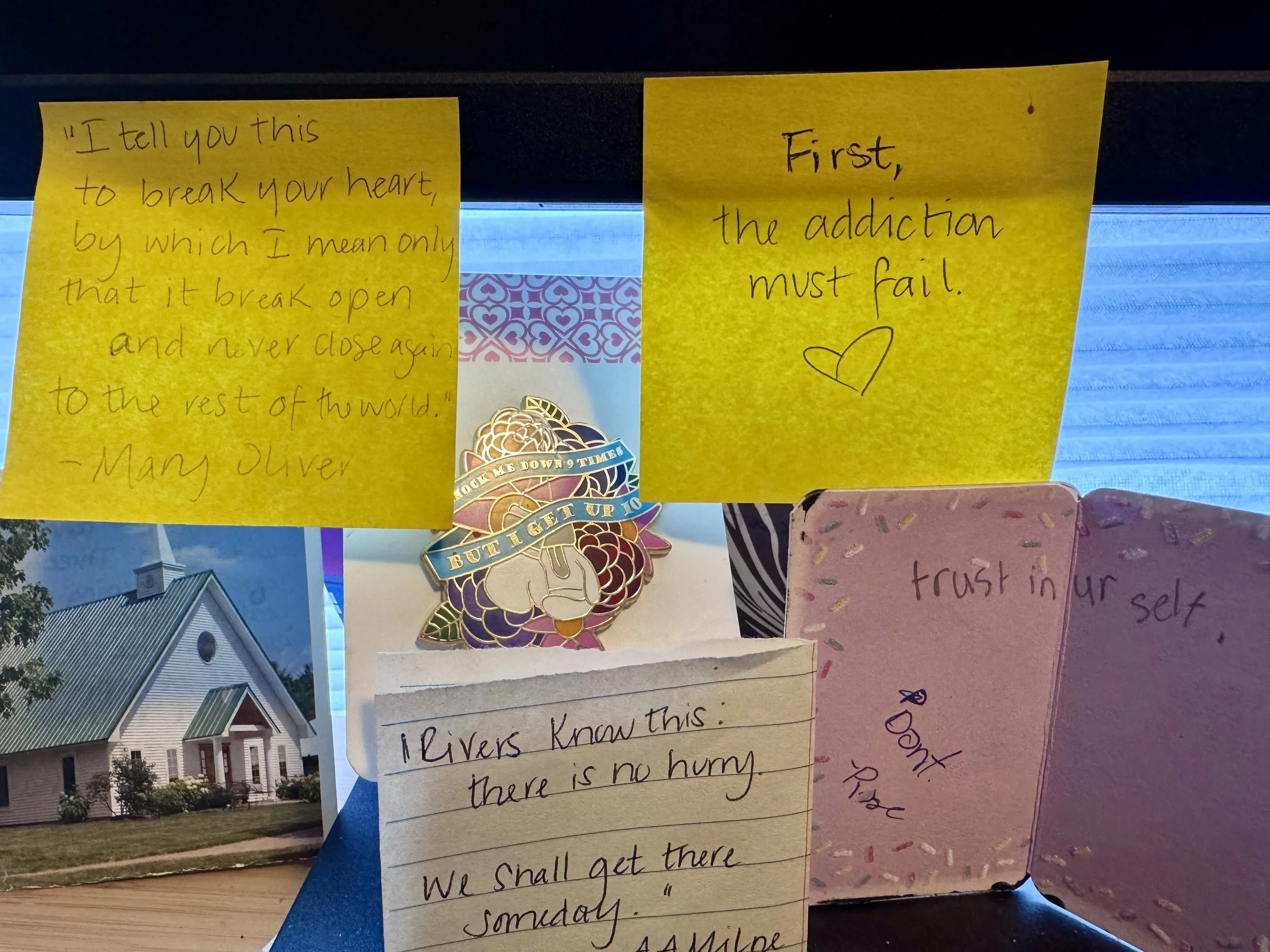
My council of advisors: A.A. Milne, Mary Oliver, Cardi B, my cheeky daughter, Terry Real, and my sister
Third in the FLOURISH series on burnout recovery. If you're just joining: F is here and L is here.
There's a thing I say in coaching that makes people genuinely angry. Not frustrated. Not resistant. Angry — the kind where I can feel it through the Zoom screen.
It's this: No one can cross your boundary. Only you can cross your boundary.
If you felt a flash of confusion just now, you're in good company. I've had clients go quiet for a full thirty seconds. I've had people argue with me for twenty minutes. One person said, very evenly, "I'm going to need you to explain that before I decide whether to fire you."
I get it. It sounds like victim-blaming. It sounds like I'm suggesting that the person who steamrolled you, who ignored your "no," who kept calling even after you asked them to stop — that they somehow didn't do anything. That somehow you're responsible for what they did.
That's not what I mean. So let me try again.
A boundary isn't a wall you build that other people are forbidden to climb. It's a declaration of what you will do. It's yours to hold, which means it's also yours to give away. When someone "crosses" a limit you thought you'd set, what's worth looking at — gently, without verdict — is what happened on your end. Did you enforce it? Did you communicate it? Did you know you had it? And if you held it and the other person still didn't respect it, what did you do next?
This is the "O" in FLOURISH, the third step in my burnout recovery framework: Own Your Limits. It's the step most people think they've already done. It's the one almost no one has fully done.
Limits Look Different Than You Think
When we talk about porous limits and burnout, the conversation usually centers on one archetype: the people-pleaser. The one who says yes when she means no, who takes on everyone else's work, who can't leave a conversation without apologizing three times. She's real. I've been her. Many of the people I coach have been her.
But the spectrum of unhealthy limits is wider than that, and it's worth naming.
On one end, there are people with limits that are too soft — the ones who feel the prick of violation constantly, who say yes from fear, who absorb other people's moods and make them their own problem. These folks are often the ones labeled "over-givers" or "martyrs," though I'd push back on both terms because they pathologize what is frequently a completely understandable nervous system response to early experiences where having needs was unsafe.
On the other end — and this is less talked about — there are people whose limits are rigid to the point of brittleness. The ones who've been hurt enough times that they've built walls and called them limits. Who control the terms of every relationship so carefully that genuine intimacy can't get in. Who say "I have great limits" but what they mean is "I've learned to need very little from people." That's not a limit. That's armor. It protects something, but it also keeps out the good stuff.
Most people I work with sit somewhere in the middle, which is messier — soft in some relationships, rigid in others, clear at work but dissolving at home, or the reverse. A client I'll call Marisol was a project manager who ran meetings with precision. She could tell her team no with zero guilt. She delegated, held deadlines, called out scope creep before it began. At work, she seemed to have her limits sorted. Then she'd go home and spend four hours managing her mother's anxiety by phone and two more hours seething about it in the kitchen after her kids went to bed, too depleted to do anything she actually wanted to do.
Her "problem" wasn't that she didn't know how to set limits. It was that her limits operated on a context-specific basis — effective in professional settings where she'd built up authority and distance, absent in relationships where her attachment and sense of self were more tangled up with the other person.
This is common. And it points to something worth sitting with: our ability to hold a limit isn't primarily a skill. It's a safety problem. We can hold limits with people who don't have much power over our nervous system. We collapse with people who do.
Why This Is So Deceptively Hard
Limits research in psychology — from the work of Nedra Glennon Tawwab to attachment theory more broadly — is consistent on this point: our capacity to hold limits is shaped early, and it's shaped relationally. Kids who grew up in environments where their "no" was ignored, punished, or received with emotional collapse learn that holding a limit is dangerous. Not dangerous abstractly — dangerous as in the attachment figure got upset, and I needed the attachment figure to survive, so I learned to override my own no.
That early learning doesn't politely exit when we become adults. It lives in the nervous system. It shapes what happens in the body when someone pushes back on a limit we've tried to hold — the flush of shame, the sudden certainty that we've been unreasonable, the urge to walk it back and smooth things over.
Bessel van der Kolk's work on trauma and the body makes clear that these patterns are physical, not just psychological. The nervous system learned to treat limit-holding as a threat. Telling yourself to "just say no" doesn't touch that. It's why behavioral approaches to limits — scripts, frameworks, techniques — often work briefly and then collapse. The behavior changed. The underlying wiring didn't.
There's also a piece that lives at the identity level, which is where it gets interesting.
For many of the people I work with, maintaining certain relationships — keeping certain people comfortable, regulated, and happy — isn't just a habit. It's the foundation of their self-concept. It's how they know they're a good person. Keeping people happy, staying useful, being the one others can rely on — these aren't just behaviors. They're the answer to the question who am I?
Which means holding a genuine limit isn't just uncomfortable. It destabilizes the whole thing.
Boundaries at Work, Because Power Dynamics Are Real, and Different than Home
I want to pause here and acknowledge something that gets soft-pedaled in a lot of coaching content about limits.
Workplaces are complicated. Power is real. Not every boss is emotionally mature. Not every organizational culture rewards directness. Some jobs genuinely suck, and people stay in them — for income, for benefits, because the market is hard, because they have kids and a mortgage and a partner who just changed careers. That's not weakness. That's life.
You can know this intellectually and still find a limits coaching framework maddening when it sounds like just hold your limits, friend — as if your VP isn't known for punishing people who push back, as if there aren't real consequences.
So here's a more honest framing: sometimes the wisest available choice is to play the game. To be professional in an environment that doesn't deserve your authenticity. To give the performance and reserve the real you for relationships and spaces that can receive it.
The issue isn't playing the game when that's the smartest move. The issue is lying to yourself about it. There's an enormous difference between I'm choosing to operate this way here, temporarily, because it's strategic and this is just how things are and there's nothing I can do. The first gives you agency. The second installs helplessness as a worldview.
So if you're in a workplace that makes genuine limits impossible right now: okay. Allow yourself to admit that. Call it what it is — a temporary, strategic constraint — and then, critically, use the energy you'd otherwise spend pretending to be fine to quietly set the conditions for an exit. That's a much more honest and ultimately more powerful place to operate from.
What Emotional Addiction Keeps You From Healthy Boundaries? (This part changed me the most)
I have a sticky note on my monitor that's been there for three years. It's a phrase I took from Terry Real's book I Don't Want to Talk About It — his landmark work on covert depression, written in 1997 and as relevant now as it was then. The phrase, my distillation of his central argument about what has to happen before real change is possible, is:
“First, the addiction must fail.”
The book is technically about depression in men. I'm not a man, but I know them and love them and realized there’s a lot here for me. I recommend it constantly to people who are also not men, because what Real describes maps onto a pattern that shows up across genders: when something painful is underneath — shame, grief, emptiness, a wound that's been running the show for a long time — we build defenses against feeling it. Those defenses look like behavior. Substance use, workaholism, people-pleasing, relentless achievement, control. They're not moral failures; they're adaptations. Clever ones. They work, in that they keep the underlying pain at a manageable distance.
But they have to keep escalating. And eventually, often, they stop working. The numbness wears off. The coping mechanism costs more than it returns. The addiction fails.
For me, the addiction was keeping people safe and regulated.
I was extraordinarily good at reading a room. At knowing what someone needed before they could articulate it.
For example: during an in-person intake session with a therapist, I noticed the sun had slid between the blinds such that the light directly hit her face. While relaying vignettes of exhaustion from over-responsibility-taking, I floated over to her shades and closed them, sat back down, without thought, irony, or break.
She blinked, smiled, and wrote a note to herself.
Adaptation is, I’ve always believed, one of my superpowers. I’m great with changes of plans and surprises. I basically have no startle reflex. I used to effortlessly adjust my behavior — my energy, my mood, my position in a disagreement, how much space I took up — to make sure the people around me stayed okay. This wasn't a skill I chose consciously. It was something I developed early, in a household where adult emotional states were unpredictable and my job, in some unspoken way, was to manage them.
By the time I was an adult, it had become completely automatic. I didn't notice I was doing it. And my entire sense of being a good person — a good partner, a good daughter, a good friend, a good professional — ran on the engine of other people's comfort.
The problem with that arrangement — and I say this without drama, just factually — is that it was wearing me down into an almost infinitesimal and highly neurotic version of me, who actually isn’t very neurotic at all. It required an increasingly extraordinary level of effort to maintain as the people around me grew to depend on the version of me who managed everything. It held my loved ones back from learning to tend to themselves. And it had nothing to do with who I actually was.
Recognizing my role in that cycle — not with blame, but with clear eyes — is what made it possible to step back. Not all at once. It's still happening. But that recognition was the thing that opened the door.
Real's framing helped me see it. He writes about how covert depression's defenses can't be dismantled until they stop working — that the person first has to walk through the fire they've been running from. The defense has to fail. The "fix" that kept the pain at bay has to stop delivering. Only then is there any real incentive to look at what's underneath.
In terms of limits, this maps onto something I see frequently in coaching. People try to hold limits at the behavioral level — saying no more often, letting calls go to voicemail, declining certain commitments — but the underlying belief hasn't moved. Maybe the belief is I'm only lovable when I'm useful. Maybe it's if I stop managing this person's feelings, they'll fall apart and it will be my fault. Maybe it's my worth is conditional and I haven't yet done enough to earn it.
New behaviors sitting on top of old beliefs don't hold. They collapse under pressure — and there will always be pressure, because the people who benefited from the old arrangement don't disappear when you try to change it.
Four Places to Start
These won't fix the belief layer. That's a longer arc and, honestly, it usually requires support. But they can surface useful information and start to loosen the grip.
1. Distinguish sensation from story.
Most limit-holding fails not at the moment of saying no, but in the minutes and hours after. The sensation — the guilt, the anxiety, the low-grade certainty that you've done something wrong — is real. But it's not information about whether you made the right call. It's information about how unfamiliar this is. Sit with the sensation without immediately acting on it. Give it twenty-four hours before you walk anything back.
2. Notice where your limits are different.
As Marisol discovered, most people have at least one domain where limits come easier. Pay attention to that. What's different there? What do you have — distance, authority, less attachment, lower stakes — that makes it feel safer? That's useful information about what the softer areas might need that they don't currently have.
3. In work situations that genuinely constrain you, be honest with yourself about what you're doing and why.
"I'm staying in this job for now because it's the right financial move while I build toward something else" is a completely legitimate position. "This is just how things are" is a story that forecloses options. The first one keeps you in the driver's seat, even if the car is currently stuck in traffic.
4. Map the cost.
Christina Maslach's burnout research identifies six organizational mismatches that predict burnout — workload, control, reward, community, fairness, and values. Limits violations usually show up in the control and values columns. Getting specific about where you feel most depleted and what limits are most consistently crossed can help you see what you're actually dealing with, rather than carrying it as a formless weight.
This kind of mapping is also something I do in the early sessions of coaching — it's the underlying diagnostic of the Forest Fire Burnout Model, where we're looking at what's acting as Wind in the system (the accelerants), not just the Spark (what started it). Limits violations are almost always Wind.
Why Behavioral Change Alone Doesn't Hold
Here's the piece I want to leave you with, because I think it's the piece most self-help content skips.
You can get very good at the language of limits. You can memorize scripts. You can practice the pause before responding. You can build systems — a "no" template, an autoresponder, a policy about responding to texts after 8pm. These things can help. They're not nothing.
But if the belief underneath hasn't shifted — if some part of you still believes that your worth is conditional on your usefulness, or that your job is to keep others regulated, or that holding a limit makes you selfish — you will recreate the depletion. In a new job, a new relationship, a new context. The limit will collapse. Or, just as often, you'll hold it with resentment and exhaustion that suggests it's costing you more than it should.
Real limits aren't gritted-teeth performances. They're expressions of what you actually value, delivered with something that feels more like clarity than struggle.
Getting there requires looking at the underlying belief. Which requires being willing to ask the uncomfortable question: what am I getting from this arrangement? What does keeping people happy give me that I haven't found another way to get?
This is why the "O" in FLOURISH sits where it does — after F: Face Reality with Compassion and L: Listen to Your Body. You can't own your limits until you've acknowledged what's actually happening (F) and started to pay attention to what your body is telling you (L). The body usually knows about the limit violation before the conscious mind catches up. It registers in the tightening chest, the flat affect after certain interactions, the particular exhaustion that follows conversations where you managed everything for everyone in the room.
Owning your limits, in the fullest sense, is not a technique. It's an identity project. It's the slow, sometimes painful work of becoming someone who believes their own wellbeing is worth protecting — not because a coach told them to, but because they've started to see, clearly and without flinching, what it costs them not to.
If This Is Where You Are
This work doesn't happen in a blog post. I know that. What I've offered here is a framework and, I hope, a mirror — something to hold up and see whether it reflects anything recognizable.
If you've been nodding along and feeling something shift, or tighten, or resist, that's worth paying attention to. If you're already in the FLOURISH process — doing the F and L work — the O step is right on time. If you're earlier in the journey and feeling like this is a lot, that's also completely correct. It is a lot. That's not a reason to avoid it. That's a reason to not do it alone.
A few ways to go deeper:
Regenerate + Relaunch is the full three-month burnout recovery program, where we work through the FLOURISH framework together. The O step — limits, patterns underneath, identity — is where a significant chunk of the work happens.
Speaking and Training — if you're a leader or work with organizations, this is also team and organizational work. Limits collapse at the system level too, not just the individual level.
If someone in your life would recognize themselves in this post, the referral program exists for exactly that.
And if you just need to sit with this for a while first — that's fine too. The O step will still be here.
Up next in the FLOURISH series: U — Uncover Your Patterns. Which is where things get very interesting, and maybe a little uncomfortable.
