Run Small Experiments: Why Seeing Your Blindspots Isn’t Enough, and How to Get Unstuck
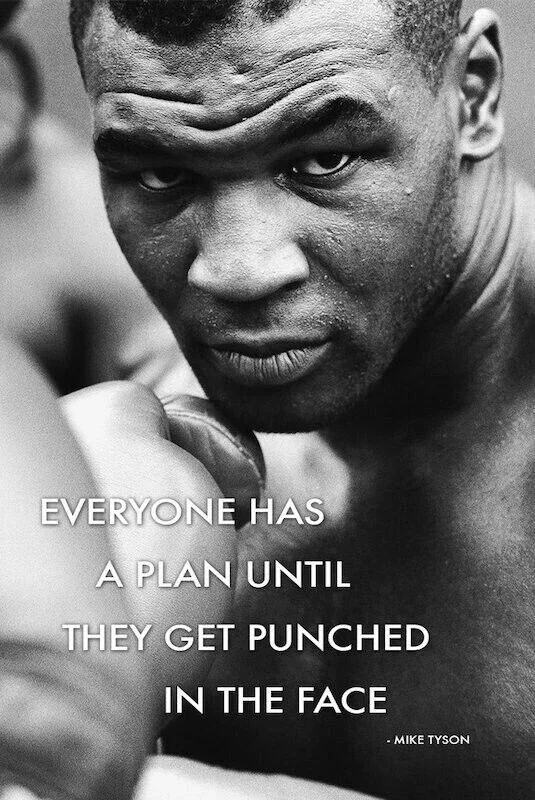
Intellectualizers, perfectionists, procrastinators, “I’m so confused” types: This article is for you (and me)
You've read the books. Maybe you've done the therapy. You've listened to the podcasts, you've journaled, you've named your patterns with a precision that would impress your therapist. You can probably describe, with reasonable accuracy, the moment in any given week when your nervous system goes offline — when you shift from capable adult to someone who's snapping at your kid over a Lego on the floor.
You know why it happens, roughly. You understand something about the stress cycle, something about how your nervous system works, something about the way childhood survival strategies became your adult management style. You've done real work. Good work.
And still — Sunday evening rolls around and it feels familiar. The dread. The tightening. The sense that the insight you paid real time and money for is somehow just residing in your head, quietly, without doing anything particularly useful there.
If that's a familiar feeling, you're not alone in it, and it's not a character flaw. It's a structural problem with how most personal growth gets taught and consumed. Insight is real and valuable. It's just not sufficient. And the gap between understanding yourself and actually living differently is where burnout keeps most people stuck, sometimes for years.
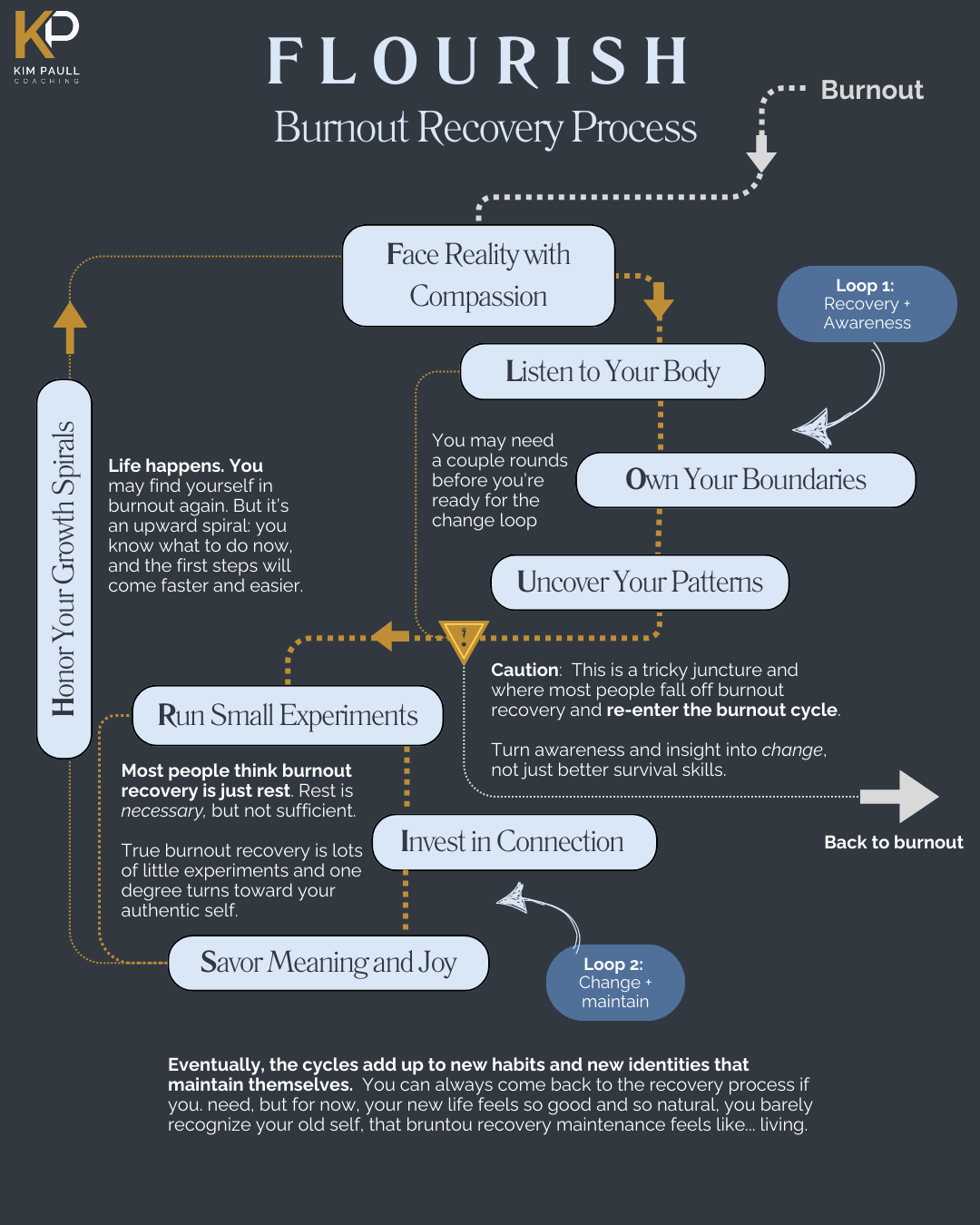
This is the R in FLOURISH: Run Small Experiments. It's the fifth step in the framework, and I'd argue it's the most important — not because the first four steps don't matter (they matter enormously), but because R is where the inner work finally becomes real. It's the hinge between understanding what's happening to you and actually doing something different about it.
Insight Is Necessary. It's Just Not Enough.
Let me tell you about a client I worked with for several months — a senior leader, brilliant at her job and depleted by it. By our third session, she could articulate her patterns clearly. The over-functioning. The difficulty delegating. The way she absorbed the anxiety of her whole team and called it leadership. She was self-aware in a way many people never get to.
And then she'd have another week exactly like the last one.
This is, in my experience, one of the most frustrating places to be in burnout recovery — and one of the most common. You've done enough inner work to see the pattern clearly. You haven't yet done enough outer work to interrupt it.
I've been there myself. I'm an intellectualizer by nature. If there's a feeling I'm not quite ready to have, I can be extremely productive at thinking about that feeling while carefully not having it. I can build an entire analytical framework around my inner life without actually doing anything differently in my outer one.
I have gotten, over the years, an advanced degree in insight. (Pancho, my co-host on Now That You See It, periodically has to remind me that the podcast is supposed to be an experiment in fun while learning. I keep forgetting the fun part.)
This is, incidentally, why I send an experiment in every issue of Experiments + Spice, my weekly newsletter. Not a homework assignment, but an actual small experiment to try, with enough context to know what you're looking for. The experiment is the thing. The newsletter just makes it easier to remember to try.
The research on this is fairly clear: understanding why you do something does not automatically produce behavior change. Overthinkers do not stop overthinking because they know they’re overthinking, for instance.
Cognitive insight and behavioral change involve different neural systems. Knowing that you over-function out of a deep, well-meaning belief that you have to manage everything or it won't be okay — that knowing doesn't make your hands stop reaching for the phone to check whether someone responded. The insight and the doing live in different parts of your brain, and you can fill up the insight part without ever touching the doing part.
This is why, in the FLOURISH framework, I don't think of insight as the destination. I think of it as the runway. And experiments are how you take off.
Your Nervous System Has to Watch You Do It
There's a practical reason experiments work that has nothing to do with discipline or willpower, and everything to do with how memory and identity actually form — in the body, not just the mind.
Your nervous system doesn't update on information alone. It updates on experience. It learns, at a biological level, by watching what you actually do and registering the outcome.
When you've spent years — maybe decades — functioning in a particular way, absorbing responsibility, managing everyone's experience, keeping things moving regardless of the cost, your nervous system has filed that pattern under "this is how survival works." It doesn't matter that you cognitively understand it's too much. The pattern has an emotional logic, a safety function, that's older than your insight about it.
We explored this in theL step — the way the body carries the residue of chronic stress in ways the thinking mind doesn't fully register — and in the O step and U step, where we looked at how old patterns of over-responsibility become so automatic they feel like identity. To update those files, your nervous system needs new evidence. And new evidence only comes from new behavior.
Even before you’re “ready”. A little bit of “Do It Scared”, “Do It Tired”, “Do It When It Doesn’t Make Sense Yet” can go a long way, if the “it” is aligned with where you want to go.
This is what's underneath the phrase "fake it til you make it," which gets dismissed as superficial but is actually pointing at something real. In Dialectical Behavior Therapy, there's a technique called opposite action — developed by Marsha Linehan — which involves deliberately doing the opposite of your avoidance pattern, not because you feel ready to, but because action precedes readiness. Behavioral science has known for decades that emotion often follows behavior rather than the other way around.
You don't have to be confident to do the thing. You have to do the thing to be confident.
What experiments do is make that safer, because they lower the stakes. When you're running an experiment, you can't technically fail. You can only collect data.
Experiments, Not Homework
I want to be precise about what I mean by experiment, because it's easy to hear "take action" and translate it into another obligation on a list that's already too long.
That's not what this is.
An experiment is specific. It has a time limit. It has a hypothesis — something you're actually curious about, not something you've already decided is true. And it's designed at the edge of your comfort zone, not way out in the terrifying unknown.
Joe Hudson, whose work on self-discovery I find consistently useful, talks about experiments as "little tests and explorations in your life that will let you understand yourself far better" — with an emphasis on curiosity and play. An experiment isn't a commitment to permanent change. It's an inquiry into what's actually possible.
In coaching, I design experiments with clients rather than assigning them. The distinction matters. Homework is something you're supposed to do. An experiment is something you actually want to find out. One creates more pressure in an already pressure-saturated life. The other creates something rarer: actual motivation.
A well-designed experiment has a few qualities:
It's bounded. "I'm going to try saying one thing I need, directly, to my partner this week" is an experiment. "I'm going to become more communicative about my needs" is a resolution. Resolutions are noble and often ineffective. Bounded, time-limited experiments generate real data.
It has a clear hypothesis. "What happens to my focus and energy at work if I take a twenty-minute walk before I open email?" is a hypothesis worth testing. You're not committing to morning walks forever. You're running a trial.
Failure is reframed as data. If the experiment doesn't happen — if you forgot, or resisted, or hated it — that's not failure. That's information. The fact that you couldn't bring yourself to try something once in a week tells us something about what that thing means to you, which is often more useful than if you'd simply done it.
Even one time counts. This is important for clients who live by an all-or-nothing ethos — and if you've been reading this series, you may recognize that flavor of thinking from the U post on patterns. Sometimes the hardest part of rewiring a habit is simply remembering to try something different, once. Once is a rep. The nervous system registers it.
James Clear writes in Atomic Habits that you don't rise to the level of your goals; you fall to the level of your systems. Experiments are how you build the system, one small data point at a time. Anne-Laure Le Cunff, who writes about the science of self-discovery and whose recent book Tiny Experiments explores this framework in depth, makes a similar argument: the goal isn't to get the experiment right. The goal is to make the experiment happen, and then pay close attention to what it tells you.
For perfectionists and procrastinators — who are, in my experience, often the same person — the experiment frame is actually liberating. You can't fail experiments. You just get data. For ADHDers, who may have spent years operating under the motto "it doesn't have to be done, it just has to be perfect" (which is its own form of paralysis), the combination of low stakes and clear boundaries tends to make starting easier. The experiment has an end. It doesn't have to be forever. It just has to be once.
Here are some of my own experiments over the past few years, in roughly ascending order of difficulty:
Timing of exercise. I rowed competitively for twelve years. In rowing culture, morning workouts aren't a preference — they're a marker of seriousness. Elite athletes train in the morning. Disciplined athletes train in the morning. Afternoons were for you second workout of the day. Or just like... softball. (Sorry softball fans.)
That belief got baked in early, which meant I spent years feeling vaguely guilty about not working out before 8 a.m., because science also agrees that morning exercise is better for productivity, mood, circadian rhythm, and approximately eleven other things. The experiment was to test this on my own body rather than accept it as a universal law. The data were unambiguous: I function better with food, caffeine, and a long mental warm-up before any physical effort. My brain fires in the morning; my body follows later. The guilt resolved when the data arrived.
Saying "yes" when help was offered. My reflexive response to "can I help with that?" is instant, almost involuntary: "No, I'm fine." I tried saying yes when it felt at least tolerable, and when I actually remembered to try. Even that low bar — tolerable, and when I remembered — was harder than I expected. Which told me something about what accepting help means to my nervous system. I'm still running this one.
Noticing rumination without trying to stop it. This sounds almost too small to be an experiment, but it turned out to be significant. When I noticed I was ruminating, I'd try to stop, which mostly produced more ruminating plus some shame about the ruminating. The experiment was to simply say, out loud or to myself, "Oh, I'm ruminating" — and do nothing else. Just name it. The naming, without the pressure to fix it, slowed it down faster than the fixing attempts ever did. That result surprised me enough that I kept the experiment running indefinitely.
Taking one small action when I felt dread or avoidance. I noticed a pattern: the dread was almost always about avoiding an anticipated emotional experience, not the task itself. Usually there was something small I could do in the moment to right-size the worry. See: taxes. The experiment was to interrupt the avoidance with one concrete action — not finish the thing, just take one step toward it. The dread, in most cases, deflated significantly once I started.
From the Coaching Room
Below are experiments from my own practice — my own, and from clients, shared with permission and gratitude. They span different contexts, different nervous systems, different versions of the same underlying question: what actually happens when I try something different?
The 100-word email. Someone who always writes three-paragraph emails — full context, caveats, backstory, apologies for the length — experiments with sending a two-sentence version. Just the ask, just the information that's actually needed. The hypothesis isn't that shorter is always better. It's a genuine question: does the recipient actually need all of that, or is the elaborate setup more for the sender than the reader? The data are often humbling. Frequently, the two-sentence version works fine. The follow-up question — what was all that extra explaining actually for? — sets the tone for learning, rather than achievement in the experiment.
The conversation before the logistics. A senior leader had been trying, for eight months, to protect two consecutive planning days each month. It never worked. Something always displaced them. The experiment wasn't to try harder at the scheduling. It was to have a direct conversation with her regional managers first, asking them to serve as the final escalation point on those two days: "I know you can handle this." She already knew, intellectually, that her team was capable. What the experiment was really testing was whether she could tolerate stepping back — not just logistically, but in terms of her sense of safety and identity at work. The scheduling was almost beside the point. The actual experiment was the conversation she had before it.
Minimal preparation. A client who tended to over-prepare for professional facilitation experimented with a narrowly defined role at a multi-day off-site — neutral observer, buffer when things got heated, timekeeper. No agenda-setting, no process design. She scanned her notes for five minutes instead of spending her usual five days in prep.
Several colleagues came to find her afterward to thank her specifically for how she'd handled the tense moments. The data didn't match the fear. She came back describing it as "such good practice" — and connecting it to a pattern she'd seen before: that her over-preparation was as much about managing her sense of safety as it was about actually producing better outcomes.
The experiment didn't answer whether she'd been wrong to prep so much in the past. It opened a question about what the preparation was actually for.
Catching yourself in intellectual mode. After several sessions, a client had built a vocabulary for what "intellectual-only" processing felt like from the inside — louder, busier brain; leaning forward; a hand-wringing quality; scenario planning that had gone well past what the situation actually required. The experiment was small: when she noticed any of those signals, she paused and named what was happening. Nothing else required. Just the catching. She later described noticing it during a week when her social battery was depleted and she didn't have capacity to do anything about it — and said the noticing itself "felt GOOD," which was different from what she'd expected. She'd assumed catching herself would feel like more self-criticism. It didn't. It felt like being found.
Staying with the emotion. A client had a fear that if she started crying she might not stop — so she'd find herself pivoting to something productive the moment feelings surfaced. The client agreed to try staying with what arose when she re-read our session notes alone.
Fear came up. Anger. Something harder to name. The waves built, peaked, and receded.
As Emily and Amelia Nagoski describe in Burnout: The Secret to Unlocking the Stress Cycle, stress cycles, when allowed to complete, don't go on indefinitely. She rested afterward and described feeling "nothing, but in a good way." That was her first experience of a stress cycle completing without intellectual override stopping it short.
Several sessions later, she discovered what she called the "laugh-cry" — a completely different form of release she hadn't known was available. Her description: "I'm surprised at the number of ways a body can complete a stress cycle."
The hard stop. A chronic late-worker puts a 5:30pm block on the calendar for one week. Nothing goes in it. It's not for exercise or a commitment or a reason. It's just a stop. The hypothesis: something will break, someone will notice, they'll fall behind in ways they can't recover from. The experiment is to find out whether any of that is true. For most people, nothing breaks. What does happen is that sitting with the discomfort of stopping — the restlessness, the guilt, the ambient sense that they should still be working — turns out to be the actual experiment. The logistics were a distraction from the real question, which was: what do I believe happens if I stop?
The structured decompression. A client reconnected with something she'd done intuitively during the pandemic: when she finished work, she'd ask her partner to turn off the TV, give her some space, turn off the lights, and let her lie on a long floor pillow and let her shoulders drop — "just allow whatever the hell was happening in my head to sort of settle." She'd stopped doing it when the pandemic ended and life sped back up. After noticing that her body was signaling a need to decompress long before her mind had caught up to that need, she drafted a specific protocol to bring it back — with concrete steps, specific requests of her partner, and a time block built in. She described an upcoming week of late-night dinners as "the perfect experimental environment to try this out." The experiment wasn't rest. It was learning whether she could ask for conditions that made rest possible.
The one-sentence reach-out. Someone who never contacts anyone when they're struggling — too much of a burden, doesn't want to make it weird, should be able to handle it — experiments with sending one low-stakes message to a friend during a hard week. Not a long explanation. Something like: "Having a rough few days. Not looking for anything, just wanted to say." The hypothesis: the friend will think less of them, or not know what to do, or it will create an obligation. The data, in most cases: the friend is glad they reached out. The person who sent it feels lighter. Not because the problem is solved, but because they didn't carry it alone, and the world didn't end.
Presence without an agenda. A parent who worked hard to create connection — asking questions, checking in, trying to create meaningful moments — experiments with just being in the same room as their teenager without initiating anything. No conversation, no activity, no pointed "how are you really doing." Just proximity.
Lisa Damour, writing for CBS News based on Australian research on adolescent wellbeing, found that parental presence alone — independent of warmth or active engagement — predicts lower depression and stronger peer relationships in teens. Just being nearby, without an agenda, is its own form of connection.
The experiment is to test whether that's true in your own house, with your own kid. It usually is. And the most interesting data point is often how hard it is to just sit there and not try to make something happen.
And then there's my own experiment I got only about half right. I wrote about it in more detail in my vacation post, but the short version: I went on vacation and essentially Odysseus-ed my way through it, lashing myself to compelling projects to resist the call of work-brain, which for me is persistent and hard to resist because I love what I think about. It was an experiment in rest, and it produced useful data. I learned exactly how much scaffolding my particular system still needs to actually unplug, which is different and more honest than thinking I just need to try harder to relax. Next time, I hope to need less mast-lashing. But even a half-learned lesson is a lesson.
There's a version of personal growth work that is, structurally, infinite. You understand yourself more deeply, you name your patterns with more precision, you trace the roots of your behavior further back — and you gain real, legitimate insight. But the insight keeps looping back to more insight, and not much in your daily life actually moves.
Some of this is structural in certain therapeutic approaches, and I want to say this carefully rather than dismissively. Talk therapy at its best is transformative. But insight-forward work without behavioral components can, for some people in some seasons, become a sophisticated form of avoidance. You feel like you're doing the work because you're gaining understanding. And you are. You're just not yet doing the other kind of work — the kind where your body watches you do something different and files new evidence.
There's a quote often attributed to Einstein: "No problem can be solved from the same level of consciousness that created it."
(The attribution is contested, but the idea is sound.) The burnout patterns you've been carrying — the over-functioning, the hyperindependence, the relentless producing — were developed by a version of you operating at a particular level of awareness, with particular resources, under particular pressures. Reading and reflecting from within that same level can happen for a long time without ever stepping outside it.
Experiments are what step you outside it.
Barbara Fredrickson's broaden-and-build theory of positive emotions describes how small positive experiences — including the small sense of capability and agency that comes from a successful experiment — literally expand your available range of thought and action. You start to see more options. Not because you read about more options, but because you had a small experience of doing something differently, and your nervous system updated its file. Small experiments don't just feel good. They create the cognitive and emotional conditions for more small experiments.
This is also the mechanism behind acting your way into a feeling rather than waiting until you feel ready to act. You don't have to believe, yet, that you're someone who sets limits and follows through on them. You just have to try it once and notice what happens. The nervous system takes it from there.
This is part of why I include a bonus 13th session in my Regenerate + Relaunch package — scheduled within six months of the main engagement, usually a month or two out. Experiments run inside the container of coaching, with someone to debrief the data with, are valuable. But then life happens — the actual unruly conditions of your actual life — and the experiments need to be tested there. That 13th session is where we look at what stuck, what generated new data, and what's still waiting to shift.
When Experiments Get Stuck
Something worth sitting with, because if experiments were as simple as "just try something different," you'd already be doing it.
One of the clients I mentioned earlier had run her own set of experiments before we ever met. She'd laid down the organizing role and let other adults manage themselves. She'd asked directly for what she needed, and also tried not to ask. She'd done this at work, in her marriage, in her extended family, in her friend group. Same outcome, she said, every time.
Her conclusion was that it didn't work, so she couldn't put it down.
The experiments were real. The data were real. But the only available interpretations were "I was right, it doesn't work" or "I give up." Neither of those moves anything.
This is, in my experience, the place where experiments alone aren't sufficient — and where the coaching relationship does some of its most important work. When someone has run the experiment and the data keep coming back the same, the question isn't whether to run more experiments. It's what the data are actually opening up, beyond "keep going" or "give up."
Sometimes the experiment is working exactly as designed, and we just haven't named what it's revealing. Sometimes it's answering the wrong question. And sometimes the interpretation of the outcome is being filtered through a belief system — about worth, about safety, about what you deserve — that the experiment alone can't touch.
That's the level below the behavior. It's where the F step and the O step do their work. And it's also why FLOURISH isn't linear — there are always loops back through the inner work as the outer work generates new data.
One finding across clients, consistently: the feared consequence almost never materializes. The client who over-prepares and doesn't this once — the conversation still goes well. The client who walks into the office and says what she needs without the managed email — she is met. The client who lets the emotion complete itself instead of redirecting to something productive — the wave peaks and recedes, just as the research said it would. It doesn't go on forever.
The data are consistent. And data, accumulated over time, are what finally start to update the file your nervous system has been running for years.
A Place to Land
If you've made it through F, L, O, and U in this series, you've done something real. You've looked honestly at what's happening, started listening to your body, begun to understand what your limits actually are and why they're hard to honor, and started to see the patterns that have been running things, often for decades.
R is where all of that becomes something you actually live, rather than just understand.
It doesn't require a dramatic overhaul. It doesn't require feeling ready. It requires one small, specific, bounded experiment — something you're actually curious about — sometime in the next week.
If you're at the place where the insight is solid and you're ready for experiments to become something real, in a supported context, I'd love to talk. My Regenerate + Relaunch program is built around exactly this: the full FLOURISH process, customized to your burnout map and your actual life, designed to move you from understanding your patterns to living differently.
If you're not quite there yet, or you want a lower-stakes starting point, The Next Right Step is a shorter engagement for people who want help figuring out which experiment to try first.
If you're a leader or organization curious about bringing this kind of work to a team, Speaking + Training is where that conversation happens.
And if you know someone who's been gaining insight beautifully for years and still finds herself repeating the same patterns — the friend who's done all the reading and all the therapy and still can't quite get traction — you can send this her way. There's also a referral program if that's useful to know about.
The experiment doesn't have to be big. It just has to be real.
Coming up in FLOURISH: I — Invest in Connection (why isolation is both a symptom of burnout and a driver of it, and what connection that actually restores looks like) · S — Savor Meaning and Joy (how to find it when you're depleted, and why it matters for recovery, not just morale) · H — Honor Your Growth Spirals (how to know you're actually changing, and what to do when you loop back)
Read the full series so far :F — Face Reality With Compassion ·L — Listen to Your Body ·O — Own Your Limits ·U — Uncover Your Patterns
